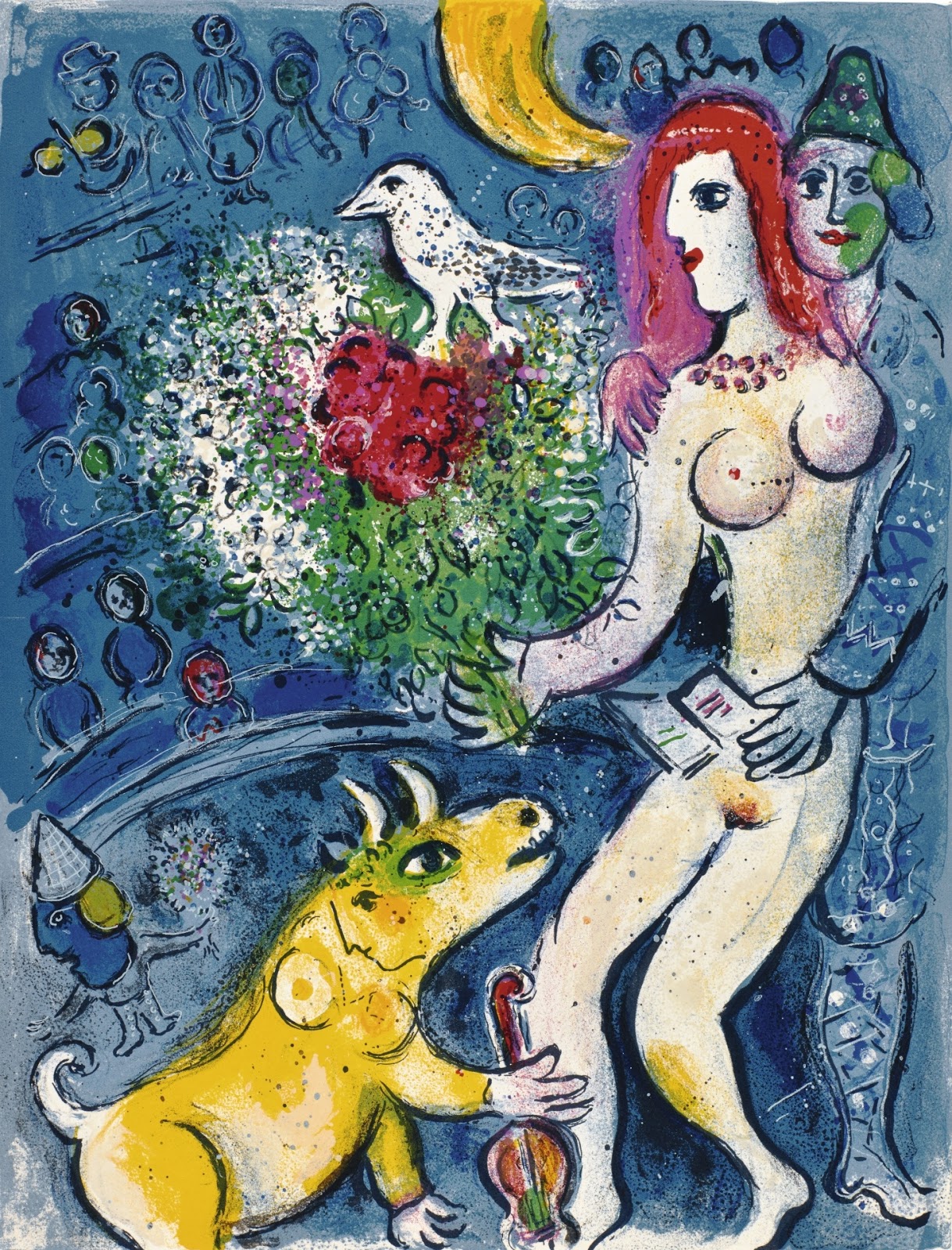
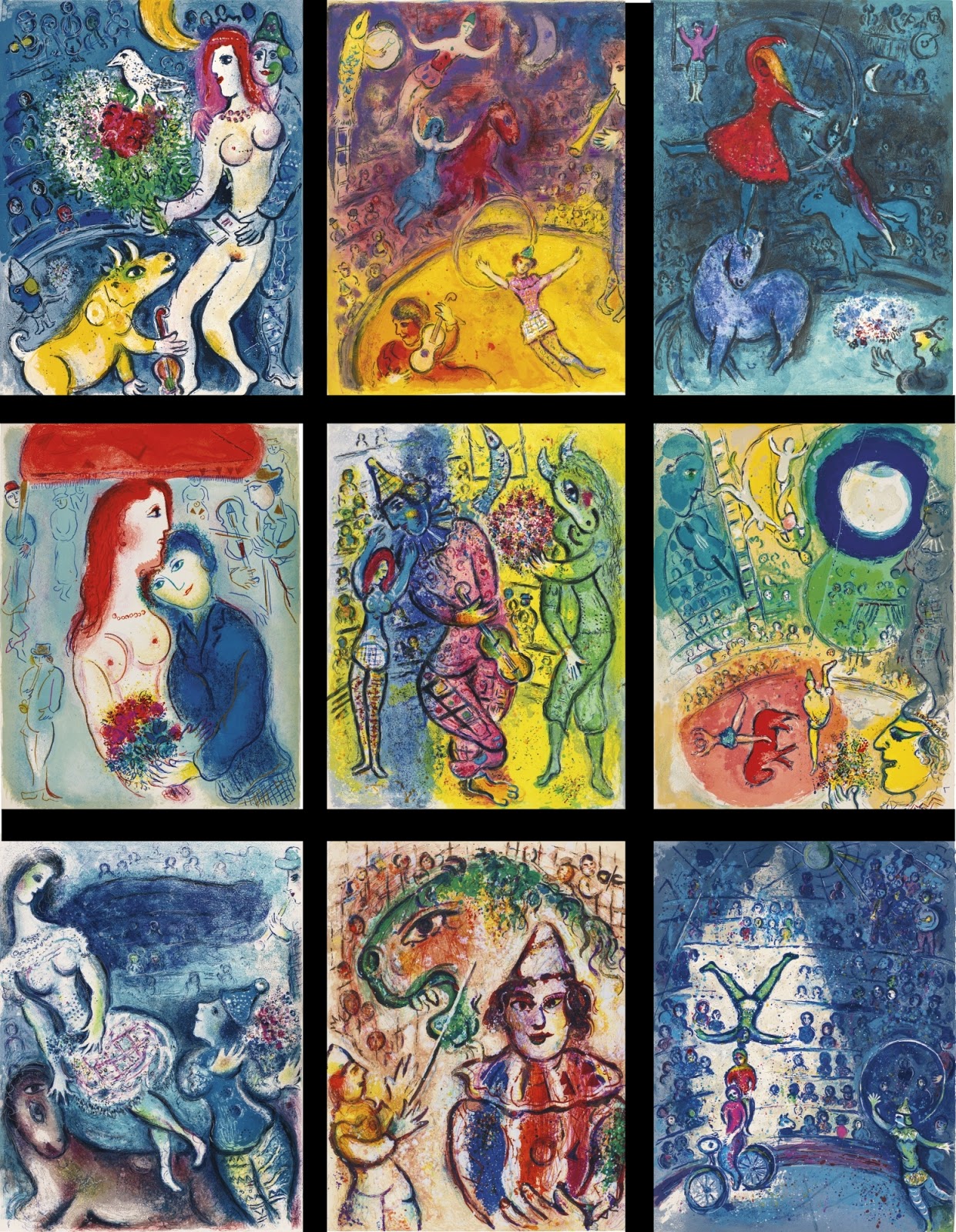
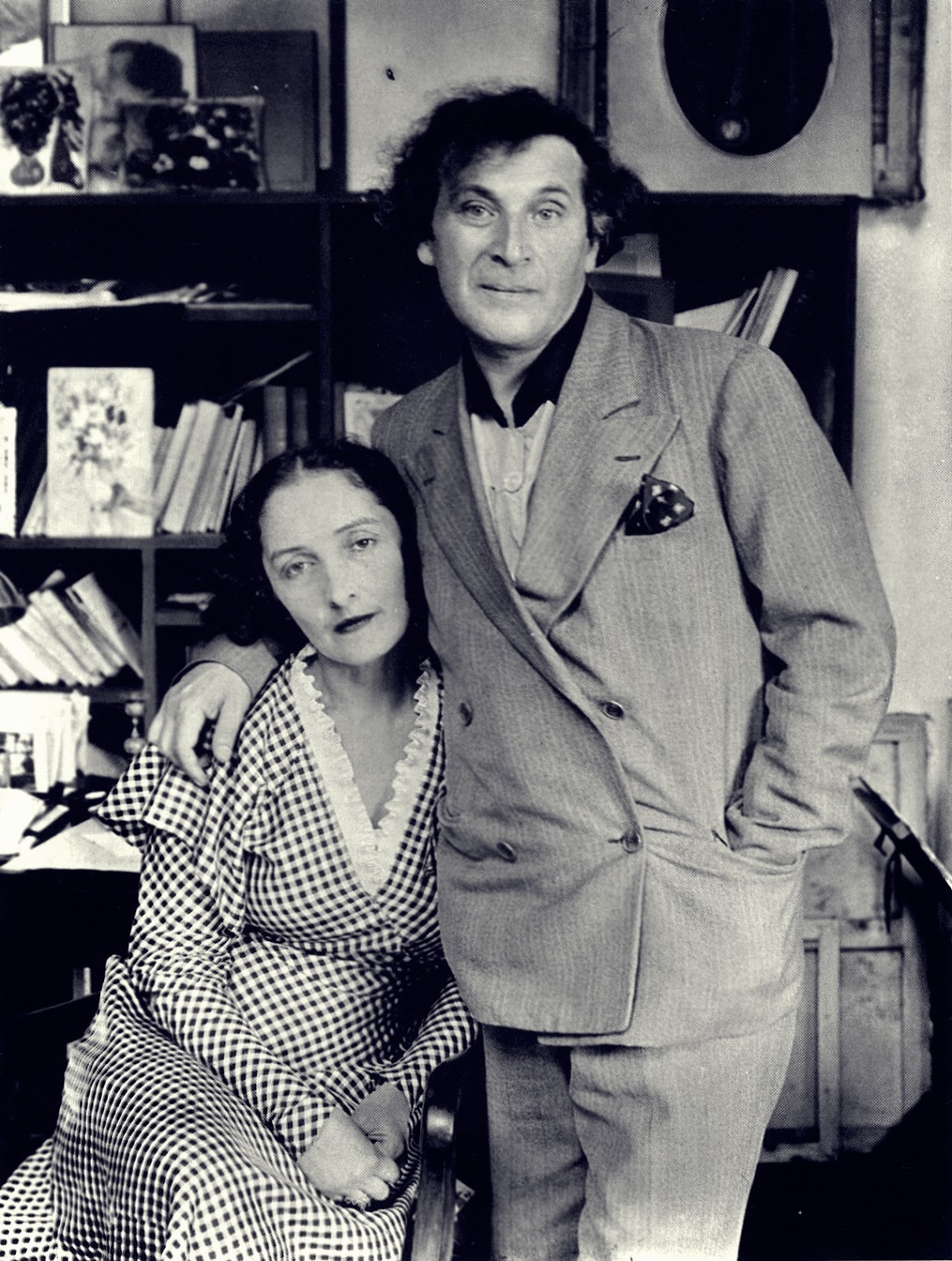
The wondrous vitality of Chagall's imagination, as youthfully whimsical and impetuous as ever, empowered him in his late paintings to become - like Picasso, notwithstanding the strong differences in their backgrounds and temperament - the impresario, auteur, director and a leading player in a lively theater of memory. Just as Picasso drew heavily on his ancestral Mediterranean roots, so Chagall became the artificer of a pictorial realm based on multiple personal mythologies he had evolved for himself as the proverbial Wandering Jew.
He assembled during his migrations and occasional travels a diverse iconography that evoked his early years in Russia, his love of Paris and the French countryside, a wartime transatlantic exile in America, and then again France, where finally he made his home by the Mediterranean, not far from Picasso.
Painted in 1971, Les Paysans is a rich and sumptuously worked canvas brimming with many of Chagall's most favored and iconic motifs.
At the center of this densely filled composition, a peasant couple stands tall, surrounded by animals, houses, trees, and other figures. Here, the panoply of imagery drawn from Chagall's personal symbolic lexicon is masterfully - and characteristically - combined with folkloric iconography.
The motifs that populate this dream-like world contain a wealth of visual references and meanings. Rural life is reflected in the many rustic dwellings, which bear a striking resemblance to those of Chagall’s native Vitebsk, now in Belarus but in Chagall's childhood part of the Russian Empire.
- “The fact that I made use of cows, milkmaids, roosters and provincial Russian architecture as my source forms is because they are part of the environment from which I spring and which undoubtedly left the deepest impression on my visual memory of the experiences I have”, Chagall explained (quoted in B. Harshav, ed., Marc Chagall on Art and Culture, Stanford, 2003, p. 83).
Tellingly, in this fantasy village, the central male figure gazes down at the village, possibly echoing a deep-seated longing in Chagall for his home. His head is bowed down towards the female figure, who, we presume, is his lover.
Contrary to the majority of Chagall’s paintings depicting lovers, the present work does not show the young couple embracing, as with the couple in the lower left of the painting.
The male leans forward towards the female, and, although the two figures do not meet each other’s eyes, it is as if they are timidly trying to hand one another the flower bouquets.
They are, perhaps, in the early stages of their courtship, experiencing a shy romance which has yet to develop and bloom into a mature love.
The theme of the young lovers is the most frequent subject in Chagall's paintings, but there are many variants on this theme.
As befitting the mysteries of human love, and so characteristic of Chagall's work generally, there is rarely a straight-forward or clearly logical narrative behind these paintings.
Time has been compressed, and events seem to take place in the haze of memories or dreams.
Susan Compton writes:
- "It was a vision of 'real' love, that love which the artist was to share with his wife Bella...this celebration by the lovers is equally fantastic, for their joy has levitated them from the ground. Their faces are real enough, but now their position is imaginary. Yet by this device Chagall has conveyed the magic carpet of human love, borrowed perhaps from the world of folk tale, where the hero and heroine live happily ever after" (Chagall, exh. cat., Royal Academy, London, 1985, pp. 15-16). | © Christie's

La meravigliosa vitalità dell'immaginazione di Chagall, giovanilmente capricciosa ed irruente come sempre, lo autorizzò nei suoi ultimi dipinti a diventare, come Picasso, nonostante le forti differenze nei retroscena e nel temperamento: l'impresario, l'autore, il regista e un attore di spicco in una vivace teatro della memoria.
Proprio come Picasso attirò pesantemente le sue ancestrali radici mediterranee, così Chagall divenne l'artefice di un regno pittorico basato su molteplici mitologie personali che si era evoluto per se stesso come il proverbiale Ebreo Errante.
Ha radunato durante le sue migrazioni e viaggi occasionali un'iconografia diversificata che ha evocato i suoi primi anni in Russia, il suo amore per Parigi e la campagna francese, un esilio transatlantico in tempo di guerra in America, e poi ancora in Francia, dove finalmente ha fatto la sua casa nel Mediterraneo, non lontano da Picasso.
Dipinto nel 1971, Les Paysans è una tela ricca e sontuosamente lavorata, ricca di molti dei motivi più iconici e preferiti di Chagall. Al centro di questa composizione densamente popolata, una coppia contadina è alta, circondata da animali, case, alberi e altre figure. Qui, la panoplia di immagini tratte dal lessico simbolico personale di Chagall è magistralmente - e tipicamente - combinata con l'iconografia folcloristica.
I motivi che popolano questo mondo onirico contengono una ricchezza di riferimenti visivi e significati. La vita rurale si riflette nelle numerose dimore rustiche, che hanno una sorprendente somiglianza con quelle del nativo di Chagall, Vitebsk, ora in Bielorussia, ma nella parte dell'infanzia russa di Chagall.
- "Il fatto di aver fatto uso di mucche, mungitrici, galli e architettura provinciale russa come mie forme di origine è perché fanno parte dell'ambiente da cui provengo e che ha indubbiamente lasciato la più profonda impressione nella mia memoria visiva delle esperienze che ho", ha spiegato Chagall (citato in B. Harshav, ed., Marc Chagall su Arte e cultura, Stanford, 2003, 83).
A dire il vero, in questo villaggio fantastico, la figura maschile centrale guarda al villaggio, forse riecheggiando un desiderio profondo in Chagall per la sua casa. La sua testa è piegata verso la figura femminile, che, presumiamo, è il suo amante. Contrariamente alla maggior parte dei dipinti di Chagall raffiguranti gli innamorati, il presente lavoro non mostra la giovane coppia che si abbraccia, come con la coppia nella parte inferiore sinistra del dipinto.
Il maschio si sporge in avanti verso la femmina e, sebbene le due figure non si incontrino, è come se cercassero timidamente di passarsi l'un l'altro i mazzi di fiori.
Sono, forse, nelle prime fasi del loro corteggiamento, vivendo un romanticismo timido che deve ancora svilupparsi e fiorire in un amore maturo.
Il tema dei giovani innamorati è il soggetto più frequente nei dipinti di Chagall, ma su questo tema ci sono molte varianti. Come si addice ai misteri dell'amore umano, e in generale così caratteristico dell'opera di Chagall, dietro questi dipinti raramente c'è una narrazione semplice e chiaramente logica.
Il tempo è stato compresso e gli eventi sembrano aver luogo nella foschia dei ricordi o dei sogni.
Scrive Susan Compton:
- "Era una visione di amore "vero", quell'amore che l'artista doveva condividere con sua moglie Bella ... questa celebrazione da parte degli innamorati è ugualmente fantastica, perché la loro gioia li ha levitati dal terreno. i volti sono abbastanza reali, ma ora la loro posizione è immaginaria, ma con questo dispositivo Chagall ha trasmesso il tappeto magico dell'amore umano, preso in prestito forse dal mondo del racconto popolare, dove l'eroe e l'eroina vivono felici e contenti" (Chagall, exh. cat., Royal Academy, Londra, 1985, pp. 15-16).| © Christie's