Burmese/Myanmar visual artist Ngwe Phyoe (born in Yangon, Myanmar) has held 10 solo exhibitions, including two art shows in Singapore and one in Hong Kong.
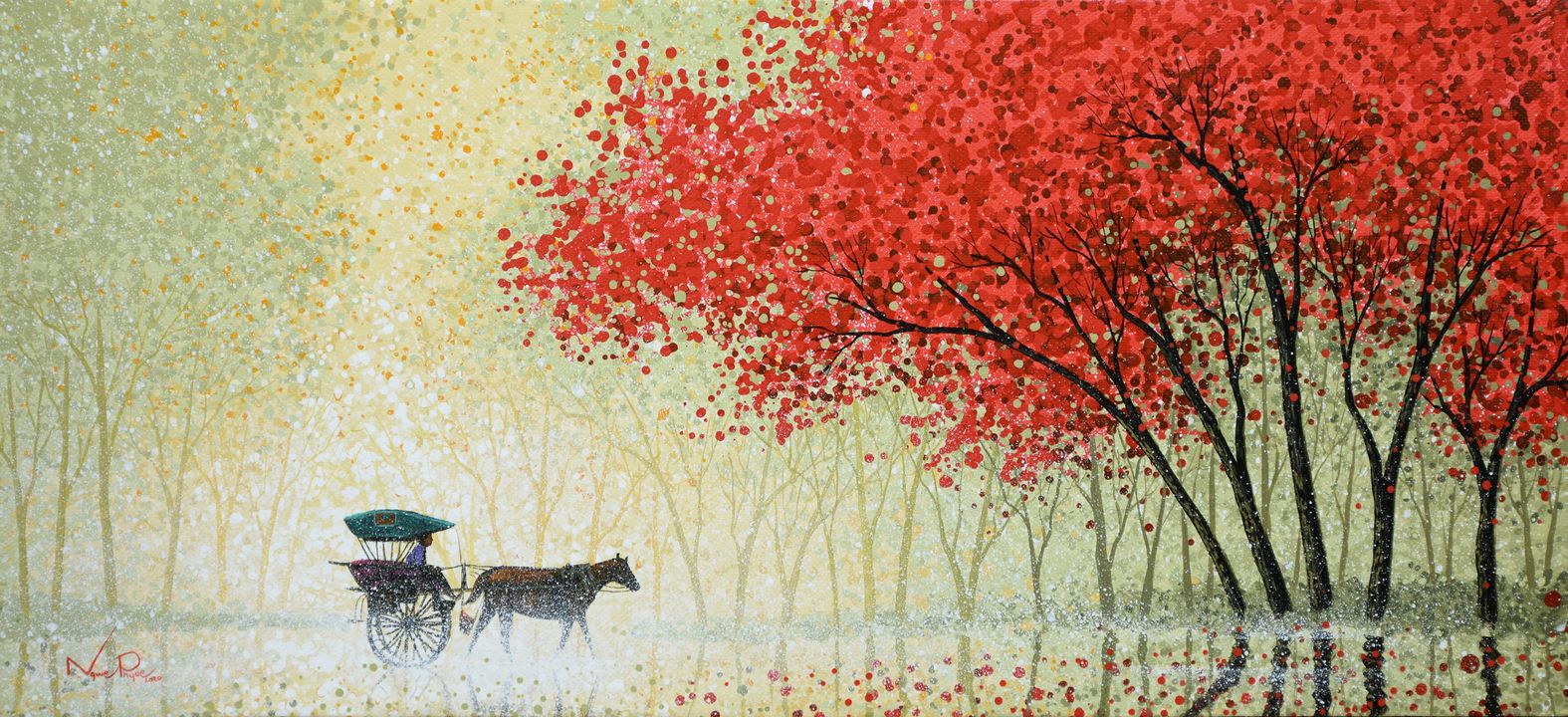
A graduate of the State School of Fine Arts in Yangon, Ngwe Phyoe started painting in the realism style but soon adopted his signature drip paint technique, a form of abstract art in which paint is dripped or poured on to the canvas.
This style of action painting was experimented with in the first half of the twentieth century by such artists as
Francis Picabia, André Masson and
Max Ernst, who employed drip painting in his works "
The Bewildered Planet" and "
Young Man Intrigued by the Flight of a Non-Euclidean Fly" (
1942).
Ernst used the novel means of painting Lissajous figures by swinging a punctured bucket of paint over a horizontal canvas.
In his paintings, Ngwe Phyoe focuses on capturing Myanmar’s unique landscape and people.
Click on the images to display them in full size
L'artista Birmano Ngwe Phyoe (nato in Yangon, Myanmar) ha tenuto 10 mostre personali, comprese due mostre d'arte a Singapore e Hong Kong.
Laureato allo State School of Fine Arts di Yangon, Ngwe Phyoe ha iniziato a dipingere nello stile del realismo, ma presto, per creare dipinti realisti ha adottato la sua tipica tecnica di pittura dripping, una tecnica pittorica caratteristica dell'action painting americana elaborato nella sua forma più tipica alla fine degli anni quaranta da Jackson Pollock.
Il dripping trae liberamente spunto dalla cosiddetta "scrittura automatica" surrealista: il colore (non olio, ma smalto opaco o vernici industriali usate per la prima volta proprio da Pollock intorno al 1947) viene lasciato sgocciolare sulla tela distesa per terra da un contenitore bucherellato o schizzato direttamente con le mani mediante l'uso di bastoni o pennelli.
Più tardi, tra gli anni cinquanta e gli anni sessanta, il dripping verrà largamente impiegato nell'ambito di tutti i movimenti europei di stile informale.
Nei suoi dipinti, Ngwe Phyoe si concentra sulla cattura del paesaggio e delle persone del Myanmar.