Visualizzazione post con etichetta 17th century Art. Mostra tutti i post
Textual description of firstImageUrl

Le Nain Brothers | The Adoration of the Shepherds, 1640

A group gathers around a manger to adore the newborn Christ.
On the right, the Virgin Mary and Joseph gaze reverently at the infant, alongside two small angels.
On the left are two young boys and an old, barefooted man: they are the shepherds mentioned in the Gospel of Luke (2: 8-20).

Le Nain Brothers (fl. 17th century) | The Adoration of the Shepherds, 1640 | The National Gallery, London

Textual description of firstImageUrl

When Christmas was prohibit

While Christmas is celebrated globally, throughout history, various nations and regions have banned Christmas celebrations for religious, political, or ideological reasons.
These bans ranged from 17th-century religious reformations to 20th-century state-sponsored atheism.
Even today, in 2025, there are nations that maintain strict bans or significant restrictions on Christmas celebrations.

A 1931 edition of the Soviet magazine Bezbozhnik, published by the League of Militant Atheists, depicting an Orthodox Christian priest being forbidden to take home a tree for the celebration of Christmastide, which was banned under the Marxist-Leninist doctrine of state atheism.

Textual description of firstImageUrl

Canaletto | London paintings, 1746-1755

The revered Venetian landscape painter Giovanni Antonio Canal (28 October 1697 - 19 April 1768), known as Canaletto, enjoyed a roaring trade from English visitors to Italy in his early career, but by 1740 the War of the Austrian Succession had taken hold and tourism was dwindling.
In 1746, Canaletto decided to move to London to be closer to his market.
At this time Britain was flourishing under newfound wealth.


Textual description of firstImageUrl

Valentin De Boulogne | Baroque painter

With the exception of Valentin de Boulogne's baptismal record, bearing a disputed date of either 1591 or 1594, the artist's early life is undocumented.
The son of a painter and stained glass worker, Valentin likely received his first training with his father in his native Coulommiers, near Paris.
He may subsequently have studied with an artist in Paris or in Fontainebleau.
It is not known when he departed for Italy, where he resided the remainder of his short life.
Joachim von Sandrart remarked (1675) that Valentin reached Rome before Simon Vouet (1590-1649), who arrived around 1614.


Textual description of firstImageUrl

Valentin de Boulogne | The Crowning with thorns, 1620

This masterpiece of Baroque naturalism is among the first known works painted by Valentin de Boulogne, Caravaggio’s most accomplished French follower and arguably his greatest acolyte.
Painted in Rome in 1615 or shortly thereafter, it shows to what extent and how quickly the Frenchman had absorbed Caravaggio’s radical innovations.

Valentin de Boulogne | The Crowning with thorns, 1620 (detail) | Sotheby's

Textual description of firstImageUrl

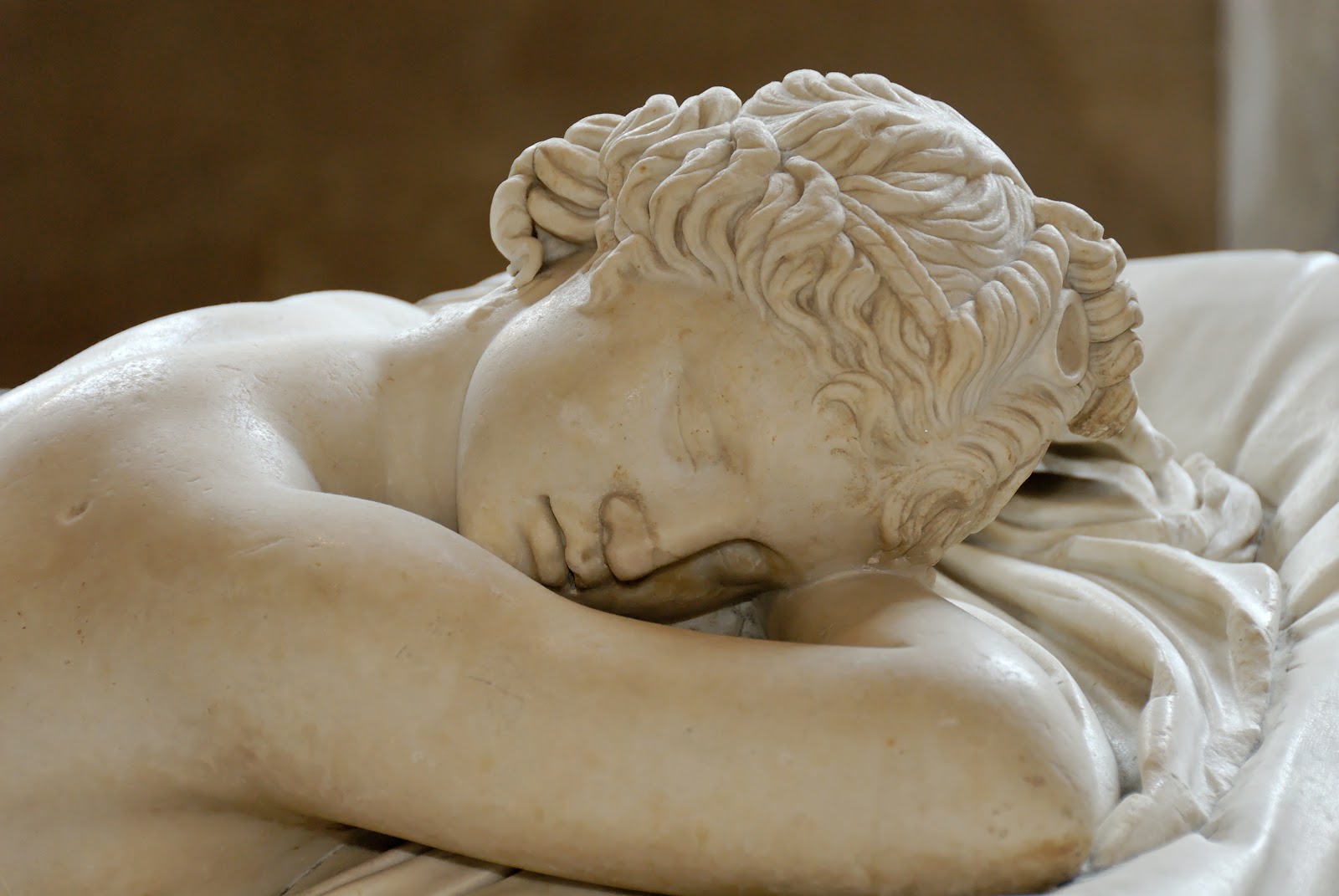
Sleeping Hermaphroditus / L'Ermafrodito dormiente

The ambivalence and voluptuous curves of this figure of Hermaphroditus, who lies asleep on a mattress sculpted by Bernini, are still a source of fascination today.
His body merged with that of the nymph Salmacis, whose advances he had rejected, Hermaphroditus, son of Hermes and Aphrodite, is represented as a bisexed figure.
The original that inspired this figure would have dated from the 2nd century BC, reflecting the late Hellenistic taste for the theatrical.

Department of Greek, Etruscan and Roman Antiquities: Hellenistic Art (3rd-1st centuries BC) Greek, Etruscan and Roman Antiquities - Musée du Louvre.

Textual description of firstImageUrl

Carlo Francesco Nuvolone | Baroque painter

Carlo Francesco Nuvolone (Milan, 1609-1662)) was an Italian painter of religious subjects and portraits who was active mainly in Lombardy.
He became the leading painter in Lombardy in the mid-17th century, producing works on canvas as well as frescoes.
Because his style was perceived as close to that of Guido Reni he was nicknamed il Guido della Lombardia (the Guido of Lombardy).


Textual description of firstImageUrl

Caravaggio and the birth of Baroque

Italian Renaissance painter Michelangelo Merisi da Caravaggio (1571-1610) "put the oscuro (shadows) into chiaroscuro".
Chiaroscuro was practised long before he came on the scene, but it was Caravaggio who made the technique a dominant stylistic element, darkening the shadows and transfixing the subject in a blinding shaft of light.


Textual description of firstImageUrl

Gian Lorenzo Bernini, uomo ed artista universale

Oltre ai suoi autoritratti e ad un ritratto fattogli dal Gaulli (Roma, Gall. Corsini), il Bernini è stato descritto fisicamente e moralmente da numerosi autori: basti ricordare lo Chantelou, ed il figlio Domenico, che lo disse "aspro di natura, fisso nelle operazioni, ardente nell'ira".
Egli fu l'artista più intimamente legato al cattolicesimo risorgente nella temperie postridentina, e non può esserci dubbio sulla sua convinzione religiosa; pare che negli anni successivi al 1630 la sua fede si fosse approfondita e che nell'ultimo periodo della sua vita frequentasse assiduamente gesuiti e oratoriani: era amico intimo dei padre G. P. Oliva, gesuita, per il quale disegnò il frontespizio al secondo volume delle Prediche (1664) e ebbe come consigliere spirituale anche un suo nipote, padre Marchesi, oratoriano.


Textual description of firstImageUrl

Gerard ter Borch | Baroque painter

Gerard Terborch, Terborch also spelled Ter Borch or Terburg (1617-1681), Dutch Baroque painter who developed his own distinctive type of interior genre in which he depicted with grace and fidelity the atmosphere of well-to-do, middle-class life in 17th-century Holland.
Terborch’s father had been an artist and had visited Rome but from 1621 was employed as a tax collector.


Textual description of firstImageUrl

Francesco Hayez / Shakespeare | The Kiss, 1859 / Sonnet 116

Let me not to the marriage of true minds
Love is not love Which alters when it alteration finds,
Or bends with the remover to remove: O no! it is an
ever-fixed mark That looks on tempests and is never shaken;

Francesco Hayez | The Kiss, 1859 | Pinacoteca di Brera

Textual description of firstImageUrl

Johannes Vermeer | Baroque Era painter

The life and art of Johannes Vermeer (1632-1675) are closely associated with the city of Delft.
He was born in Delft in 1632 and lived there until his death in 1675.
His father, Reynier Vermeer, was a silk weaver who produced caffa, a fine satin fabric, but in 1631 he also registered in the Saint Luke’s Guild in Delft as a master art dealer.
By 1641 he was sufficiently prosperous to purchase a large house, the “Mechelen”, which contained an inn on the market square in Delft and from which he probably also sold paintings.


Textual description of firstImageUrl

Caravaggio's hands

Revolutionary in his way of painting, Michelangelo Merisi da Caravaggio (1571-1610) personifies in every aspect of his eventful life the romantic figure of the damned artist.
Caravaggio was a leading Italian painter of the late 16th and early 17th centuries who became famous for the intense and unsettling realism of his large-scale religious works.
Caravaggio's innovations inspired Baroque painting, but the latter incorporated the drama of his chiaroscuro without the psychological realism.


Textual description of firstImageUrl

Johannes Vermeer | Lady with Her Maidservant Holding a Letter, 1667

Lady with Her Maidservant Holding a Letter is a painting produced by Jan Vermeer (Delft, 1632-1675), now in the Frick Collection in New York City.
The work of Johannes Vermeer (also known as Jan), is well known for many characteristics that are present in this painting.
The use of yellow and blue, female models, and domestic scenes are all signatures of Vermeer.
This oil on canvas portrays two women, a Mistress and her Maid, as they look over the Mistress' love letter.
Mistress and Maid was painted over the years 1666-1670 on a canvas.
The painting shows an elegant mistress and her maid as they look over a love letter that the mistress just received.


Textual description of firstImageUrl

The Story of Music: A Chronicle of Resonance

The impulse began, as all things do, from a foundational state of near-silence.
Not a void, mind you. A state of potential.
A world teeming with vibration, but lacking organization.
Consider the cave: a resonating chamber.
Water dripping, wind sighing… these were the first notes.
Not "music" as we understand it, but precursors.
The potential for pattern was always present.

Orazio Gentileschi | Young Woman with a Violin (Saint Cecilia), 1612 | Detroit Institute of Arts

Textual description of firstImageUrl

Johann Sebastian Bach | The Prelude and Fugue in C major, BWV 846

The Prelude and Fugue in C major, BWV 846, is a keyboard composition written by German composer and musician of the late Baroque period Johann Sebastian Bach (1685-1750).
It is the first prelude and fugue in the first book of The Well-Tempered Clavier, a series of 48 preludes and fugues by the composer.
An early version of the prelude, BWV 846A, is found in the Klavierbüchlein für Wilhelm Friedemann Bach.

Francis Sydney Muschamp (British, 1851-1929) | A musical interlude

Textual description of firstImageUrl

Peter Paul Rubens | Old woman and boy with candles, 1616-1617

An old woman gazes ahead, shielding her eyes from the candlelight, while the boy behind her holds his candle, ready to be lit.
The panel is painted in the style of Caravaggio, whose work Peter Paul Rubens (1577-1640) had seen in Italy.
This style is characterised by its exciting effects of light and unpolished naturalism.
Rubens did not make this painting to be sold; instead he retained possession of it. He probably used it as study material for the pupils in his studio.

Peter Paul Rubens | Old Woman and Boy with Candles, 1616-1617 | Museum Mauritshuis The Hague

Textual description of firstImageUrl

Tomaso Albinoni | 12 Concerti a cinque (op. 9), 1722

12 Concerti a cinque (op. 9) is a collection of concertos by the Italian baroque composer Tomaso Albinoni (1671-1751), published in 1722.
The most famous piece from Albinoni's Opus 9 is the Concerto in D minor for oboe (Opus 9, Number 2).
It is known for its slow movement.

Leopold Pollak (1806-1880) |A little shepherd playing the oboe at the Claudia Aqueduct on the Roman Campagna", 1857

Textual description of firstImageUrl

Ave Maria (Schubert)

"Ellens dritter Gesang" ("Ellens Gesang III", D. 839, Op. 52, No. 6, 1825), in English: "Ellen's Third Song", was composed by Franz Schubert in 1825 as part of his Op. 52, a setting of seven songs from Walter Scott's 1810 popular narrative poem The Lady of the Lake, loosely translated into German.

Giovanni Battista Salvi called Sassoferrato (1609-1685) | The Madonna in prayer | Christie's

Textual description of firstImageUrl

Francesco Lavagna | The Neapolitan still life of the eighteenth century

Francesco Lavagna (Naples, 1684-1724) was an Italian still life painter who worked mainly in Naples.
Little is known about his biographical data and career, but he was first mentioned by B. De Dominici in the 18th century and has since been regarded as an important still life painter of the Neapolitan School.