Visualizzazione post con etichetta 16th century Art. Mostra tutti i post
Cristoforo Stati | Orpheus with Violin, 1600-1601

Cristoforo Stati | Orpheus with Violin, 1600-1601

Orpheus by Italian sculptor Cristoforo Stati / Cristofano da Bracciano (1556-1619), famous for taming beasts with his music, is here shown entertaining himself, his body swaying to the sound of the lira da braccio.
The statue was carved for the Palazzo Corsi, Florence. | © The Metropolitan Museum of Art


Read More

Cristoforo Stati | Orpheus with Violin, 1600-1601

Orpheus by Italian sculptor Cristoforo Stati / Cristofano da Bracciano (1556-1619), famous for taming beasts with his music, is here shown entertaining himself, his body swaying to the sound of the lira da braccio.
The statue was carved for the Palazzo Corsi, Florence. | © The Metropolitan Museum of Art


Joachim Patinir | Renaissance painter

Joachim Patinir | Renaissance painter


Joachim Patinir, in full Joachim de Patinir, Patinir also spelled Patinier or Patenier, (1485, Bouvignes or Dinan, Namur, Belgium - October 5, 1524, Antwerp), Flemish painter, the first Western artist known to have specialized in landscape painting.
Little is known of his early life, but his work reflects an early knowledge of the painting of Gerard David, the last of the Early Netherlandish painters.
He may have studied under Hiëronymus Bosch, the painter of fantastic allegories and landscapes.

Read More

Joachim Patinir | Renaissance painter


Joachim Patinir, in full Joachim de Patinir, Patinir also spelled Patinier or Patenier, (1485, Bouvignes or Dinan, Namur, Belgium - October 5, 1524, Antwerp), Flemish painter, the first Western artist known to have specialized in landscape painting.
Little is known of his early life, but his work reflects an early knowledge of the painting of Gerard David, the last of the Early Netherlandish painters.
He may have studied under Hiëronymus Bosch, the painter of fantastic allegories and landscapes.

Leonardo and Michelangelo: The 1504 Duel in Florence

Leonardo and Michelangelo: The 1504 Duel in Florence

The "duel" between Leonardo da Vinci and Michelangelo Buonarroti refers to a legendary artistic competition, when the Florentine Republic commissioned both masters to paint massive, opposing battle frescoes in the Palazzo Vecchio Grand Hall of the Five Hundred.
In 1504, Michelangelo Buonarroti was commissioned by Pier Soderini to complete a celebrative fresco depicting the Battle of Cascina, to be placed in the Florentine Room of the Great Council (or Salone dei Cinquecento) of Palazzo Vecchio while Leonardo da Vinci was commissioned to complete another painting on the opposite wall to celebrate the equally important Florentine victory at the 1440 Battle of Anghiari, effectively pitting the two rivals against one another.

Leonardo da Vinci | Study of a Warrior's Head for the Battle of Anghiari, 1504-1505 | Museum of Fine Arts, Budapest

Read More

Leonardo and Michelangelo: The 1504 Duel in Florence

The "duel" between Leonardo da Vinci and Michelangelo Buonarroti refers to a legendary artistic competition, when the Florentine Republic commissioned both masters to paint massive, opposing battle frescoes in the Palazzo Vecchio Grand Hall of the Five Hundred.
In 1504, Michelangelo Buonarroti was commissioned by Pier Soderini to complete a celebrative fresco depicting the Battle of Cascina, to be placed in the Florentine Room of the Great Council (or Salone dei Cinquecento) of Palazzo Vecchio while Leonardo da Vinci was commissioned to complete another painting on the opposite wall to celebrate the equally important Florentine victory at the 1440 Battle of Anghiari, effectively pitting the two rivals against one another.

Leonardo da Vinci | Study of a Warrior's Head for the Battle of Anghiari, 1504-1505 | Museum of Fine Arts, Budapest

Paolo Fiammingo | Mannerist painter

Paolo Fiammingo | Mannerist painter

Pauwels Franck - known in Italy as Paolo Fiammingo and Paolo dei Franceschi (1540-1596), was a Flemish painter, mainly of landscapes with mythological and religious scenes, who was active in Venice for most of his life.
He was likely born c. 1540 but his birthplace is not known. He became a member of the Antwerp Guild of Saint Luke in 1561.
He is recorded in Venice from 1573 but was likely an assistant in Tintoretto’s workshop there already in the 1560s.
He worked in Venice for the rest of his career.


Read More

Paolo Fiammingo | Mannerist painter

Pauwels Franck - known in Italy as Paolo Fiammingo and Paolo dei Franceschi (1540-1596), was a Flemish painter, mainly of landscapes with mythological and religious scenes, who was active in Venice for most of his life.
He was likely born c. 1540 but his birthplace is not known. He became a member of the Antwerp Guild of Saint Luke in 1561.
He is recorded in Venice from 1573 but was likely an assistant in Tintoretto’s workshop there already in the 1560s.
He worked in Venice for the rest of his career.


Allegory of Poetry

Allegory of Poetry

As a literary device, an allegory is a metaphor in which a character, place or event is used to deliver a broader message about real-world issues and occurrences.
Allegory (in the sense of the practice and use of allegorical devices and works) has occurred widely throughout history in all forms of art, largely because it can readily illustrate or convey complex ideas and concepts in ways that are comprehensible or striking to its viewers, readers, or listeners.
Writers or speakers typically use allegories as literary devices or as rhetorical devices that convey (semi-)hidden or complex meanings through symbolic figures, actions, imagery, or events, which together create the moral, spiritual, or political meaning the author wishes to convey.

Auger Lucas (French Rococo Era painter, 1685-1765) | An Allegory of Poetry

Read More

Allegory of Poetry

As a literary device, an allegory is a metaphor in which a character, place or event is used to deliver a broader message about real-world issues and occurrences.
Allegory (in the sense of the practice and use of allegorical devices and works) has occurred widely throughout history in all forms of art, largely because it can readily illustrate or convey complex ideas and concepts in ways that are comprehensible or striking to its viewers, readers, or listeners.
Writers or speakers typically use allegories as literary devices or as rhetorical devices that convey (semi-)hidden or complex meanings through symbolic figures, actions, imagery, or events, which together create the moral, spiritual, or political meaning the author wishes to convey.

Auger Lucas (French Rococo Era painter, 1685-1765) | An Allegory of Poetry

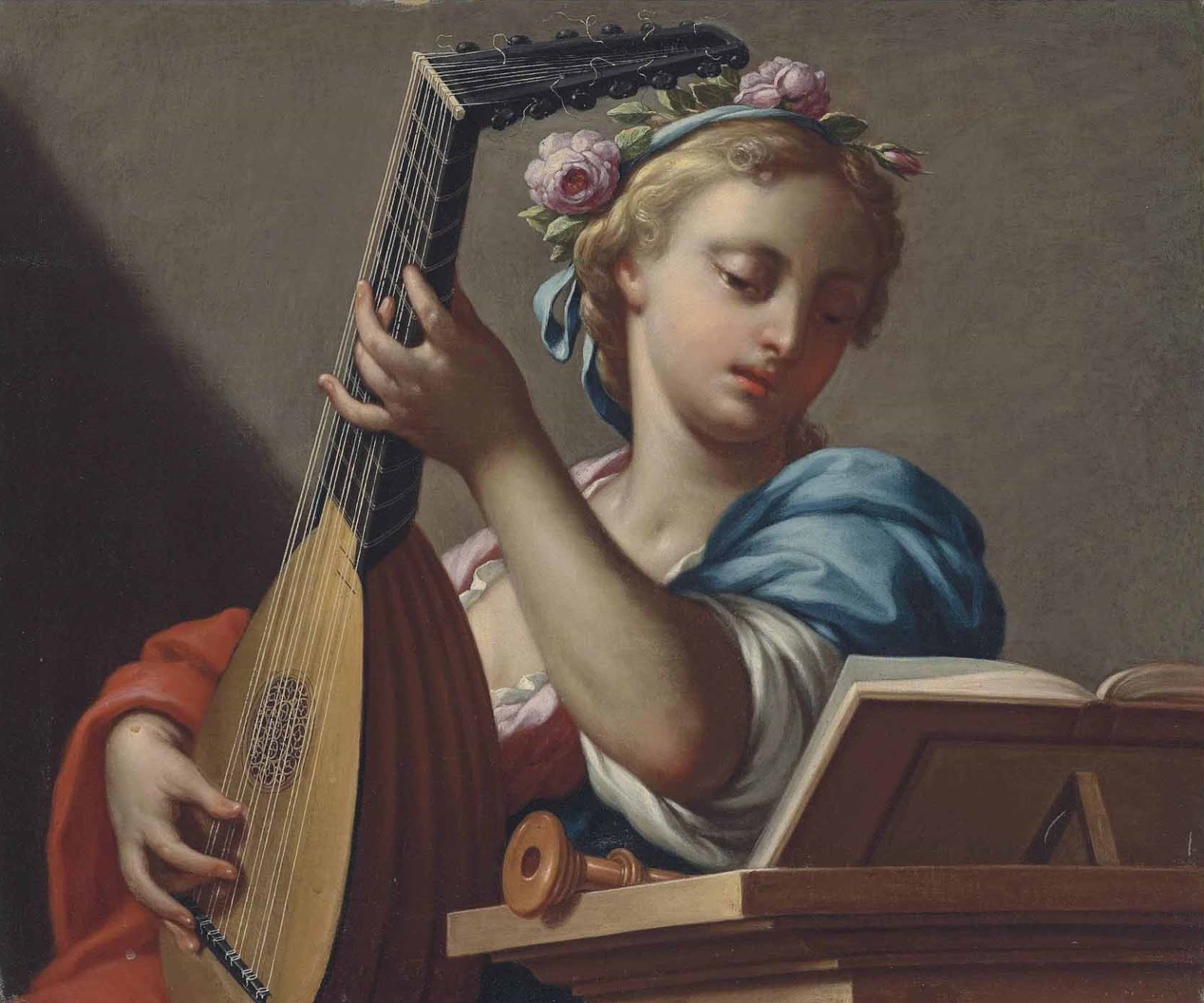
Allegory of Music

Allegory of Music

The "Allegory of Music" is a classic artistic theme used to personify the beauty, harmony, and theory of sound.
Historically, these artworks often feature a female figure (sometimes a Muse like Euterpe or Polyhymnia) surrounded by various instruments, sheet music, and symbolic animals.
Historically, it is often depicted as one of the Seven Liberal Arts, representing the mathematical and harmonic ratios that govern the universe.
The theme remains relevant today; for instance, modern songwriters use allegory in lyrics to convey deep moral lessons or complex emotions through surface-level stories.

Francesco Trevisani (Italian Rococo Era painter, 1656-1746) | An allegory of music

Read More

Allegory of Music

The "Allegory of Music" is a classic artistic theme used to personify the beauty, harmony, and theory of sound.
Historically, these artworks often feature a female figure (sometimes a Muse like Euterpe or Polyhymnia) surrounded by various instruments, sheet music, and symbolic animals.
Historically, it is often depicted as one of the Seven Liberal Arts, representing the mathematical and harmonic ratios that govern the universe.
The theme remains relevant today; for instance, modern songwriters use allegory in lyrics to convey deep moral lessons or complex emotions through surface-level stories.

Francesco Trevisani (Italian Rococo Era painter, 1656-1746) | An allegory of music

Matthias Grünewald | Altare di Issenheim, 1512-1516

Matthias Grünewald | Altare di Issenheim, 1512-1516

L'Altare di Isenheim (o Issenheim, secondo la denominazione francese della città alsaziana) costituisce l'opera più importante eseguita da Matthias Grünewald (1475-1528), uno dei più importanti pittori Tedeschi, noto per la drammaticità visionaria con cui ha affrontato temi di carattere religioso.
Si tratta di una sorprendente "macchina di altare" fatta di ante fisse ed ante rimovibili, che possono assumere tre diverse configurazioni.
Committente dell'opera fu l'abate del monastero di Issenheim, Guido Guersi.
Essa era destinata alla preghiera dei monaci antoniani e dei tanti malati (soprattutto quelli sofferenti del "Fuoco di Sant'Antonio") che venivano pietosamente accolti nel monastero.


Read More

Matthias Grünewald | Altare di Issenheim, 1512-1516

L'Altare di Isenheim (o Issenheim, secondo la denominazione francese della città alsaziana) costituisce l'opera più importante eseguita da Matthias Grünewald (1475-1528), uno dei più importanti pittori Tedeschi, noto per la drammaticità visionaria con cui ha affrontato temi di carattere religioso.
Si tratta di una sorprendente "macchina di altare" fatta di ante fisse ed ante rimovibili, che possono assumere tre diverse configurazioni.
Committente dell'opera fu l'abate del monastero di Issenheim, Guido Guersi.
Essa era destinata alla preghiera dei monaci antoniani e dei tanti malati (soprattutto quelli sofferenti del "Fuoco di Sant'Antonio") che venivano pietosamente accolti nel monastero.


Market painting | The historical origins

Market painting | The historical origins

Market paintings capture the vibrant energy and cultural diversity of trading spaces across the world, from bustling open-air bazaars to serene floral stalls.
Market scenes have been a popular genre for centuries, capturing the vibrancy of daily life, commerce and culture.
These paintings often use "visual seduction" to make the depicted commodities - like fruits, vegetables, or flowers - as alluring to the viewer as the art itself.
This subject is a favorite for artists to explore crowd dynamics, architectural perspective, and color theory through various mediums like oil and watercolor.


Read More

Market painting | The historical origins

Market paintings capture the vibrant energy and cultural diversity of trading spaces across the world, from bustling open-air bazaars to serene floral stalls.
Market scenes have been a popular genre for centuries, capturing the vibrancy of daily life, commerce and culture.
These paintings often use "visual seduction" to make the depicted commodities - like fruits, vegetables, or flowers - as alluring to the viewer as the art itself.
This subject is a favorite for artists to explore crowd dynamics, architectural perspective, and color theory through various mediums like oil and watercolor.


Giorgio Vasari: "Vita di Sandro Botticello - Pittor Fiorentino"

Giorgio Vasari: "Vita di Sandro Botticello - Pittor Fiorentino"

Ne’ medesimi tempi del Magnifico Lorenzo Vecchio de’ Medici, che fu veramente per le persone d’ingegno un secol d’oro, fiorì ancora Alessandro, chiamato a l’uso nostro Sandro e detto di Botticello per la cagione che appresso vedremo.
Costui fu figliuolo di Mariano Filipepi, cittadino fiorentino dal quale diligentemente allevato e fatto instruire in tutte quelle cose che usanza è di insegnarsi a’ fanciulli in quella età, prima che e’ si ponghino a le botteghe, ancora che agevolmente apprendesse tutto quello che e’ voleva, era nientedimanco inquieto sempre; né si contentava di scuola alcuna, di leggere, di scrivere o di abbaco; di maniera che il padre infastidito di questo cervello sì stravagante, per disperato lo pose a lo orefice con un suo compare chiamato Botticello, assai competente maestro allora in quell’arte.


Read More

Giorgio Vasari: "Vita di Sandro Botticello - Pittor Fiorentino"

Ne’ medesimi tempi del Magnifico Lorenzo Vecchio de’ Medici, che fu veramente per le persone d’ingegno un secol d’oro, fiorì ancora Alessandro, chiamato a l’uso nostro Sandro e detto di Botticello per la cagione che appresso vedremo.
Costui fu figliuolo di Mariano Filipepi, cittadino fiorentino dal quale diligentemente allevato e fatto instruire in tutte quelle cose che usanza è di insegnarsi a’ fanciulli in quella età, prima che e’ si ponghino a le botteghe, ancora che agevolmente apprendesse tutto quello che e’ voleva, era nientedimanco inquieto sempre; né si contentava di scuola alcuna, di leggere, di scrivere o di abbaco; di maniera che il padre infastidito di questo cervello sì stravagante, per disperato lo pose a lo orefice con un suo compare chiamato Botticello, assai competente maestro allora in quell’arte.


Boccaccio Boccaccino | Early Renaissance painter

Boccaccio Boccaccino | Early Renaissance painter


Boccaccio Boccaccino (1467-1525) was a painter of the early Italian Renaissance, belonging to the Emilian school. He is profiled in Vasari's "Le Vite delle più eccellenti pittori, scultori, ed architettori" (or, in English, Lives of the Most Excellent Painters, Sculptors, and Architects).
He was born in Ferrara and studied there, probably under Domenico Panetti.
Few facts of his life are known.

Read More

Boccaccio Boccaccino | Early Renaissance painter


Boccaccio Boccaccino (1467-1525) was a painter of the early Italian Renaissance, belonging to the Emilian school. He is profiled in Vasari's "Le Vite delle più eccellenti pittori, scultori, ed architettori" (or, in English, Lives of the Most Excellent Painters, Sculptors, and Architects).
He was born in Ferrara and studied there, probably under Domenico Panetti.
Few facts of his life are known.

Happy Valentine's Day 💕 | La storia di San Valentino 💕

Happy Valentine's Day 💕 | La storia di San Valentino 💕


Saint Valentine, officially known as Saint Valentine of Rome, is a third-century Roman saint widely celebrated on February 14 and commonly associated with "courtly love".
At least three different Saint Valentines, all of them martyrs, are mentioned in the early martyrologies under date of 14 February.
One is described as a priest at Rome, another as bishop of Interamna (modern Terni), and these two seem both to have suffered in the second half of the third century and to have been buried on the Flaminian Way, but at different distances from the city.

Read More

Happy Valentine's Day 💕 | La storia di San Valentino 💕


Saint Valentine, officially known as Saint Valentine of Rome, is a third-century Roman saint widely celebrated on February 14 and commonly associated with "courtly love".
At least three different Saint Valentines, all of them martyrs, are mentioned in the early martyrologies under date of 14 February.
One is described as a priest at Rome, another as bishop of Interamna (modern Terni), and these two seem both to have suffered in the second half of the third century and to have been buried on the Flaminian Way, but at different distances from the city.

Bartolomeo Veneto | High Renaissance painter

Bartolomeo Veneto | High Renaissance painter


Bartolomeo Veneto (1502-1555) was an Italian painter who worked in Venice, the Veneto and Lombardy.
During his time in Venice, he studied under Gentile Bellini.
The little information available about Bartolomeo's life has been derived from his signatures, dates, and inscriptions.
His best known works are portraits or pictures with portrait-like character.
Bartolomeo's later works, and especially those done on commission in Milan, indicate an influence from the artist Leonardo da Vinci.

Read More

Bartolomeo Veneto | High Renaissance painter


Bartolomeo Veneto (1502-1555) was an Italian painter who worked in Venice, the Veneto and Lombardy.
During his time in Venice, he studied under Gentile Bellini.
The little information available about Bartolomeo's life has been derived from his signatures, dates, and inscriptions.
His best known works are portraits or pictures with portrait-like character.
Bartolomeo's later works, and especially those done on commission in Milan, indicate an influence from the artist Leonardo da Vinci.

Valentin De Boulogne | Baroque painter

Valentin De Boulogne | Baroque painter

With the exception of Valentin de Boulogne's baptismal record, bearing a disputed date of either 1591 or 1594, the artist's early life is undocumented.
The son of a painter and stained glass worker, Valentin likely received his first training with his father in his native Coulommiers, near Paris.
He may subsequently have studied with an artist in Paris or in Fontainebleau.
It is not known when he departed for Italy, where he resided the remainder of his short life.
Joachim von Sandrart remarked (1675) that Valentin reached Rome before Simon Vouet (1590-1649), who arrived around 1614.


Read More

Valentin De Boulogne | Baroque painter

With the exception of Valentin de Boulogne's baptismal record, bearing a disputed date of either 1591 or 1594, the artist's early life is undocumented.
The son of a painter and stained glass worker, Valentin likely received his first training with his father in his native Coulommiers, near Paris.
He may subsequently have studied with an artist in Paris or in Fontainebleau.
It is not known when he departed for Italy, where he resided the remainder of his short life.
Joachim von Sandrart remarked (1675) that Valentin reached Rome before Simon Vouet (1590-1649), who arrived around 1614.


Valentin de Boulogne | The Crowning with thorns, 1620

Valentin de Boulogne | The Crowning with thorns, 1620

This masterpiece of Baroque naturalism is among the first known works painted by Valentin de Boulogne, Caravaggio’s most accomplished French follower and arguably his greatest acolyte.
Painted in Rome in 1615 or shortly thereafter, it shows to what extent and how quickly the Frenchman had absorbed Caravaggio’s radical innovations.

Valentin de Boulogne | The Crowning with thorns, 1620 (detail) | Sotheby's

Read More

Valentin de Boulogne | The Crowning with thorns, 1620

This masterpiece of Baroque naturalism is among the first known works painted by Valentin de Boulogne, Caravaggio’s most accomplished French follower and arguably his greatest acolyte.
Painted in Rome in 1615 or shortly thereafter, it shows to what extent and how quickly the Frenchman had absorbed Caravaggio’s radical innovations.

Valentin de Boulogne | The Crowning with thorns, 1620 (detail) | Sotheby's

Narcissus by Boltraffio and after Boltraffio, 1500-1510

Narcissus by Boltraffio and after Boltraffio, 1500-1510

Narcissus at the Fountain is a 1500-1510 oil-on-panel painting by Giovanni Antonio Boltraffio, now in the Uffizi, in Florence.
A copy is held in the National Gallery, London.
Both works show a young man in profile, interpreted as Narcissus due to his downward gaze.

Giovanni Antonio Boltraffio | Narcissus at the Fountain | Uffizi Gallery, Florence

Read More

Narcissus by Boltraffio and after Boltraffio, 1500-1510

Narcissus at the Fountain is a 1500-1510 oil-on-panel painting by Giovanni Antonio Boltraffio, now in the Uffizi, in Florence.
A copy is held in the National Gallery, London.
Both works show a young man in profile, interpreted as Narcissus due to his downward gaze.

Giovanni Antonio Boltraffio | Narcissus at the Fountain | Uffizi Gallery, Florence

15th-16th century Art | Sitemap

15th-16th century Art | Sitemap

The 15th and 16th centuries saw the flowering of the Renaissance, a period of renewed interest in classical antiquity that emphasized humanism, naturalism, and the development of new artistic techniques.
It began in Italy and later spread throughout Europe, with distinct regional styles and priorities.

Key periods

The Early Renaissance (15th century)

Originating in Florence, the Early Renaissance, or Quattrocento, established the foundations for the later High Renaissance.
Masaccio (1401-1428): Credited with popularizing linear perspective and creating realistic figures with solidity and emotion.
Donatello (1386-1466): His bronze David was the first free-standing nude sculpture since antiquity, demonstrating classical influence.
Sandro Botticelli (1445-1510): Known for elegant mythological paintings like The Birth of Venus and Primavera.
Jan van Eyck (1390-1441): A pioneer of the Northern Renaissance who mastered oil painting and meticulous detail, as seen in The Arnolfini Portrait.


Read More

15th-16th century Art | Sitemap

The 15th and 16th centuries saw the flowering of the Renaissance, a period of renewed interest in classical antiquity that emphasized humanism, naturalism, and the development of new artistic techniques.
It began in Italy and later spread throughout Europe, with distinct regional styles and priorities.

Key periods

The Early Renaissance (15th century)

Originating in Florence, the Early Renaissance, or Quattrocento, established the foundations for the later High Renaissance.
Masaccio (1401-1428): Credited with popularizing linear perspective and creating realistic figures with solidity and emotion.
Donatello (1386-1466): His bronze David was the first free-standing nude sculpture since antiquity, demonstrating classical influence.
Sandro Botticelli (1445-1510): Known for elegant mythological paintings like The Birth of Venus and Primavera.
Jan van Eyck (1390-1441): A pioneer of the Northern Renaissance who mastered oil painting and meticulous detail, as seen in The Arnolfini Portrait.


Giovanni Antonio Boltraffio | The Virgin and Child, 1493-1499

Giovanni Antonio Boltraffio | The Virgin and Child, 1493-1499

A grave, statuesque young woman gazes down at a positively enormous child, who lies sideways across her lap.
Her deep red gown is open to reveal her breast, which she offers to her son - though he seems uninterested.
He turns his head away from his mother to look out at the viewer, while playing with the beads which dangle from her scarf.
We know from their delicate haloes that these are the Virgin Mary and infant Christ, but this is a very modern Mary, painted in a newly realistic manner.
Boltraffio (Milan, 1467-1516) was Leonardo da Vinci’s most gifted pupil, and imitated his master in style and technique.


Read More

Giovanni Antonio Boltraffio | The Virgin and Child, 1493-1499

A grave, statuesque young woman gazes down at a positively enormous child, who lies sideways across her lap.
Her deep red gown is open to reveal her breast, which she offers to her son - though he seems uninterested.
He turns his head away from his mother to look out at the viewer, while playing with the beads which dangle from her scarf.
We know from their delicate haloes that these are the Virgin Mary and infant Christ, but this is a very modern Mary, painted in a newly realistic manner.
Boltraffio (Milan, 1467-1516) was Leonardo da Vinci’s most gifted pupil, and imitated his master in style and technique.


Michelangelo | Bacchus, 1496-1497

Michelangelo | Bacchus, 1496-1497

Bacchus (1496-1497) is a marble sculpture by the Italian High Renaissance sculptor, painter, architect and poet Michelangelo Buonarroti.
The statue is somewhat over life-size and depicts Bacchus, the Roman god of wine, in a reeling pose suggestive of drunkenness.
Commissioned by Raffaele Riario, a high-ranking Cardinal and collector of antique sculpture, it was rejected by him and was bought instead by Jacopo Galli, Riario’s banker and a friend to Michelangelo.
Along with the Pietà the Bacchus is one of only two surviving sculptures from the artist's first period in Rome.


Read More

Michelangelo | Bacchus, 1496-1497

Bacchus (1496-1497) is a marble sculpture by the Italian High Renaissance sculptor, painter, architect and poet Michelangelo Buonarroti.
The statue is somewhat over life-size and depicts Bacchus, the Roman god of wine, in a reeling pose suggestive of drunkenness.
Commissioned by Raffaele Riario, a high-ranking Cardinal and collector of antique sculpture, it was rejected by him and was bought instead by Jacopo Galli, Riario’s banker and a friend to Michelangelo.
Along with the Pietà the Bacchus is one of only two surviving sculptures from the artist's first period in Rome.


Cappella Sistina | La Volta di Michelangelo, 1508-1512

Cappella Sistina | La Volta di Michelangelo, 1508-1512

"Senza aver visto la Cappella Sistina non è possibile formare un'idea apprezzabile di cosa un uomo solo sia in grado di ottenere" - Johann Wolfgang von Goethe

La decisione di Giulio II di rifare integralmente la decorazione della volta fu probabilmente dovuta ai gravi problemi di natura statica che interessarono la Sistina fin dai primi anni del suo pontificato (1503-1513).
Essi dovettero essere la conseguenza degli scavi eseguiti sia a nord che a sud dell’edificio per la costruzione della Torre Borgia e del nuovo San Pietro.
Dopo che nel maggio del 1504, una lunga crepa si aprì nella volta, fu incaricato Bramante, allora architetto di Palazzo, di porvi rimedio, il quale mise in opera alcune catene nel locale soprastante la Cappella.


Read More

Cappella Sistina | La Volta di Michelangelo, 1508-1512

"Senza aver visto la Cappella Sistina non è possibile formare un'idea apprezzabile di cosa un uomo solo sia in grado di ottenere" - Johann Wolfgang von Goethe

La decisione di Giulio II di rifare integralmente la decorazione della volta fu probabilmente dovuta ai gravi problemi di natura statica che interessarono la Sistina fin dai primi anni del suo pontificato (1503-1513).
Essi dovettero essere la conseguenza degli scavi eseguiti sia a nord che a sud dell’edificio per la costruzione della Torre Borgia e del nuovo San Pietro.
Dopo che nel maggio del 1504, una lunga crepa si aprì nella volta, fu incaricato Bramante, allora architetto di Palazzo, di porvi rimedio, il quale mise in opera alcune catene nel locale soprastante la Cappella.


Caravaggio and the birth of Baroque

Caravaggio and the birth of Baroque

Italian Renaissance painter Michelangelo Merisi da Caravaggio (1571-1610) "put the oscuro (shadows) into chiaroscuro".
Chiaroscuro was practised long before he came on the scene, but it was Caravaggio who made the technique a dominant stylistic element, darkening the shadows and transfixing the subject in a blinding shaft of light.


Read More

Caravaggio and the birth of Baroque

Italian Renaissance painter Michelangelo Merisi da Caravaggio (1571-1610) "put the oscuro (shadows) into chiaroscuro".
Chiaroscuro was practised long before he came on the scene, but it was Caravaggio who made the technique a dominant stylistic element, darkening the shadows and transfixing the subject in a blinding shaft of light.