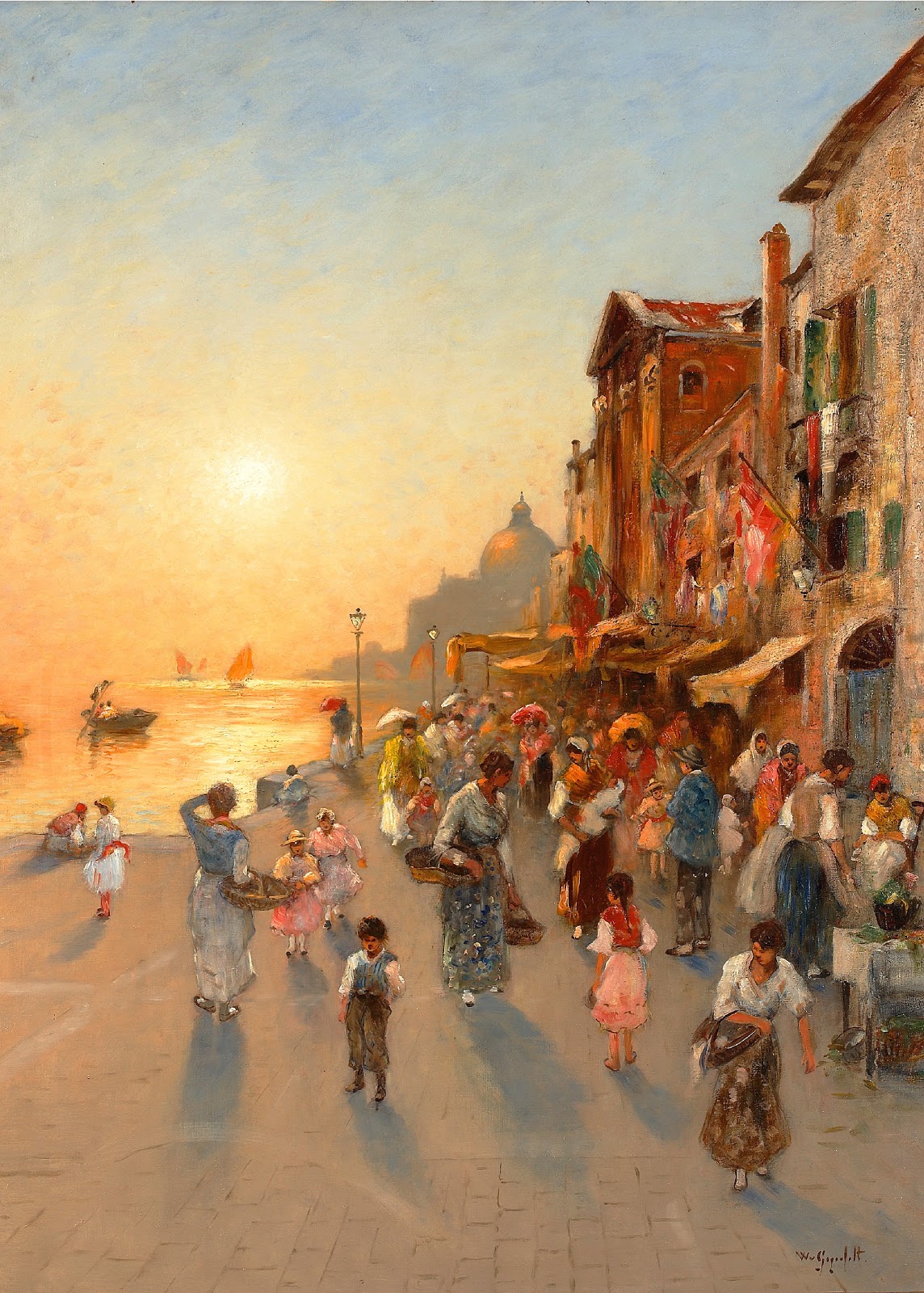
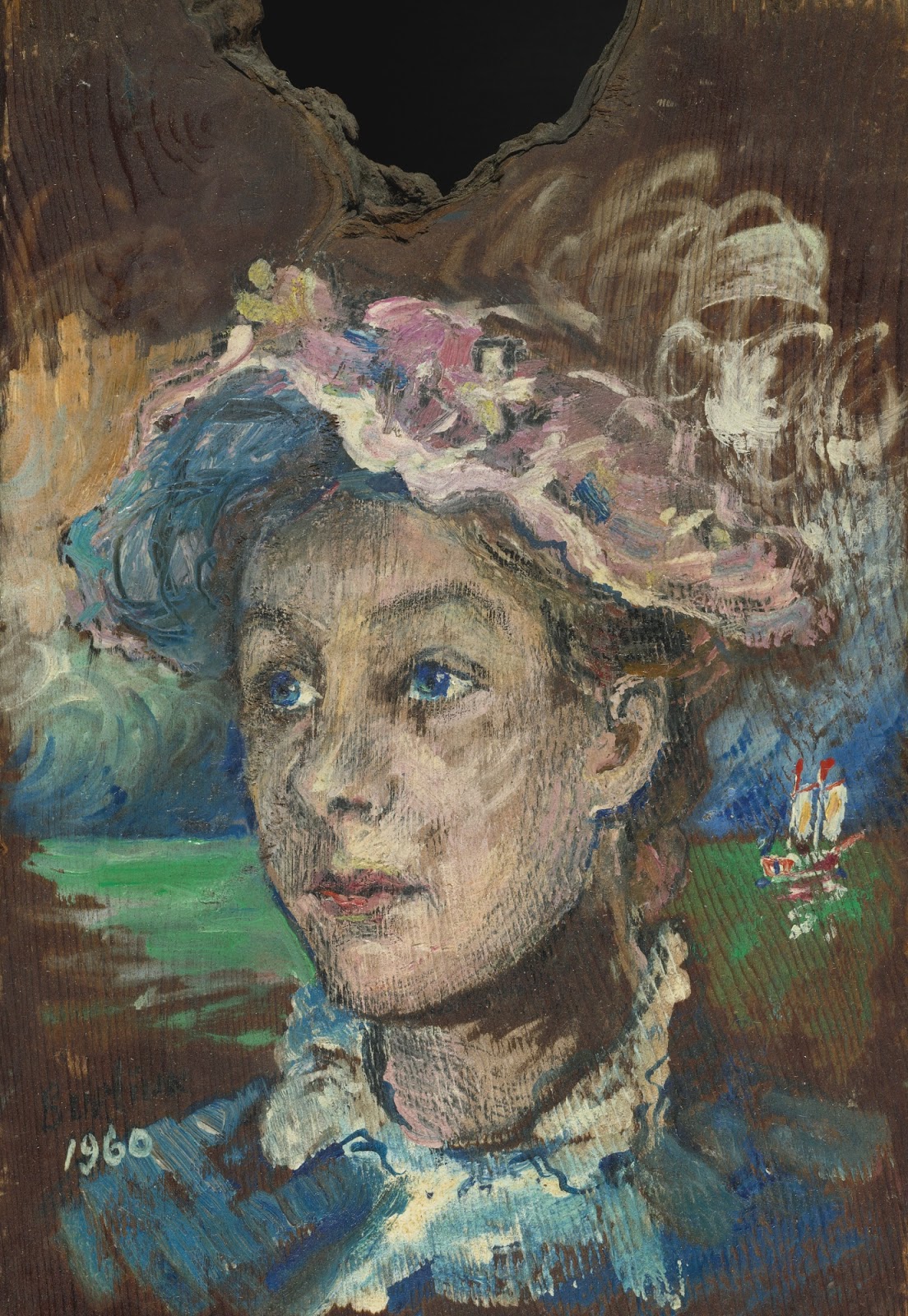
An early work by Italian divisionist painter Cesare Maggi (1881-1961), "At least there's fire!" - signed and dated "Firenze 1898"- was one of two exhibited by the artist, not yet eighteen, at the fifty-second annual exhibition of the Society of Fine Arts in Florence (1898-1899).
Home » Post con etichetta Post-Impressionism
Visualizzazione post con etichetta Post-Impressionism. Mostra tutti i post
Wassily Kandinsky | Post-Impressionism period, 1896-1909
One of the pioneers of Abstraction in Western art, Wassily Kandinsky's (1866-1944) early work was influenced by Art Nouveau, Impressionist and Post-Impressionist styles.
The number of his existing paintings increased at the beginning of the 20th century; much remains of the landscapes and towns he painted, using broad swaths of colour and recognisable forms.
Such works reveal Kandinsky’s strong interest in the tradition of capturing light and the life of cities evident in Impressionism and Post-Impressionism, as well as his love of vibrant and expressive color.
Miloslava Vrbova-Štefková | Ballet dancers
Czech artist Miloslava Vrbova-Štefková (1909-1991) was an traditionalist post-impressionist painter.
During the 1937-1938 Miloslava Vrbova-Štefková studied at the Académie des Beaux-Arts in Paris with Czech Abstract painter František Kupka (1871-1957).
Besides the dancers, the ballet scenes and portraits, Miloslava Vrbova also painted landscapes and the Prague urban motifs, religious scenes (the Crucifixion in the church Žinkovie), still lifes and flowers.
Robert Antoine Pinchon | Post-Impressionist painter
Claude Monet referred to him: "As a surprising touch in the service of a surprising eye".
Among Robert Antoine Pynchons' important works are a series of paintings of the River Seine, mostly around Rouen and landscapes depicting places in or near Upper Normandy.
Robert Antoine Pinchon (1886-1943) was a French Post-Impressionist landscape painter of the Rouen School- l'École de Rouen.
He was consistent throughout his career in his dedication to painting landscapes en plein air.
Sexto Canegallo | Pointillist / Futurist painter
Italian painter Giuseppe Sexto Canegallo (1892-1966) was born on 2 February 1892 in Sestri Ponente.
He attended the Linguistic Academy in Genoa, where he was a student of Lazzaro Luxardo, Tullio Salvatore Quinzio, Lorenzo Massa and Alfredo Luxoro.
His artistic style was initially influenced by the pointillist poetics of Plinio Nomellini, together with other artists such as Angelo Morbelli, Gaetano Previati and Rubaldo Merello.
Flip Gaasendam,1957 | Neo-Impressionist painter
Flip Gaasendam studied from 1977-1982 at the Minerva Academy of Groningen.
In 1988 he obtained the 'J. Egberts' price of the Pictura Association. From 1992 on, he was welcomed in the best galleries of The Netherlands.
In 1997 he participated at the ‘Painters of Minerva' exhibition, held at the same time at ‘De Twee Pauwen’ Gallery in The Hague and at Panorama Mesdag Museum.
Gaasendam’s works are present in many collections, notably at the Drenthe Museum, Gasunie, ING and Unilever.
Othon Friesz | Fauve painter
Achille-Émile Othon Friesz (6 February 1879 - 10 January 1949), who later called himself Othon Friesz, a native of Le Havre, was a French artist of the Fauvist movement.
Othon Friesz was born in Le Havre, the son of a long line of shipbuilders and sea captains.
He went to school in his native city.
It was while he was at the Lycée that he met his lifelong friend Raoul Dufy.
Félix Vallotton | Landscapes and seascapes
Vallotton's landscapes and seascapes avoided conventional views and techniques, and presented unusual viewpoints and perspectives.
The scene is sometimes seen from above, with the horizon very high in the picture, or without the sky being visible at all.
The forms are simplified, and the figures are often small and almost unrecognizable.
Felix-Vallotton | The Ball, 1899 | Musée d'Orsay, Paris
Henri Matisse | Orientalist Odalisque
In 1917 Matisse relocated to Cimiez on the French Riviera, a suburb of the city of Nice.
His work of the decade or so following this relocation shows a relaxation and a softening of his approach.
This "return to order" is characteristic of much art of the post-World War I period and can be compared with the neoclassicism of Picasso and Stravinsky as well as the return to traditionalism of Derain.
.jpg)
Odilon Redon | Hommage a Goya, 1885 | The series
Homage to Goya (Hommage à Goya) is an portfolio of 6 lithographs on chine appliqué reveal Redon's admiration for the Spanish painter and printmaker, who died in 1828.
This series is one of many that Odilon Redon created throughout his career.
Nearly two-thirds of his lithographs took the form of portfolios - prints connected conceptually by a theme or narrative and physically by a folder or binding.
Odilon Redon | Hommage a Goya, 1885 | Scharf Gerstenberg Collection
Raffaello Gambogi | Post-Macchiaioli painter
Raffaello Gambogi (Livorno, 1874-1943) was an Italian painter, mainly of urban landscapes and genre scenes.
In 1891 Gambogi obtained a scholarship to the Academy of Fine Arts of Florence, where he studied under Giovanni Fattori.
Paul Gauguin | The Siesta, 1892-94
The unaffected grace and communal ease of Tahitian women impressed Gauguin enormously.
The artist worked on this painting over an extended period, incorporating numerous changes.
The skirt of the woman in the foreground, for example, was originally bright red; there was a dog in the position now occupied by the basket at lower right; and the woman seated at the left edge of the porch was previously situated further to the left. | © The Metropolitan Museum of Art.
Felix Vallotton | Still life with gladioli, 1924
Félix Vallotton's still life paintings are characterized by their formal simplicity, striking compositions, and a cool, detached sensibility.
While still lifes were a minor subject for him earlier in his career, they became prominent in his work from around 1910 onwards.
In his later years, painting in his studio in Honfleur, Vallotton concentrated particularly on still lifes, particularly flowers, fruits and vegetables, very carefully arranged and painted with extreme precision.
Paul Gauguin | Post-Impressionist painter
Paul Gauguin, in full Eugène-Henri-Paul Gauguin (born June 7, 1848, Paris, France-died May 8, 1903, Atuona, Hiva Oa, Marquesas Islands, French Polynesia) French painter, printmaker and sculptor who sought to achieve a "primitive” expression of spiritual and emotional states in his work.
The artist, whose work has been categorized as Post-Impressionist, Synthetist and Symbolist, is particularly well known for his creative relationship with Vincent van Gogh as well as for his self-imposed exile in Tahiti, French Polynesia.
His artistic experiments influenced many avant-garde developments in the early 20th century.
Van Gogh | Saintes-Maries (series)
Saintes-Maries is the subject of a series of paintings that Vincent van Gogh made in 1888.
When Van Gogh lived in Arles, he took a trip to Saintes-Maries-de-la-Mer on the Mediterranean sea, where he made several paintings of the seascape and town.
The work he produced in Saintes-Maries took on a more experimental and expressive style than his earlier work.
Over the course of his visit, Van Gogh made two paintings of the sea, one of the village, and nine drawings.
Vincent van Gogh | Small bottle with peonies and blue delphiniums, 1886
Vincent van Gogh began experimenting with color in his still life flower series.
By the summer of 1885, the artist created some 40 paintings with a traditional approach, meaning that the flowers were in a vase and placed in the center of the canvas.
His 1886 painting Small Bottle with Peonies and Blue Delphiniums, done with oil on painter's board -a cheaper material than canvas-, from the Gemeente Museum collection, is one of them.
Flowers became the subject of many of the artist's works during this period.
But after painting over 10 species in mid-September, he sought out other subjects including fruit, shoes, fish and budding flower bulbs.
Vincent van Gogh | Small bottle with peonies and blue delphiniums, 1886 | Van Gogh Museum, Amsterdam
Paul Cézanne: "Voglio dipingere la verginità del mondo"!
• Il disegno ed il colore non sono affatto distinti. Man mano che si dipinge, si disegna. Più il colore diventa armonioso, più il disegno si fa preciso.
• Deriviamo tutti da Pissarro.
• Di Cézanne c'è n'è uno ogni due secoli!
• Ho una sensazione lieve, ma non riesco ad esprimerla. Sono come uno incapace di usare la moneta d'oro in suo possesso.
Henri Lebasque | Pittore post-impressionista
Henri Lebasque (1865-1937) fu membro fondatore del Salon d'Automne nel 1903 con il suo amico Henri Matisse ed espose al Salon des Indépendants.
Nacque in una famiglia modesta (il padre era bottaio) e si iscrisse all'Académie Colarossi nel 1886.
In seguito collaborò con Ferdinand Humbert agli affreschi del Panthéon per sei anni, a partire dal 1888.
Vincent van Gogh | Sunflowers series
Sunflowers (original title, in French: Tournesols) are the subject of two series of still life paintings by the Dutch painter Vincent van Gogh.
The earlier series, executed in Paris in 1887, depicts the flowers lying on the ground, while the second set, executed a year later in Arles, shows bouquets of sunflowers in a vase.
In the artist's mind both sets were linked by the name of his friend Paul Gauguin, who acquired two of the Paris versions.
Vincent van Gogh | Sunflowers, 1887 | National Gallery, London
Angelo Barabino | Divisionist painter
Angelo Barabino (Tortona, 1 January 1883 - Milan, 5 November 1950) was an Italian painter, friend and student of Giuseppe Pellizza Volpedo.
He was born in Tortona on 1 January 1883. Barabino attended the Academy of Fine Arts in Milan and studying Volpedo who initiated him to painting in the Divisionism style.
Iscriviti a:
Commenti (Atom)


.jpg)


.jpg)