Visualizzazione post con etichetta German Art. Mostra tutti i post
Wolfgang Lettl | Surrealist painter

Wolfgang Lettl | Surrealist painter

Wolfgang Lettl (1919-2008) was a surrealist painter who was born and who died in Augsburg, Germany.
Success with his freelance art led him to develop his surrealism, and he participated in the 1963 Grosse Kunstausstellung München - the "Grand Art Exhibition Munich", becoming a member of the Neue Münchener Künstlergenossenschaft - "New Munich Artist Cooperative Society".
One-man shows in Germany and abroad followed.


Read More

Wolfgang Lettl | Surrealist painter

Wolfgang Lettl (1919-2008) was a surrealist painter who was born and who died in Augsburg, Germany.
Success with his freelance art led him to develop his surrealism, and he participated in the 1963 Grosse Kunstausstellung München - the "Grand Art Exhibition Munich", becoming a member of the Neue Münchener Künstlergenossenschaft - "New Munich Artist Cooperative Society".
One-man shows in Germany and abroad followed.


Johann Wolfgang Goethe | Presenza / Presence

Johann Wolfgang Goethe | Presenza / Presence

Tutto è annuncio di te!
Appare il sole radioso, e tu dietro a lui, spero.
Esci fuori in giardino e sei rosa fra le rose,
e sei giglio fra i gigli.


Read More

Johann Wolfgang Goethe | Presenza / Presence

Tutto è annuncio di te!
Appare il sole radioso, e tu dietro a lui, spero.
Esci fuori in giardino e sei rosa fra le rose,
e sei giglio fra i gigli.


Matthias Grünewald | Altare di Issenheim, 1512-1516

Matthias Grünewald | Altare di Issenheim, 1512-1516

L'Altare di Isenheim (o Issenheim, secondo la denominazione francese della città alsaziana) costituisce l'opera più importante eseguita da Matthias Grünewald (1475-1528), uno dei più importanti pittori Tedeschi, noto per la drammaticità visionaria con cui ha affrontato temi di carattere religioso.
Si tratta di una sorprendente "macchina di altare" fatta di ante fisse ed ante rimovibili, che possono assumere tre diverse configurazioni.
Committente dell'opera fu l'abate del monastero di Issenheim, Guido Guersi.
Essa era destinata alla preghiera dei monaci antoniani e dei tanti malati (soprattutto quelli sofferenti del "Fuoco di Sant'Antonio") che venivano pietosamente accolti nel monastero.


Read More

Matthias Grünewald | Altare di Issenheim, 1512-1516

L'Altare di Isenheim (o Issenheim, secondo la denominazione francese della città alsaziana) costituisce l'opera più importante eseguita da Matthias Grünewald (1475-1528), uno dei più importanti pittori Tedeschi, noto per la drammaticità visionaria con cui ha affrontato temi di carattere religioso.
Si tratta di una sorprendente "macchina di altare" fatta di ante fisse ed ante rimovibili, che possono assumere tre diverse configurazioni.
Committente dell'opera fu l'abate del monastero di Issenheim, Guido Guersi.
Essa era destinata alla preghiera dei monaci antoniani e dei tanti malati (soprattutto quelli sofferenti del "Fuoco di Sant'Antonio") che venivano pietosamente accolti nel monastero.


Johann Wolfgang Goethe | Per l'Anno Nuovo / For the New Year

Johann Wolfgang Goethe | Per l'Anno Nuovo / For the New Year

Andy Warhol | Johann Wolfgang Goethe, 1982

Tra il vecchio e il nuovo,
la sorte dona
queste ore liete;
e il passato impone
d’aver fiducia
a guardare avanti
e a guardare indietro.

Read More

Johann Wolfgang Goethe | Per l'Anno Nuovo / For the New Year

Andy Warhol | Johann Wolfgang Goethe, 1982

Tra il vecchio e il nuovo,
la sorte dona
queste ore liete;
e il passato impone
d’aver fiducia
a guardare avanti
e a guardare indietro.

Tina Cassati | Surreal fashion

Tina Cassati | Surreal fashion

Berlin based artist Tina Cassati, makes costumes (sculpture le mode and giardino di arte), ruffs, hats-, bags - and shoes-, jewelry objects into modern surreale digital-photo-art worlds and illustrations.
She paints, sews, draws, photographs, digital collage - mixed media, collage, illustration.
She does not care about genres.
Her work is influenced by Renaissance, Baroque, Traditional Clothing (Folk Costumes) fairy tales. To her, fashion is fine art.


Read More

Tina Cassati | Surreal fashion

Berlin based artist Tina Cassati, makes costumes (sculpture le mode and giardino di arte), ruffs, hats-, bags - and shoes-, jewelry objects into modern surreale digital-photo-art worlds and illustrations.
She paints, sews, draws, photographs, digital collage - mixed media, collage, illustration.
She does not care about genres.
Her work is influenced by Renaissance, Baroque, Traditional Clothing (Folk Costumes) fairy tales. To her, fashion is fine art.


Richard Nadler, 1987 | Generative art

Richard Nadler, 1987 | Generative art

Richard Nadler is a contemporary digital artist based in Munich, Germany, whose innovative work explores the dynamic interplay between tradition, Artificial Intelligence, and digital media.
With roots in the Bavarian countryside and formative experiences from extensive travels in Japan, his artistry is deeply infused with personal narrative and cultural resonance.


Read More

Richard Nadler, 1987 | Generative art

Richard Nadler is a contemporary digital artist based in Munich, Germany, whose innovative work explores the dynamic interplay between tradition, Artificial Intelligence, and digital media.
With roots in the Bavarian countryside and formative experiences from extensive travels in Japan, his artistry is deeply infused with personal narrative and cultural resonance.


Andy Warhol | Johann Wolfgang von Goethe, 1982

Andy Warhol | Johann Wolfgang von Goethe, 1982

Andy Warhol saw the famous portrait of Johann Wolfgang von Goethe by J. H. Wilhelm Tischbein during a visit to the Städel.
As the quintessence of German culture, it inspired him to create this work and other prints, some of which are likewise in the Städel collection.
In 1962 Warhol - a key figure of American Pop Art - began reproducing press photos of celebrities such as Marilyn Monroe or Elvis Presley with the silkscreen technique.

Andy Warhol | Johann Wolfgang von Goethe, 1982 | Städel Museum, Frankfurt

Read More

Andy Warhol | Johann Wolfgang von Goethe, 1982

Andy Warhol saw the famous portrait of Johann Wolfgang von Goethe by J. H. Wilhelm Tischbein during a visit to the Städel.
As the quintessence of German culture, it inspired him to create this work and other prints, some of which are likewise in the Städel collection.
In 1962 Warhol - a key figure of American Pop Art - began reproducing press photos of celebrities such as Marilyn Monroe or Elvis Presley with the silkscreen technique.

Andy Warhol | Johann Wolfgang von Goethe, 1982 | Städel Museum, Frankfurt

Leo Putz | Impressionist painter

Leo Putz | Impressionist painter

Leo Putz (1869-1940) was a Tyrolean painter. His work encompasses Art Nouveau, Impressionism and the beginnings of Expressionism. Figures and landscapes are his predominant subjects.
Leo Putz was born in Merano in South Tyrol, Italy, in 1869.
His artistic career began in 1885 under the aegis of his stepbrother.
This was Robert Poetzelberger (1856-1930) who was a professor at the Munich Academy and who taught him drawing.


Read More

Leo Putz | Impressionist painter

Leo Putz (1869-1940) was a Tyrolean painter. His work encompasses Art Nouveau, Impressionism and the beginnings of Expressionism. Figures and landscapes are his predominant subjects.
Leo Putz was born in Merano in South Tyrol, Italy, in 1869.
His artistic career began in 1885 under the aegis of his stepbrother.
This was Robert Poetzelberger (1856-1930) who was a professor at the Munich Academy and who taught him drawing.


Wolfgang Alexander Kossuth | Ballet dancers

Wolfgang Alexander Kossuth | Ballet dancers

German musician and sculptor Wolfgang Alexander Kossuth (1947-2009) was born in Pfronten, Germany.
He was a painter, a sculptor, a violinist and an orchestra leader and he dedicated all hos life to art, join the passion for the music with the figurative arts one.
His artworks portray important people of the musical, literally and ballet background.
He prefers sculpture because with it he expresses himself better. The human being is always the centre of the composition.

Alexander Kossuth | Roberto Bolle

Read More

Wolfgang Alexander Kossuth | Ballet dancers

German musician and sculptor Wolfgang Alexander Kossuth (1947-2009) was born in Pfronten, Germany.
He was a painter, a sculptor, a violinist and an orchestra leader and he dedicated all hos life to art, join the passion for the music with the figurative arts one.
His artworks portray important people of the musical, literally and ballet background.
He prefers sculpture because with it he expresses himself better. The human being is always the centre of the composition.

Alexander Kossuth | Roberto Bolle

Johann Jungblut | Romantic Landscape painter

Johann Jungblut | Romantic Landscape painter

Johan Jungblut (1860-1912), a Düsseldorf school, painted winter landscapes of rural Netherlands, Germany, and Norway in an old master style.
Jungblut was born in Sarrebourg on the French/German border in April of 1860, although in 1885 he made the German city of Dusseldorf his home.
Johan Jungblut was a solitary figure who lived alone; he made frequent trips to Holland to paint, specialising in Winter scenes infused with tranquil light.


Read More

Johann Jungblut | Romantic Landscape painter

Johan Jungblut (1860-1912), a Düsseldorf school, painted winter landscapes of rural Netherlands, Germany, and Norway in an old master style.
Jungblut was born in Sarrebourg on the French/German border in April of 1860, although in 1885 he made the German city of Dusseldorf his home.
Johan Jungblut was a solitary figure who lived alone; he made frequent trips to Holland to paint, specialising in Winter scenes infused with tranquil light.


Johann Georg Meyer | Pittore di genere

Johann Georg Meyer | Pittore di genere

Johann Georg Meyer von Bremen (1813-1886), noto come Meyer von Bremen, è stato un importante rappresentante della pittura di genere classica Tedesca.
Meyer è considerato un rappresentante della Scuola di pittura di Düsseldorf e fu membro della Colonia di pittori di Willingshausen.
Johann Georg Meyer realizzò circa 1.000 opere.
Meyer ricevette numerosi premi ed onorificenze.


Read More

Johann Georg Meyer | Pittore di genere

Johann Georg Meyer von Bremen (1813-1886), noto come Meyer von Bremen, è stato un importante rappresentante della pittura di genere classica Tedesca.
Meyer è considerato un rappresentante della Scuola di pittura di Düsseldorf e fu membro della Colonia di pittori di Willingshausen.
Johann Georg Meyer realizzò circa 1.000 opere.
Meyer ricevette numerosi premi ed onorificenze.


August Macke: "The most important thing for me is the direct observation of nature in its light-filled existence"

August Macke: "The most important thing for me is the direct observation of nature in its light-filled existence"

"I'm interested in creating a space through color contrasts, rather than by simple shadows of light and dark".
"Mi interessa creare uno spazio attraverso contrasti di colore, piuttosto che attraverso semplici ombre di luce e buio".


Read More

August Macke: "The most important thing for me is the direct observation of nature in its light-filled existence"

"I'm interested in creating a space through color contrasts, rather than by simple shadows of light and dark".
"Mi interessa creare uno spazio attraverso contrasti di colore, piuttosto che attraverso semplici ombre di luce e buio".


August Macke | Promenade, 1913

August Macke | Promenade, 1913

Promenade is an oil-on-cardboard painting by the German artist August Macke (1887-1914), executed in 1913.
It is held at the Städtische Galerie im Lenbachhaus in Munich.
Chronologically, it is the first of the paintings that he created after moving to Hilterfingen in Switzerland.


Read More

August Macke | Promenade, 1913

Promenade is an oil-on-cardboard painting by the German artist August Macke (1887-1914), executed in 1913.
It is held at the Städtische Galerie im Lenbachhaus in Munich.
Chronologically, it is the first of the paintings that he created after moving to Hilterfingen in Switzerland.


Richard Wagner | Ride of the Valkyries

Richard Wagner | Ride of the Valkyries

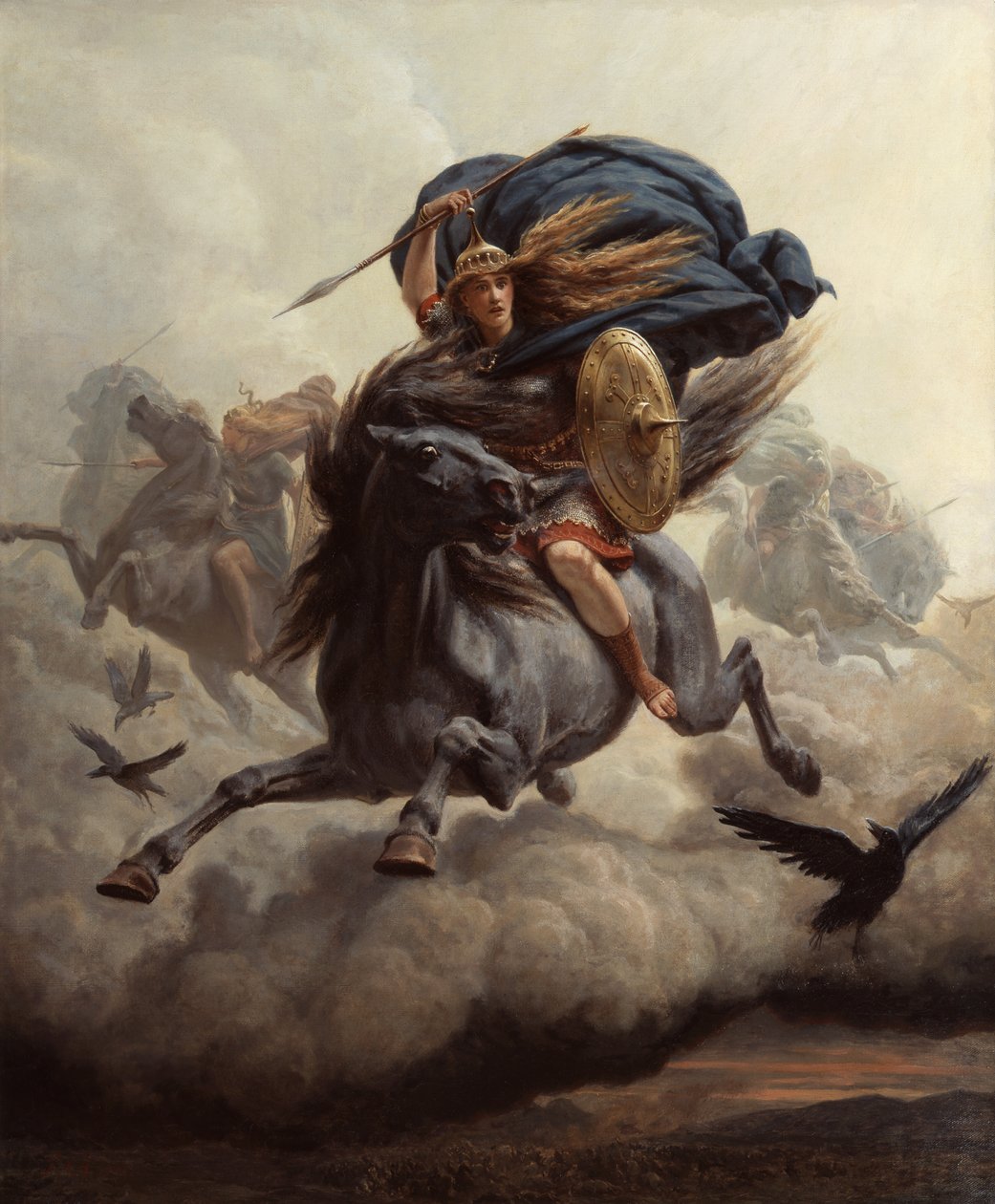
The Ride of the Valkyries (German: Walkürenritt or Ritt der Walküren) is the popular name of the prelude to the first scene of the third and last act of Die Walküre, the second of the four epic music dramas that constitute the operatic cycle Der Ring des Nibelungen (English: The Ring of the Nibelung), composed by Richard Wagner.
As a separate piece, the "Ride" is often heard in a purely instrumental version, which may be as short as three minutes.

Peter Nicolai Arbo (Norwegian historical painter, 1831-1892) | The Valkyrie

Read More

Richard Wagner | Ride of the Valkyries

The Ride of the Valkyries (German: Walkürenritt or Ritt der Walküren) is the popular name of the prelude to the first scene of the third and last act of Die Walküre, the second of the four epic music dramas that constitute the operatic cycle Der Ring des Nibelungen (English: The Ring of the Nibelung), composed by Richard Wagner.
As a separate piece, the "Ride" is often heard in a purely instrumental version, which may be as short as three minutes.

Peter Nicolai Arbo (Norwegian historical painter, 1831-1892) | The Valkyrie

A Midsummer Night's Dream

A Midsummer Night's Dream

A Midsummer Night’s Dream, incidental music by German composer, pianist, organist and conductor of the early Romantic period Felix Mendelssohn (1809-1847) written to accompany performances of Shakespeare’s play "A Midsummer Night’s Dream" at the Prussian royal court.
Mendelssohn became familiar with Shakespeare by reading German translations as a boy, and in 1827, at age 17, he was inspired to write a piece capturing the atmosphere of Shakespeare’s comedy.
The piece, a concert overture, quickly became a popular favourite throughout Europe.

Marc Chagall | La branche de gui or Le rêve, 1928

Read More

A Midsummer Night's Dream

A Midsummer Night’s Dream, incidental music by German composer, pianist, organist and conductor of the early Romantic period Felix Mendelssohn (1809-1847) written to accompany performances of Shakespeare’s play "A Midsummer Night’s Dream" at the Prussian royal court.
Mendelssohn became familiar with Shakespeare by reading German translations as a boy, and in 1827, at age 17, he was inspired to write a piece capturing the atmosphere of Shakespeare’s comedy.
The piece, a concert overture, quickly became a popular favourite throughout Europe.

Marc Chagall | La branche de gui or Le rêve, 1928

Mozart: "A little night music", 1787

Mozart: "A little night music", 1787

Eine kleine Nachtmusik (Serenade No. 13 for strings in G major), K. 525, is a 1787 composition for a chamber ensemble by Wolfgang Amadeus Mozart (1756-1791).
The German title means "a little night music" and is one of Mozart's most famous works.
The serenade is written for an ensemble of two violins, viola, cello, and double bass, but it is often performed by string orchestras.


Read More

Mozart: "A little night music", 1787

Eine kleine Nachtmusik (Serenade No. 13 for strings in G major), K. 525, is a 1787 composition for a chamber ensemble by Wolfgang Amadeus Mozart (1756-1791).
The German title means "a little night music" and is one of Mozart's most famous works.
The serenade is written for an ensemble of two violins, viola, cello, and double bass, but it is often performed by string orchestras.


Offenbach's Can-can | The scandalous Moulin Rouge's dance

Offenbach's Can-can | The scandalous Moulin Rouge's dance

The French Cancan dance is an eight-minute performance facing the audience, during which dancers measuring 5’7” tall lead the dance to a piece of music by German-born French composer Jacques Offenbach (1819-1880).
It’s an art that requires Parisian cabaret dancers to have balance, flexibility, acrobatic ability and rhythm.
They have to be able to do the splits and perform impressive moves like the “port d’armes”, the “cathedral” and the “military salute”.

Henri de Toulouse-Lautrec | At the Moulin Rouge, the Dance, 1889-90 | Philadelphia Museum of Art

Read More

Offenbach's Can-can | The scandalous Moulin Rouge's dance

The French Cancan dance is an eight-minute performance facing the audience, during which dancers measuring 5’7” tall lead the dance to a piece of music by German-born French composer Jacques Offenbach (1819-1880).
It’s an art that requires Parisian cabaret dancers to have balance, flexibility, acrobatic ability and rhythm.
They have to be able to do the splits and perform impressive moves like the “port d’armes”, the “cathedral” and the “military salute”.

Henri de Toulouse-Lautrec | At the Moulin Rouge, the Dance, 1889-90 | Philadelphia Museum of Art

Johann Sebastian Bach | The Prelude and Fugue in C major, BWV 846

Johann Sebastian Bach | The Prelude and Fugue in C major, BWV 846

The Prelude and Fugue in C major, BWV 846, is a keyboard composition written by German composer and musician of the late Baroque period Johann Sebastian Bach (1685-1750).
It is the first prelude and fugue in the first book of The Well-Tempered Clavier, a series of 48 preludes and fugues by the composer.
An early version of the prelude, BWV 846A, is found in the Klavierbüchlein für Wilhelm Friedemann Bach.

Francis Sydney Muschamp (British, 1851-1929) | A musical interlude

Read More

Johann Sebastian Bach | The Prelude and Fugue in C major, BWV 846

The Prelude and Fugue in C major, BWV 846, is a keyboard composition written by German composer and musician of the late Baroque period Johann Sebastian Bach (1685-1750).
It is the first prelude and fugue in the first book of The Well-Tempered Clavier, a series of 48 preludes and fugues by the composer.
An early version of the prelude, BWV 846A, is found in the Klavierbüchlein für Wilhelm Friedemann Bach.

Francis Sydney Muschamp (British, 1851-1929) | A musical interlude

Elli Michler | I wish you Time

Elli Michler | I wish you Time

I don't wish you all sorts of gifts.
I just wish you, what most people don't have.
I wish you the time to be happy and to laugh
and if you use it, you can make something out of it.
I wish you the time for your doings and thinking,
not only for yourself, but also to give away.


Read More

Elli Michler | I wish you Time

I don't wish you all sorts of gifts.
I just wish you, what most people don't have.
I wish you the time to be happy and to laugh
and if you use it, you can make something out of it.
I wish you the time for your doings and thinking,
not only for yourself, but also to give away.


Mozart | Concerto for Flute and Harp | 1 - Allegro

Mozart | Concerto for Flute and Harp | 1 - Allegro

Mozart wrote the "Concerto for Flute, Harp, and Orchestra in C major" in April 1778, during his seven-month sojourn in Paris.
It was commissioned by Adrien-Louis de Bonnières, duc de Guînes (1735-1806), a flutist, for his use and for that of his eldest daughter, Marie-Louise-Philippine (1759-1796), a harpist, who was taking composition lessons from the composer, at the duke's home, the Hôtel de Castries.
Mozart stated in a letter to his father that he thought the duke played the flute "extremely well" and that Marie's playing of the harp was "magnifique".

Louis-Ernest Barrias (1841-1905) | Mozart child with a violin, 1887 | Musée Fabre

Read More

Mozart | Concerto for Flute and Harp | 1 - Allegro

Mozart wrote the "Concerto for Flute, Harp, and Orchestra in C major" in April 1778, during his seven-month sojourn in Paris.
It was commissioned by Adrien-Louis de Bonnières, duc de Guînes (1735-1806), a flutist, for his use and for that of his eldest daughter, Marie-Louise-Philippine (1759-1796), a harpist, who was taking composition lessons from the composer, at the duke's home, the Hôtel de Castries.
Mozart stated in a letter to his father that he thought the duke played the flute "extremely well" and that Marie's playing of the harp was "magnifique".

Louis-Ernest Barrias (1841-1905) | Mozart child with a violin, 1887 | Musée Fabre