Visualizzazione post con etichetta Museum Masterpieces. Mostra tutti i post
Le Gallerie di Piazza Scala, Milano

Le Gallerie di Piazza Scala, Milano

Situato nel cuore di Milano, il complesso espositivo Gallerie di Piazza Scala propone un viaggio affascinante nell'arte del XIX e XX secolo.
Il polo museale si snoda attraverso quattro edifici storici della città.
Negli storici Palazzo Anguissola e Palazzo Brentani sono esposti 197 dipinti e sculture che partono da bassorilievi neoclassici di Antonio Canova, per toccare quindi le altre correnti che hanno caratterizzato le arti figurative italiane ottocentesche:

Ferrari Arturo - Via San Bernardino in Milano

Read More

Le Gallerie di Piazza Scala, Milano

Situato nel cuore di Milano, il complesso espositivo Gallerie di Piazza Scala propone un viaggio affascinante nell'arte del XIX e XX secolo.
Il polo museale si snoda attraverso quattro edifici storici della città.
Negli storici Palazzo Anguissola e Palazzo Brentani sono esposti 197 dipinti e sculture che partono da bassorilievi neoclassici di Antonio Canova, per toccare quindi le altre correnti che hanno caratterizzato le arti figurative italiane ottocentesche:

Ferrari Arturo - Via San Bernardino in Milano

Cristoforo Stati | Orpheus with Violin, 1600-1601

Cristoforo Stati | Orpheus with Violin, 1600-1601

Orpheus by Italian sculptor Cristoforo Stati / Cristofano da Bracciano (1556-1619), famous for taming beasts with his music, is here shown entertaining himself, his body swaying to the sound of the lira da braccio.
The statue was carved for the Palazzo Corsi, Florence. | © The Metropolitan Museum of Art


Read More

Cristoforo Stati | Orpheus with Violin, 1600-1601

Orpheus by Italian sculptor Cristoforo Stati / Cristofano da Bracciano (1556-1619), famous for taming beasts with his music, is here shown entertaining himself, his body swaying to the sound of the lira da braccio.
The statue was carved for the Palazzo Corsi, Florence. | © The Metropolitan Museum of Art


Claude Monet | The Path through the Irises, 1914-1917

Claude Monet | The Path through the Irises, 1914-1917

Irises, among Monet's favorite flowers, lined the pathways leading up to the house and Japanese bridge on the artist's property at Giverny.
This bird's-eye view of a garden path belongs to a series of monumental works painted during the First World War that capture the vital essence of these flowers with intensity and breadth of vision.
Late in life, as his eyesight faltered, he dispensed with subtlety and "took in the motif in large masses", waiting "until the idea took shape, until the arrangement and composition inscribed themselves on the brain". | Source: © The Metropolitan Museum of Art

Claude Monet | The Path through the Irises, 1914-1917 | The Metropolitan Museum of Art

Read More

Claude Monet | The Path through the Irises, 1914-1917

Irises, among Monet's favorite flowers, lined the pathways leading up to the house and Japanese bridge on the artist's property at Giverny.
This bird's-eye view of a garden path belongs to a series of monumental works painted during the First World War that capture the vital essence of these flowers with intensity and breadth of vision.
Late in life, as his eyesight faltered, he dispensed with subtlety and "took in the motif in large masses", waiting "until the idea took shape, until the arrangement and composition inscribed themselves on the brain". | Source: © The Metropolitan Museum of Art

Claude Monet | The Path through the Irises, 1914-1917 | The Metropolitan Museum of Art

Vincent van Gogh | Irises, 1889-1890

Vincent van Gogh | Irises, 1889-1890

Vincent van Gogh (1853-1890) returned to irises again and again in the final year of his life.
While staying at the psychiatric institution in Saint-Rémy (1889-1890), the garden became one of his main sources of inspiration.
He painted several studies of irises over the course of about a year.
Sometimes a single flower, sometimes overflowing bouquets.
He experimented with colour, rhythm and composition.
A small detail: the irises we see as blue today were originally painted a vibrant purple.
Over time, some of Van Gogh’s pigments faded, subtly changing the colours.

Vincent van Gogh | Irises, 1889 | Getty Museum


Read More

Vincent van Gogh | Irises, 1889-1890

Vincent van Gogh (1853-1890) returned to irises again and again in the final year of his life.
While staying at the psychiatric institution in Saint-Rémy (1889-1890), the garden became one of his main sources of inspiration.
He painted several studies of irises over the course of about a year.
Sometimes a single flower, sometimes overflowing bouquets.
He experimented with colour, rhythm and composition.
A small detail: the irises we see as blue today were originally painted a vibrant purple.
Over time, some of Van Gogh’s pigments faded, subtly changing the colours.

Vincent van Gogh | Irises, 1889 | Getty Museum


Frederic Edwin Church | Hudson River School

Frederic Edwin Church | Hudson River School


Frederic Edwin Church (1826-1900) was perhaps the best-known representative of the Hudson River School of landscape painting as well as one its most traveled.
Born in Hartford in 1826, he was the privileged son of Joseph Church, a jeweler and banker of that city, who interceded with Connecticut scion and collector Daniel Wadsworth to persuade the landscape painter Thomas Cole to accept his son as a pupil.
From 1844-1846, Church studied with Cole in his Catskill, New York, studio and accompanied him on sketching sojourns in the Catskill Mountains and the Berkshires of Massachusetts.
At one point, the master characterized the student as having "the finest eye for drawing in the world".

Read More

Frederic Edwin Church | Hudson River School


Frederic Edwin Church (1826-1900) was perhaps the best-known representative of the Hudson River School of landscape painting as well as one its most traveled.
Born in Hartford in 1826, he was the privileged son of Joseph Church, a jeweler and banker of that city, who interceded with Connecticut scion and collector Daniel Wadsworth to persuade the landscape painter Thomas Cole to accept his son as a pupil.
From 1844-1846, Church studied with Cole in his Catskill, New York, studio and accompanied him on sketching sojourns in the Catskill Mountains and the Berkshires of Massachusetts.
At one point, the master characterized the student as having "the finest eye for drawing in the world".

Salvador Dalì | The hallucinogenic toreador, 1969-1970

Salvador Dalì | The hallucinogenic toreador, 1969-1970


The Hallucinogenic Toreador (Spanish: El Torero Alucinógeno) is a 1969–1970 multi-leveled oil painting by Salvador Dalí which employs the canons of his particular interpretation of surrealist thought.
It is currently being exhibited at the Salvador Dalí Museum in St. Petersburg, Florida.
In The Hallucinogenic Toreador Dalí transmits his wife's dislike for bullfighting by combining symbolism, optical illusions, and estranging yet familiar motifs.
Dalí used his paranoiac-critical method to create his own visual language within the painting, and combined versatile images as an instructive example of his artistic ability and vision.

Read More

Salvador Dalì | The hallucinogenic toreador, 1969-1970


The Hallucinogenic Toreador (Spanish: El Torero Alucinógeno) is a 1969–1970 multi-leveled oil painting by Salvador Dalí which employs the canons of his particular interpretation of surrealist thought.
It is currently being exhibited at the Salvador Dalí Museum in St. Petersburg, Florida.
In The Hallucinogenic Toreador Dalí transmits his wife's dislike for bullfighting by combining symbolism, optical illusions, and estranging yet familiar motifs.
Dalí used his paranoiac-critical method to create his own visual language within the painting, and combined versatile images as an instructive example of his artistic ability and vision.

Vincent Van Gogh | Sunset at Montmajour, 1888

Vincent Van Gogh | Sunset at Montmajour, 1888

Sunset at Montmajour is a landscape in oils painted by the Dutch artist Vincent van Gogh on 4 July 1888.
It was painted while the artist was at Arles, France and depicts a landscape of garrigue with the ruins of Montmajour Abbey in the background.
The painting is 73.3 cm × 93.3 cm (28.9 in × 36.7 in).
For over 100 years, it was in a Norwegian industrialist's private collection and wrongly assumed to be fake, before being re-examined, authenticated and sold to its current private owner.
The painting was temporarily on display from 24 September 2013 until 12 January 2014 as part of an exhibition at the Van Gogh Museum in Amsterdam.


Read More

Vincent Van Gogh | Sunset at Montmajour, 1888

Sunset at Montmajour is a landscape in oils painted by the Dutch artist Vincent van Gogh on 4 July 1888.
It was painted while the artist was at Arles, France and depicts a landscape of garrigue with the ruins of Montmajour Abbey in the background.
The painting is 73.3 cm × 93.3 cm (28.9 in × 36.7 in).
For over 100 years, it was in a Norwegian industrialist's private collection and wrongly assumed to be fake, before being re-examined, authenticated and sold to its current private owner.
The painting was temporarily on display from 24 September 2013 until 12 January 2014 as part of an exhibition at the Van Gogh Museum in Amsterdam.


Michelangelo | Cappella Paolina, Vaticano

Michelangelo | Cappella Paolina, Vaticano

The Cappella Paolina (the Pauline Chapel) is a chapel in the Apostolic Palace, Vatican City.
It is separated from the Sistine Chapel by the Sala Regia.
It is not on any of the regular tourist itineraries.
Michelangelo's two frescoes in the Cappella Paolina, The Conversion of Saul and The Crucifixion of St Peter were painted from 1542 to 1549, the height of his fame, but were widely viewed as disappointments and even failures by their contemporary audience.

Michelangelo's Crucifixion of Saint Peter

Read More

Michelangelo | Cappella Paolina, Vaticano

The Cappella Paolina (the Pauline Chapel) is a chapel in the Apostolic Palace, Vatican City.
It is separated from the Sistine Chapel by the Sala Regia.
It is not on any of the regular tourist itineraries.
Michelangelo's two frescoes in the Cappella Paolina, The Conversion of Saul and The Crucifixion of St Peter were painted from 1542 to 1549, the height of his fame, but were widely viewed as disappointments and even failures by their contemporary audience.

Michelangelo's Crucifixion of Saint Peter

Claude Monet | The Rue Montorgueil, 1878

Claude Monet | The Rue Montorgueil, 1878

The Rue Montorgueil, Paris was painted by Claude Monet (1840-1926) on 30 June 1878 for a festival declared that year by the government celebrating "peace and work".
This was one of the events organised for the third Universal Exhibition in Paris a few weeks after it opened, and intended to be a symbol of France’s recovery after the defeat of 1870.


Read More

Claude Monet | The Rue Montorgueil, 1878

The Rue Montorgueil, Paris was painted by Claude Monet (1840-1926) on 30 June 1878 for a festival declared that year by the government celebrating "peace and work".
This was one of the events organised for the third Universal Exhibition in Paris a few weeks after it opened, and intended to be a symbol of France’s recovery after the defeat of 1870.


Matthias Grünewald | Altare di Issenheim, 1512-1516

Matthias Grünewald | Altare di Issenheim, 1512-1516

L'Altare di Isenheim (o Issenheim, secondo la denominazione francese della città alsaziana) costituisce l'opera più importante eseguita da Matthias Grünewald (1475-1528), uno dei più importanti pittori Tedeschi, noto per la drammaticità visionaria con cui ha affrontato temi di carattere religioso.
Si tratta di una sorprendente "macchina di altare" fatta di ante fisse ed ante rimovibili, che possono assumere tre diverse configurazioni.
Committente dell'opera fu l'abate del monastero di Issenheim, Guido Guersi.
Essa era destinata alla preghiera dei monaci antoniani e dei tanti malati (soprattutto quelli sofferenti del "Fuoco di Sant'Antonio") che venivano pietosamente accolti nel monastero.


Read More

Matthias Grünewald | Altare di Issenheim, 1512-1516

L'Altare di Isenheim (o Issenheim, secondo la denominazione francese della città alsaziana) costituisce l'opera più importante eseguita da Matthias Grünewald (1475-1528), uno dei più importanti pittori Tedeschi, noto per la drammaticità visionaria con cui ha affrontato temi di carattere religioso.
Si tratta di una sorprendente "macchina di altare" fatta di ante fisse ed ante rimovibili, che possono assumere tre diverse configurazioni.
Committente dell'opera fu l'abate del monastero di Issenheim, Guido Guersi.
Essa era destinata alla preghiera dei monaci antoniani e dei tanti malati (soprattutto quelli sofferenti del "Fuoco di Sant'Antonio") che venivano pietosamente accolti nel monastero.


Paul Chabas | Figurative painter

Paul Chabas | Figurative painter

Paul Émile Chabas (1869-1937) was a French painter and illustrator and member of the Académie des Beaux-Arts.
He was born in Nantes, and had his artistic training under William-Adolphe Bouguereau and Tony Robert-Fleury. He first exhibited at the Salon in 1890.
He was awarded a gold medal at the Exposition Universelle of 1900 and in 1912 received the Médaille d’honneur.
His preferred subject was a young girl in a natural setting.


Read More

Paul Chabas | Figurative painter

Paul Émile Chabas (1869-1937) was a French painter and illustrator and member of the Académie des Beaux-Arts.
He was born in Nantes, and had his artistic training under William-Adolphe Bouguereau and Tony Robert-Fleury. He first exhibited at the Salon in 1890.
He was awarded a gold medal at the Exposition Universelle of 1900 and in 1912 received the Médaille d’honneur.
His preferred subject was a young girl in a natural setting.


The Marathon Boy, 340-330 B.C.

The Marathon Boy, 340-330 B.C.

The Marathon Boy or Ephebe of Marathon is a Greek bronze sculpture found in the Aegean Sea in the bay of Marathon in 1925.
It is conserved in the National Archaeological Museum of Athens where it is dated to around 340-330 BC.
The Museum suggests that the subject is the winner of an athletic competition.


Read More

The Marathon Boy, 340-330 B.C.

The Marathon Boy or Ephebe of Marathon is a Greek bronze sculpture found in the Aegean Sea in the bay of Marathon in 1925.
It is conserved in the National Archaeological Museum of Athens where it is dated to around 340-330 BC.
The Museum suggests that the subject is the winner of an athletic competition.


Valentin de Boulogne | The Crowning with thorns, 1620

Valentin de Boulogne | The Crowning with thorns, 1620

This masterpiece of Baroque naturalism is among the first known works painted by Valentin de Boulogne, Caravaggio’s most accomplished French follower and arguably his greatest acolyte.
Painted in Rome in 1615 or shortly thereafter, it shows to what extent and how quickly the Frenchman had absorbed Caravaggio’s radical innovations.

Valentin de Boulogne | The Crowning with thorns, 1620 (detail) | Sotheby's

Read More

Valentin de Boulogne | The Crowning with thorns, 1620

This masterpiece of Baroque naturalism is among the first known works painted by Valentin de Boulogne, Caravaggio’s most accomplished French follower and arguably his greatest acolyte.
Painted in Rome in 1615 or shortly thereafter, it shows to what extent and how quickly the Frenchman had absorbed Caravaggio’s radical innovations.

Valentin de Boulogne | The Crowning with thorns, 1620 (detail) | Sotheby's

Antonio Canova | Paolina Borghese, 1805-1808

Antonio Canova | Paolina Borghese, 1805-1808

The reclining Paolina Borghese as Venus Victrix in the center of the room holds an apple in her hand, evoking the Venus Victrix in the judgement of Paris, who was chosen to settle a dispute between Juno (power), Minerva (arts and science) and Venus (love).
The same subject was painted on the ceiling by Domenico de Angelis (1779), framed by Giovan Battista Marchetti's tromp d'oeil architecture, and was inspired by a famous relief on the façade of the Villa Medici.
This marble statue of Pauline in a highly refined pose is considered a supreme example of the Neoclassical style.


Read More

Antonio Canova | Paolina Borghese, 1805-1808

The reclining Paolina Borghese as Venus Victrix in the center of the room holds an apple in her hand, evoking the Venus Victrix in the judgement of Paris, who was chosen to settle a dispute between Juno (power), Minerva (arts and science) and Venus (love).
The same subject was painted on the ceiling by Domenico de Angelis (1779), framed by Giovan Battista Marchetti's tromp d'oeil architecture, and was inspired by a famous relief on the façade of the Villa Medici.
This marble statue of Pauline in a highly refined pose is considered a supreme example of the Neoclassical style.


Sleeping Hermaphroditus / L'Ermafrodito dormiente

Sleeping Hermaphroditus / L'Ermafrodito dormiente

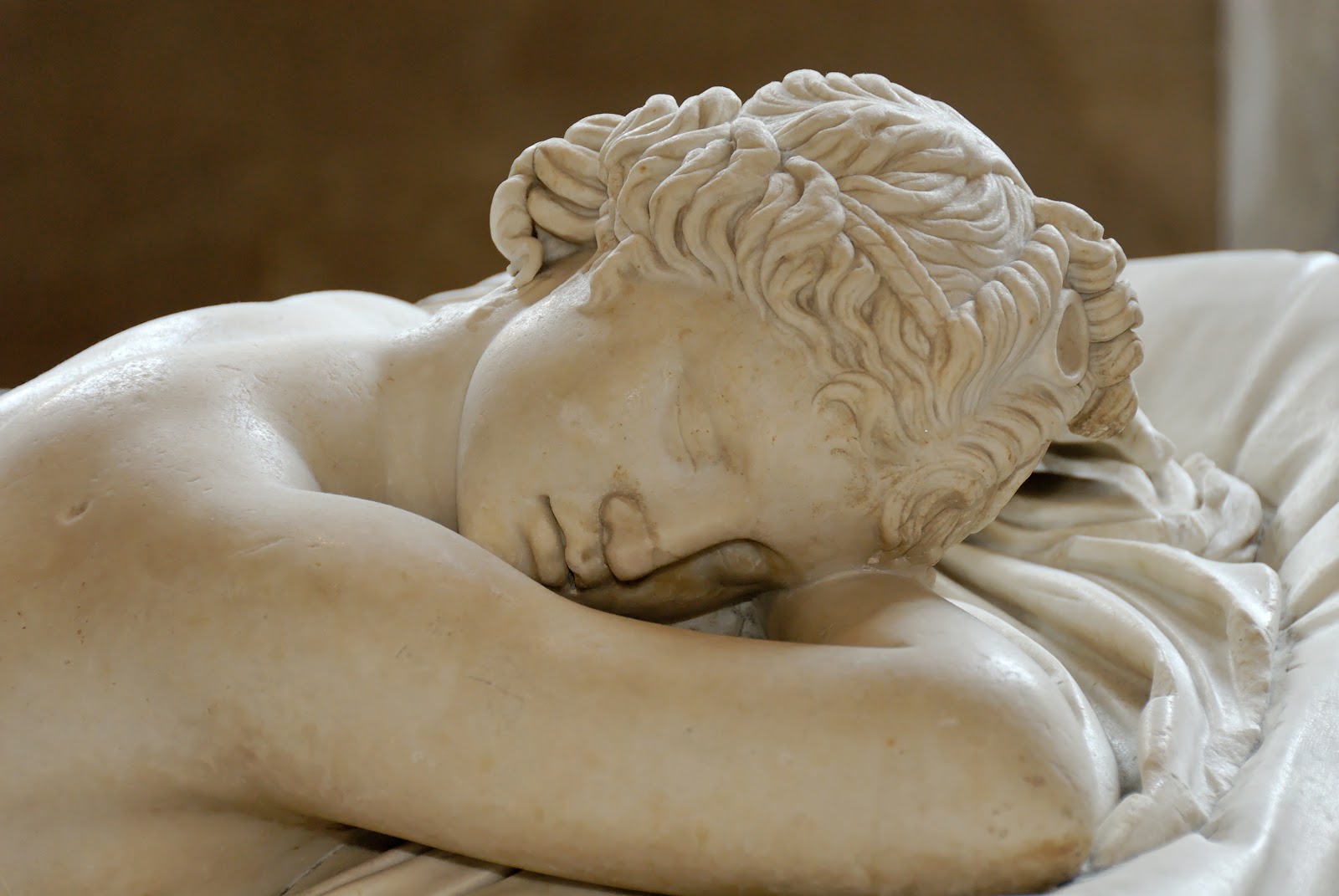
The ambivalence and voluptuous curves of this figure of Hermaphroditus, who lies asleep on a mattress sculpted by Bernini, are still a source of fascination today.
His body merged with that of the nymph Salmacis, whose advances he had rejected, Hermaphroditus, son of Hermes and Aphrodite, is represented as a bisexed figure.
The original that inspired this figure would have dated from the 2nd century BC, reflecting the late Hellenistic taste for the theatrical.

Department of Greek, Etruscan and Roman Antiquities: Hellenistic Art (3rd-1st centuries BC) Greek, Etruscan and Roman Antiquities - Musée du Louvre.

Read More

Sleeping Hermaphroditus / L'Ermafrodito dormiente

The ambivalence and voluptuous curves of this figure of Hermaphroditus, who lies asleep on a mattress sculpted by Bernini, are still a source of fascination today.
His body merged with that of the nymph Salmacis, whose advances he had rejected, Hermaphroditus, son of Hermes and Aphrodite, is represented as a bisexed figure.
The original that inspired this figure would have dated from the 2nd century BC, reflecting the late Hellenistic taste for the theatrical.

Department of Greek, Etruscan and Roman Antiquities: Hellenistic Art (3rd-1st centuries BC) Greek, Etruscan and Roman Antiquities - Musée du Louvre.

Winslow Homer | Summer Night / Notte d'estate, 1890

Winslow Homer | Summer Night / Notte d'estate, 1890

Winslow Homer started his career as a graphic reporter during the American Civil War, before going on to paint scenes of army life and the rural world with the Naturalist precision which then prevailed in American painting.
After a stay in Paris, Homer used an Impressionist palette for a while then developed a personal style midway between Realism and Symbolism.
Summer Night perfectly expresses this synthesis and may be considered one of the first masterpieces of American art still in search of its identity.

Winslow Homer | Summer Night / Notte d'estate, 1890 | Musée d'Orsay

Read More

Winslow Homer | Summer Night / Notte d'estate, 1890

Winslow Homer started his career as a graphic reporter during the American Civil War, before going on to paint scenes of army life and the rural world with the Naturalist precision which then prevailed in American painting.
After a stay in Paris, Homer used an Impressionist palette for a while then developed a personal style midway between Realism and Symbolism.
Summer Night perfectly expresses this synthesis and may be considered one of the first masterpieces of American art still in search of its identity.

Winslow Homer | Summer Night / Notte d'estate, 1890 | Musée d'Orsay

Lord Frederic Leighton | Cymon and Iphigenia, 1884

Lord Frederic Leighton | Cymon and Iphigenia, 1884

Cymon and Iphigenia is an oil on canvas painting by Frederic Leighton, 1st Baron Leighton PRA.
The painting does not bear a date but was first exhibited at the Royal Academy of Arts, London, in 1884.
The Art Gallery of New South Wales in Sydney, Australia, purchased it at a Christie's auction in London in 1976.


Read More

Lord Frederic Leighton | Cymon and Iphigenia, 1884

Cymon and Iphigenia is an oil on canvas painting by Frederic Leighton, 1st Baron Leighton PRA.
The painting does not bear a date but was first exhibited at the Royal Academy of Arts, London, in 1884.
The Art Gallery of New South Wales in Sydney, Australia, purchased it at a Christie's auction in London in 1976.


Carlo Crivelli | Santa Maria Maddalena, 1480

Carlo Crivelli | Santa Maria Maddalena, 1480

With Carlo Crivelli, the so-called "International Gothic" style experienced its final flowering in Italy.
This perfectly preserved panel was painted towards the end of his career.
It served as the altarpiece of a provincial church dedicated to Mary Magdalene in the sparsely populated rural area of the Marches where Crivelli lived. | Source: © Rijksmuseum, Amsterdam

Carlo Crivelli | Mary Magdalene, 1480 | Rijksmuseum, Amsterdam

Read More

Carlo Crivelli | Santa Maria Maddalena, 1480

With Carlo Crivelli, the so-called "International Gothic" style experienced its final flowering in Italy.
This perfectly preserved panel was painted towards the end of his career.
It served as the altarpiece of a provincial church dedicated to Mary Magdalene in the sparsely populated rural area of the Marches where Crivelli lived. | Source: © Rijksmuseum, Amsterdam

Carlo Crivelli | Mary Magdalene, 1480 | Rijksmuseum, Amsterdam

Narcissus by Boltraffio and after Boltraffio, 1500-1510

Narcissus by Boltraffio and after Boltraffio, 1500-1510

Narcissus at the Fountain is a 1500-1510 oil-on-panel painting by Giovanni Antonio Boltraffio, now in the Uffizi, in Florence.
A copy is held in the National Gallery, London.
Both works show a young man in profile, interpreted as Narcissus due to his downward gaze.

Giovanni Antonio Boltraffio | Narcissus at the Fountain | Uffizi Gallery, Florence

Read More

Narcissus by Boltraffio and after Boltraffio, 1500-1510

Narcissus at the Fountain is a 1500-1510 oil-on-panel painting by Giovanni Antonio Boltraffio, now in the Uffizi, in Florence.
A copy is held in the National Gallery, London.
Both works show a young man in profile, interpreted as Narcissus due to his downward gaze.

Giovanni Antonio Boltraffio | Narcissus at the Fountain | Uffizi Gallery, Florence

Giovanni Antonio Boltraffio | The Virgin and Child, 1493-1499

Giovanni Antonio Boltraffio | The Virgin and Child, 1493-1499

A grave, statuesque young woman gazes down at a positively enormous child, who lies sideways across her lap.
Her deep red gown is open to reveal her breast, which she offers to her son - though he seems uninterested.
He turns his head away from his mother to look out at the viewer, while playing with the beads which dangle from her scarf.
We know from their delicate haloes that these are the Virgin Mary and infant Christ, but this is a very modern Mary, painted in a newly realistic manner.
Boltraffio (Milan, 1467-1516) was Leonardo da Vinci’s most gifted pupil, and imitated his master in style and technique.


Read More

Giovanni Antonio Boltraffio | The Virgin and Child, 1493-1499

A grave, statuesque young woman gazes down at a positively enormous child, who lies sideways across her lap.
Her deep red gown is open to reveal her breast, which she offers to her son - though he seems uninterested.
He turns his head away from his mother to look out at the viewer, while playing with the beads which dangle from her scarf.
We know from their delicate haloes that these are the Virgin Mary and infant Christ, but this is a very modern Mary, painted in a newly realistic manner.
Boltraffio (Milan, 1467-1516) was Leonardo da Vinci’s most gifted pupil, and imitated his master in style and technique.