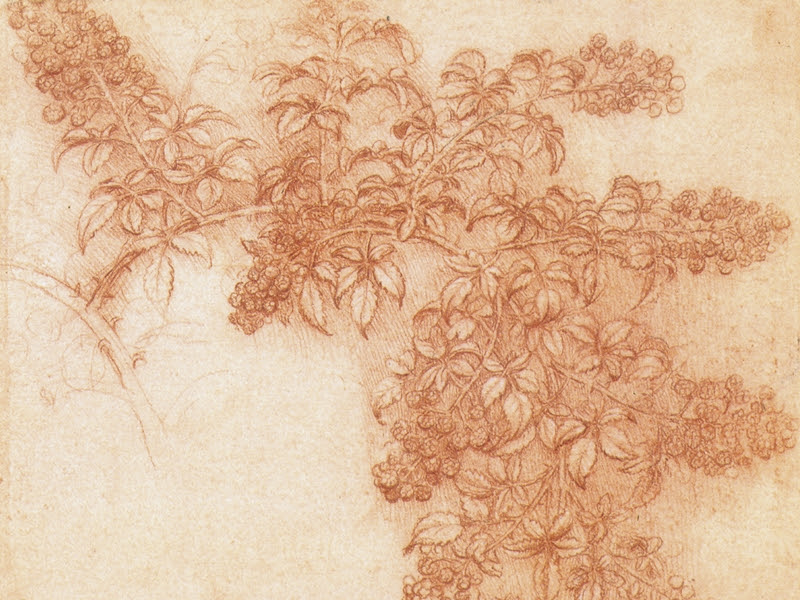
Leonardo da Vinci | Del verde delle foglie

Leonardo da Vinci | Del verde delle foglie

Trattato della Pittura
Parte sesta | Capitoli 841-867


Indice
841. Del centro degli alberi nella loro grossezza.
842. Qual pianta cresce nelle selve di piú continuata grossezza ed in maggiore altezza.
843. Qual pianta è di grossezza piú disforme e di minore altezza e piú dura.
844. Delle piante e legnami segati i quali mai per sé si piegheranno.
845. Delle aste che piú si mantengono diritte.
846. Delle crepature de' legni quando si seccano.
847. De' legni che non si scoppiano nel seccarsi.


Leonardo da Vinci | De' paesi in pittura

Leonardo da Vinci | De' paesi in pittura

Trattato della Pittura
Parte sesta | Capitoli 894-916


Indice
894. Delle erbe de' prati.
895. Dell'ombra della verdura.
896. De' paesi in pittura.
897. Perché le ombre de' rami fronzuti non si dimostrano potenti vicino alle loro parti luminose come nelle parti opposite.
898. Qual parte del ramo della pianta sarà piú oscura.
899. Della veduta degli alberi.
900. De' paesi.


Edgar Degas | Repasseuses / Le Stiratrici, 1884-1886

Edgar Degas | Repasseuses / Le Stiratrici, 1884-1886


Degas often made portraits of his family and friends but he was also an attentive observer of the working world in millinery workshops or laundries.
Only Daumier before him had taken an interest in washerwoman, who became one of Degas's favorite subjects between 1869-1895.
At first he painted single figures seen against the light, picked out sharply against the white linen.
Then, about 1884-1886, he dwelled more heavily on the subject, this time depicting two women in a laundry.

Vishma Maharaj, 1984 | Le squisite opere di vetro colorato

Vishma Maharaj, 1984 | Le squisite opere di vetro colorato

Vishma Maharaj è un'artista multimediale Americana che segue i propri sogni, interpretandoli su carta, per mezzo della Intelligenza Artificiale.
- "Sono una viaggiatrice dell'anima che condivide la propria esperienza attraverso la mia visione e prospettiva.
Sono la ragazzina che correva lungo la riva del mare lanciando stelle marine ed esprimendo desideri... che un giorno creerò cose che le persone adorerebbero.
Quei piccoli semi ora sono ciò di cui sono fatte le piante dei miei sogni..."


Vincent Van Gogh | The sowers series

Vincent Van Gogh | The sowers series


Peasant imagery and especially that of the 'Sower' was something that Van Gogh turned to numerous times throughout his career.
His affiliation with this subject was partly as a response to the work of the romantic Realists such as Millet, and a reflection of his own socialist ideals.
The sower in particular was a figure that Van Gogh saw in terms of representing the eternal cycle of agricultural life, of honorable endeavor and tradition, and symbolized these qualities to the artist.

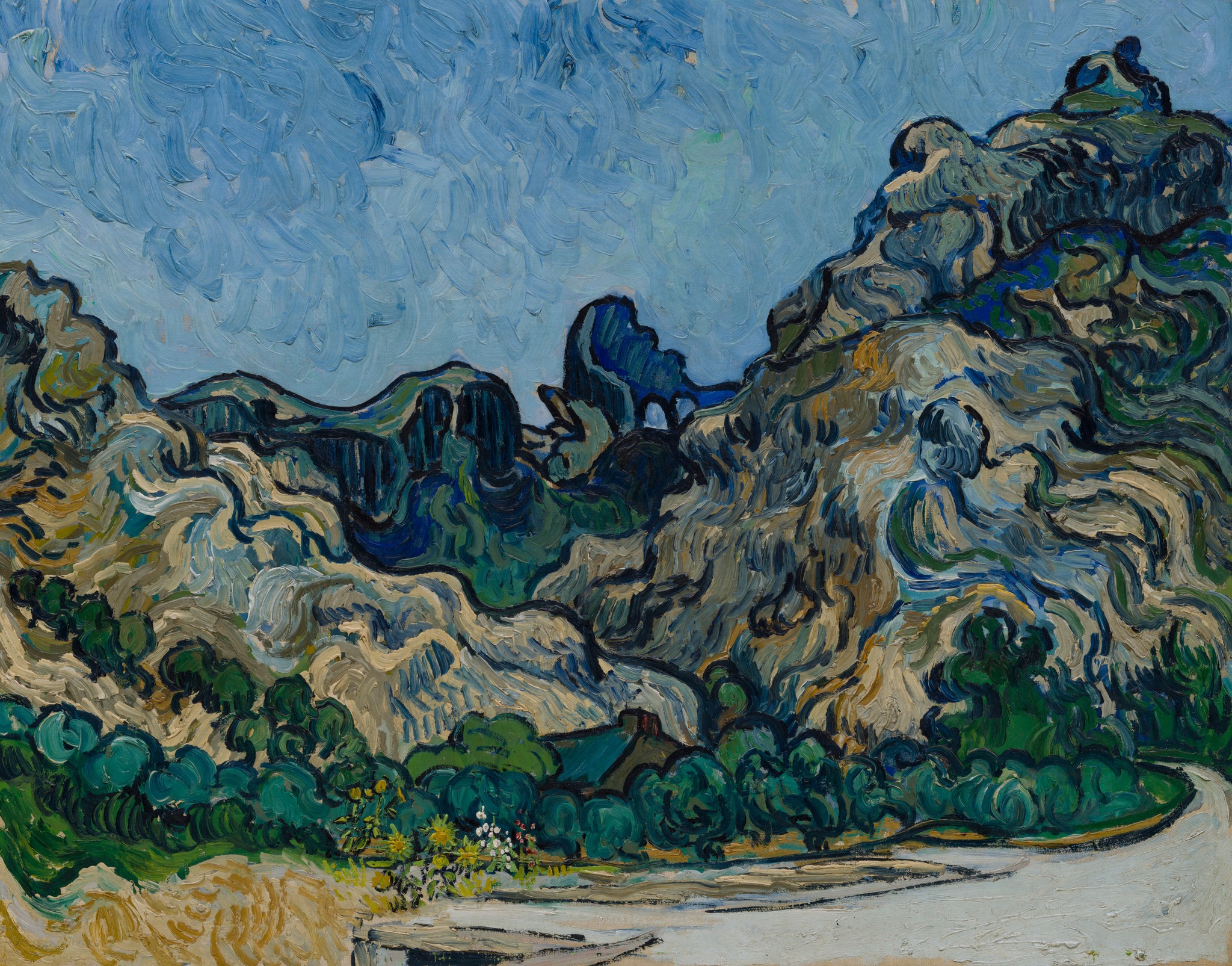
Vincent van Gogh | Mountains at Saint-Rémy, 1889

Vincent van Gogh | Mountains at Saint-Rémy, 1889

"Always continue walking a lot and loving nature, for that's the real way to learn to understand art better and better.
Painters understand nature and love it, and teach us to see" 
- Vincent van Gogh's letter to his brother Theo, 1874.

Vincent van Gogh | Mountains at Saint-Rémy, 1889 | Solomon R. Guggenheim Museum, New York

During the years preceding his suicide in 1890, Vincent van Gogh suffered increasingly frequent attacks of mental distress, the cause of which remains unclear.
"Mountains at Saint-Rémy" was painted in July 1889, when Van Gogh was recovering from just such an episode at the hospital of Saint-Paul-de-Mausole in the southern French town of Saint-Rémy.

Bruce Cohen, 1953

Bruce Cohen, 1953

Bruce Cohen is known for engaging his viewers with intriguing interiors in his distinctive, crisp, realist style.
Influenced by Dutch still-life painting and Surrealism he orchestrates compositions which include fruit, books, vases and always flowers from his garden.
These items are placed in geometric interiors devoid of human beings but haunted by a human presence.


Gustave Poetzsch | Belle Époque painter

Gustave Poetzsch | Belle Époque painter

Swiss painter of the Belle Époque, Gustave Poetzsch (1870-1950) was born in Neuchâtel where he started to learn painting very young.
Swiss mountains and lakes were the first inspiring influence for the young painter turned to nature.
As he wanted to improve his technique, he went to Paris in 1892 and joined the Julian Academy.
He entered the Fine Art School in 1895 and studied in the class of Gustave Moreau near Henri Matisse, Charles Camoin and Paul de Frick.