Textual description of firstImageUrl

Yannis Koutrikas, 1954 | Expressionist painter


Greek🎨 painter and sculptor Γιάννης Κούτρικας was born in Kalamata. From 1966-1978 he lived in Chicago, USA where studied Biology at the University of Illinois.
On his return to Greece, he studied painting in the National School of Fine Arts in Athens (1982-1987) under the supervision of Dimitris Mytaras. After graduating, he won a scholarship by the State Scholarship Institute for the Ecole Nationale Superieure des Beaux - Arts in Paris.

Textual description of firstImageUrl

Charles Bukowski | Che cosa diranno i vicini?

I miei genitori erano sempre dietro a
chiederlo,
naturalmente non mi importava un fico di
che cosa diranno i vicini.
mi facevano pena i vicini,
codardi che spiavano da dietro le
tendine.

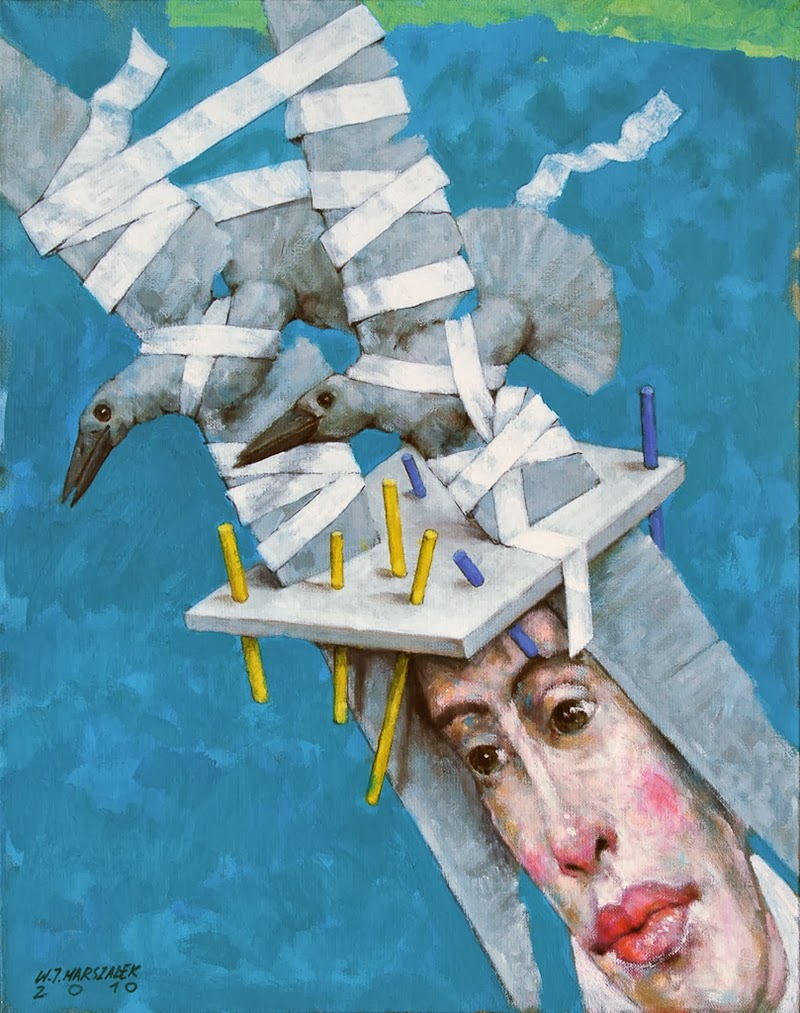
Waldemar J. Marszałek

Textual description of firstImageUrl

Salustiano Garcia Cruz, 1965

Spanish painter Salustiano García Cruz graduated from the University of Seville.
The paintings of this artist are red or white pictures in a pure concept of Renaissance style, transmitting calm through a detailed study of form and a clear brush stroke.
The characters are lone busts and faces over an empty and monochrome space, appearing like in dreams where everything turns red.


Textual description of firstImageUrl

Loui Jover, 1967 | Abstract /Surrealist painter


Loui Jover is an Australian based painter with a unique style of art. He basically uses ink on pages from vintage books to create eye-catching and emotionally charged images of women’s faces. His images also incorporate couples in intensely emotional states. His works have been hailed as truly creative and emotional. As an avid artist who draws every single day creating books of cartoons and drawings, Loui has travelled extensively all over Europe and Asia.

Textual description of firstImageUrl

Nefertiti, la Dea dell'Egitto

Il pezzo più pregiato della collezione di reperti archeologici egizi è senza dubbio il busto della regina Nefertiti.
C'è chi afferma che valga da solo un viaggio a Berlino.
Nefertiti, che per gli egiziani "la bella che è arrivata", identifica la regina egiziana (XIV secolo a.C.), sposa di Amenophis IV (Akhenaton, 1364-1347 a.C.).
Non si limitò ad interpretare il ruolo di grande sposa reale, poiché il faraone l’aveva coinvolta nella gestione del potere, e la sua influenza sulla guida politica del regno fu notevolissima.