Visualizzazione post con etichetta Michelangelo. Mostra tutti i post
Michelangelo | Bacchus, 1496-1497

Michelangelo | Bacchus, 1496-1497

Bacchus (1496-1497) is a marble sculpture by the Italian High Renaissance sculptor, painter, architect and poet Michelangelo Buonarroti.
The statue is somewhat over life-size and depicts Bacchus, the Roman god of wine, in a reeling pose suggestive of drunkenness.
Commissioned by Raffaele Riario, a high-ranking Cardinal and collector of antique sculpture, it was rejected by him and was bought instead by Jacopo Galli, Riario’s banker and a friend to Michelangelo.
Along with the Pietà the Bacchus is one of only two surviving sculptures from the artist's first period in Rome.


Read More

Michelangelo | Bacchus, 1496-1497

Bacchus (1496-1497) is a marble sculpture by the Italian High Renaissance sculptor, painter, architect and poet Michelangelo Buonarroti.
The statue is somewhat over life-size and depicts Bacchus, the Roman god of wine, in a reeling pose suggestive of drunkenness.
Commissioned by Raffaele Riario, a high-ranking Cardinal and collector of antique sculpture, it was rejected by him and was bought instead by Jacopo Galli, Riario’s banker and a friend to Michelangelo.
Along with the Pietà the Bacchus is one of only two surviving sculptures from the artist's first period in Rome.


Cappella Sistina | La Volta di Michelangelo, 1508-1512

Cappella Sistina | La Volta di Michelangelo, 1508-1512

"Senza aver visto la Cappella Sistina non è possibile formare un'idea apprezzabile di cosa un uomo solo sia in grado di ottenere" - Johann Wolfgang von Goethe

La decisione di Giulio II di rifare integralmente la decorazione della volta fu probabilmente dovuta ai gravi problemi di natura statica che interessarono la Sistina fin dai primi anni del suo pontificato (1503-1513).
Essi dovettero essere la conseguenza degli scavi eseguiti sia a nord che a sud dell’edificio per la costruzione della Torre Borgia e del nuovo San Pietro.
Dopo che nel maggio del 1504, una lunga crepa si aprì nella volta, fu incaricato Bramante, allora architetto di Palazzo, di porvi rimedio, il quale mise in opera alcune catene nel locale soprastante la Cappella.


Read More

Cappella Sistina | La Volta di Michelangelo, 1508-1512

"Senza aver visto la Cappella Sistina non è possibile formare un'idea apprezzabile di cosa un uomo solo sia in grado di ottenere" - Johann Wolfgang von Goethe

La decisione di Giulio II di rifare integralmente la decorazione della volta fu probabilmente dovuta ai gravi problemi di natura statica che interessarono la Sistina fin dai primi anni del suo pontificato (1503-1513).
Essi dovettero essere la conseguenza degli scavi eseguiti sia a nord che a sud dell’edificio per la costruzione della Torre Borgia e del nuovo San Pietro.
Dopo che nel maggio del 1504, una lunga crepa si aprì nella volta, fu incaricato Bramante, allora architetto di Palazzo, di porvi rimedio, il quale mise in opera alcune catene nel locale soprastante la Cappella.


The Sistine Chapel, Michelangelo's masterpiece, 1508-1512

The Sistine Chapel, Michelangelo's masterpiece, 1508-1512

Julius II's decision to completely renovate the decoration of the Ceiling was probably due to the serious problems of a static nature that affected the Sistine Chapel from the earliest years of his pontificate (1503-1513).
They must have been the result of the excavations carried out both to the north and to the south of the building for the construction of the Borgia Tower and for the new St Peter's.
After a long crack had opened in the Ceiling in May 1504, Bramante, then the Palace architect, was charged with finding a solution and he fixed some tie rods in the area above the Chapel.
However, the damage suffered by the old painting must have been such as to convince the pontiff to entrust Michelangelo with a new pictorial decoration.


Read More

The Sistine Chapel, Michelangelo's masterpiece, 1508-1512

Julius II's decision to completely renovate the decoration of the Ceiling was probably due to the serious problems of a static nature that affected the Sistine Chapel from the earliest years of his pontificate (1503-1513).
They must have been the result of the excavations carried out both to the north and to the south of the building for the construction of the Borgia Tower and for the new St Peter's.
After a long crack had opened in the Ceiling in May 1504, Bramante, then the Palace architect, was charged with finding a solution and he fixed some tie rods in the area above the Chapel.
However, the damage suffered by the old painting must have been such as to convince the pontiff to entrust Michelangelo with a new pictorial decoration.


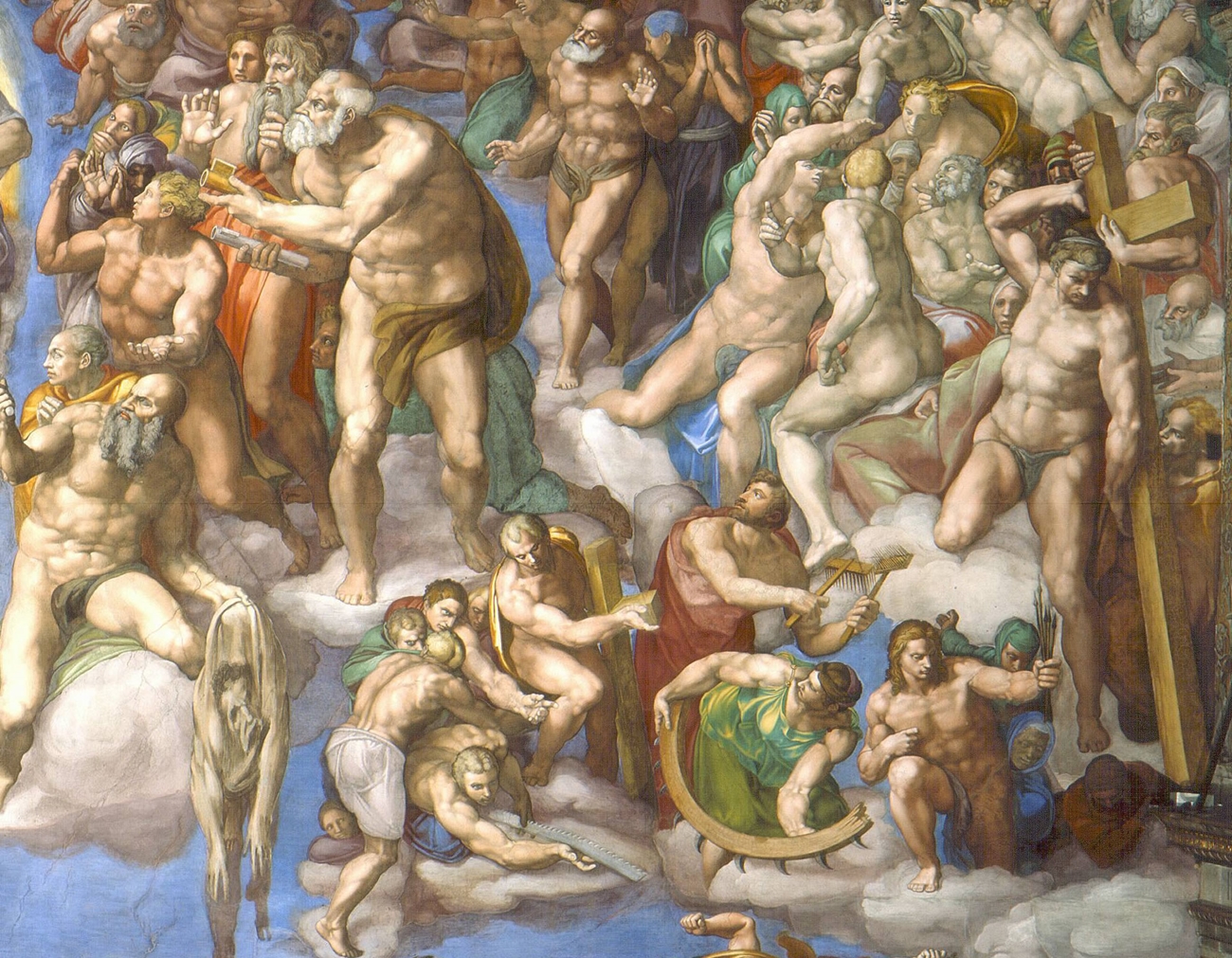
The Last Judgment, 1535-1541 (Michelangelo)

The Last Judgment, 1535-1541 (Michelangelo)

The mighty composition, painted by Michelangelo between 1536-1541, is centred around the dominant figure of Christ, captured in the moment preceding that when the verdict of the Last Judgement is uttered (Matthew 25:31-46).
His calm imperious gesture seems to both command attention and placate the surrounding agitation. It starts a wide slow rotary movement in which all the figures are involved.


Read More

The Last Judgment, 1535-1541 (Michelangelo)

The mighty composition, painted by Michelangelo between 1536-1541, is centred around the dominant figure of Christ, captured in the moment preceding that when the verdict of the Last Judgement is uttered (Matthew 25:31-46).
His calm imperious gesture seems to both command attention and placate the surrounding agitation. It starts a wide slow rotary movement in which all the figures are involved.


Michelangelo | The young Saint John the Baptist, 1495-1496

Michelangelo | The young Saint John the Baptist, 1495-1496

The biographies of Michelangelo by Vasari (1550) and Condivi (1553) recount that following the artist’s return to Florence from Bologna in 1495, his first commission was for a marble sculpture of a “San Giovannino” for Lorenzo di Pierfrancesco de’Medici (cousin of Lorenzo the Magnificent), now identified as the present work.
Rather than following the model of Donatello’s Saint John the Baptist (Florence, Museo del Bargello) as other Florentine sculptors had done, Michelangelo depicted the Baptist as much younger, no more than a boy of six or seven.


Read More

Michelangelo | The young Saint John the Baptist, 1495-1496

The biographies of Michelangelo by Vasari (1550) and Condivi (1553) recount that following the artist’s return to Florence from Bologna in 1495, his first commission was for a marble sculpture of a “San Giovannino” for Lorenzo di Pierfrancesco de’Medici (cousin of Lorenzo the Magnificent), now identified as the present work.
Rather than following the model of Donatello’s Saint John the Baptist (Florence, Museo del Bargello) as other Florentine sculptors had done, Michelangelo depicted the Baptist as much younger, no more than a boy of six or seven.


Why the Michelangelo's David statue is so famous?

Why the Michelangelo's David statue is so famous?

David is a masterpiece of Renaissance sculpture created between 1501-1504 by Michelangelo.
It is a 5.17-metre (17.0 ft)[a] marble statue of a standing male.
The statue represents the Biblical hero David, a favoured subject in the art of Florence.
Originally commissioned as one of a series of statues of prophets to be positioned along the roofline of the east end of Florence Cathedral, the statue was placed instead in a public square, outside the Palazzo della Signoria, the seat of civic government in Florence, where it was unveiled on 8 September 1504.


Read More

Why the Michelangelo's David statue is so famous?

David is a masterpiece of Renaissance sculpture created between 1501-1504 by Michelangelo.
It is a 5.17-metre (17.0 ft)[a] marble statue of a standing male.
The statue represents the Biblical hero David, a favoured subject in the art of Florence.
Originally commissioned as one of a series of statues of prophets to be positioned along the roofline of the east end of Florence Cathedral, the statue was placed instead in a public square, outside the Palazzo della Signoria, the seat of civic government in Florence, where it was unveiled on 8 September 1504.


Michelangelo Buonarroti | Vita ed Opere

Michelangelo Buonarroti | Vita ed Opere


Michelàngelo (o Michelàngiolo; propr. Michelàgnolo) Buonarroti - Architetto, scultore, pittore, poeta (Caprese, od. Caprese Michelangelo, Arezzo, 1475 - Roma 1564). Culmine della civiltà rinascimentale, celebrato come il massimo genio del suo tempo, ne rappresentò anche la drammatica conclusione. Apprendista dal 1487 nella bottega di D. Ghirlandaio, intorno al 1489 venne in contatto presso il giardino di S. Marco, domicilio della collezione di antichità della famiglia Medici, con la statuaria classica e la filosofia neoplatonica, componenti essenziali per lo sviluppo della sua produzione artistica.
Nel 1498 il cardinale J. Bilhères gli commissionò per la sua tomba in S. Petronilla a Roma la Pietà : per il carattere di perfetta armonia, grazia e bellezza, l'opera suscitò universale ammirazione. Tornato a Firenze, Michelàngelo realizzò la statua di David🎨(1501-04), quindi nel 1505 fu di nuovo a Roma per eseguire la tomba di Giulio II in S. Pietro, i cui tormentati lavori si sarebbero protratti per oltre quarant'anni.

Read More

Michelangelo Buonarroti | Vita ed Opere


Michelàngelo (o Michelàngiolo; propr. Michelàgnolo) Buonarroti - Architetto, scultore, pittore, poeta (Caprese, od. Caprese Michelangelo, Arezzo, 1475 - Roma 1564). Culmine della civiltà rinascimentale, celebrato come il massimo genio del suo tempo, ne rappresentò anche la drammatica conclusione. Apprendista dal 1487 nella bottega di D. Ghirlandaio, intorno al 1489 venne in contatto presso il giardino di S. Marco, domicilio della collezione di antichità della famiglia Medici, con la statuaria classica e la filosofia neoplatonica, componenti essenziali per lo sviluppo della sua produzione artistica.
Nel 1498 il cardinale J. Bilhères gli commissionò per la sua tomba in S. Petronilla a Roma la Pietà : per il carattere di perfetta armonia, grazia e bellezza, l'opera suscitò universale ammirazione. Tornato a Firenze, Michelàngelo realizzò la statua di David🎨(1501-04), quindi nel 1505 fu di nuovo a Roma per eseguire la tomba di Giulio II in S. Pietro, i cui tormentati lavori si sarebbero protratti per oltre quarant'anni.

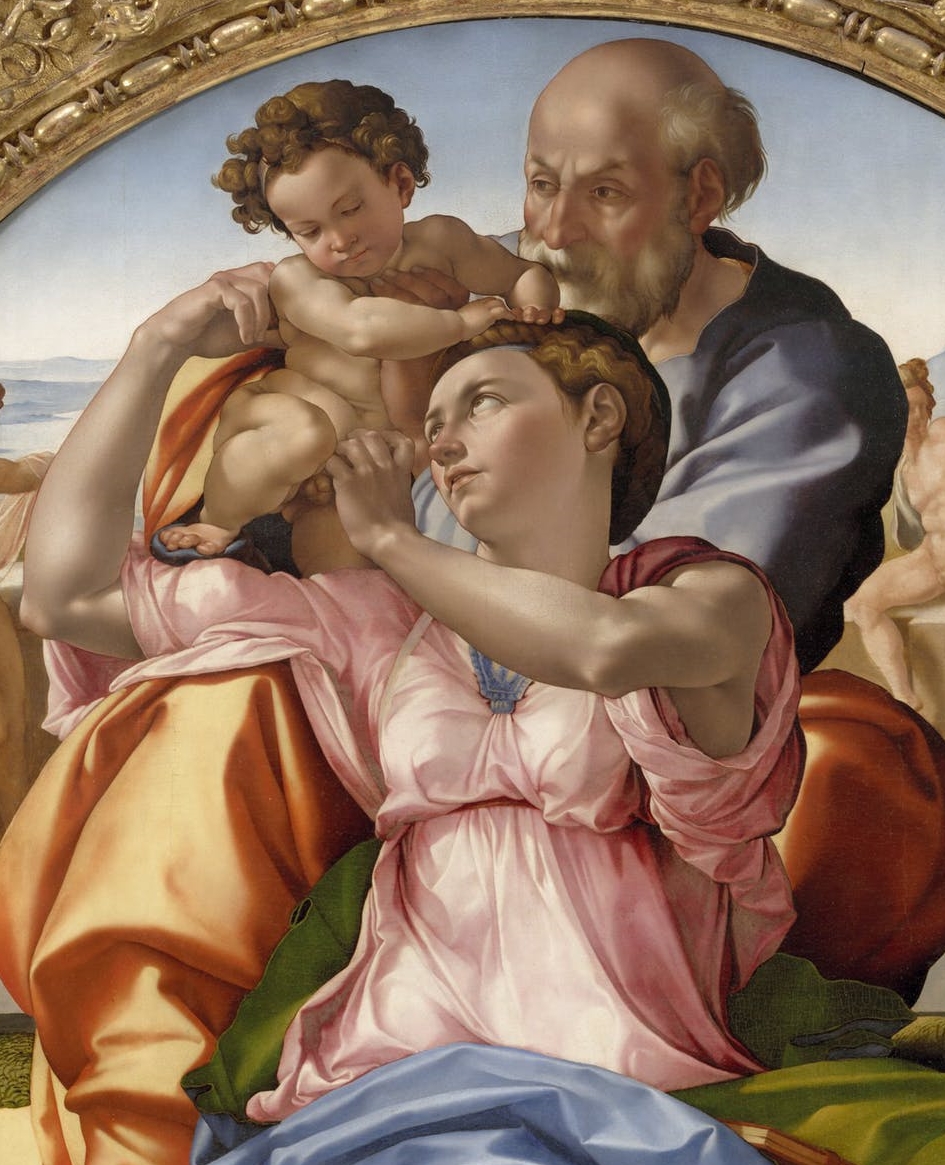
Michelangelo Buonarroti | Tondo Doni, 1505-1506

Michelangelo Buonarroti | Tondo Doni, 1505-1506


Michelangelo painted this Holy Family for a Florentine merchant, Agnolo Doni, whose prestigious marriage to Maddalena Strozzi in 1504 took place in a period that was crucial for early 16th-century Florentine art.
The presence in the city of Leonardo, Michelangelo and Raphael together, boosted the already lively Florentine art scene, which in the first decade of the century experienced a period of great cultural fervour.

Read More

Michelangelo Buonarroti | Tondo Doni, 1505-1506


Michelangelo painted this Holy Family for a Florentine merchant, Agnolo Doni, whose prestigious marriage to Maddalena Strozzi in 1504 took place in a period that was crucial for early 16th-century Florentine art.
The presence in the city of Leonardo, Michelangelo and Raphael together, boosted the already lively Florentine art scene, which in the first decade of the century experienced a period of great cultural fervour.

Michelangelo Buonarroti | Crouching Boy, 1530

Michelangelo Buonarroti | Crouching Boy, 1530


Author: Michelangelo Buonarroti (Italian High Renaissance / Mannerist Painter / Sculptor, 1475-1564)
Title: Crouching Boy
Place: Italy. Florence
Date: circa 1530-1534
Material: marble
Dimensions: height: 54 cm
Acquisition date: Entered the Hermitage in 1851; transferred from the Academy of Fine Arts

Read More

Michelangelo Buonarroti | Crouching Boy, 1530


Author: Michelangelo Buonarroti (Italian High Renaissance / Mannerist Painter / Sculptor, 1475-1564)
Title: Crouching Boy
Place: Italy. Florence
Date: circa 1530-1534
Material: marble
Dimensions: height: 54 cm
Acquisition date: Entered the Hermitage in 1851; transferred from the Academy of Fine Arts

Michelangelo Buonarroti | Giunto è già 'l corso della vita mia | Sonetto 285

Michelangelo Buonarroti | Giunto è già 'l corso della vita mia | Sonetto 285

Giunto è già 'l corso della vita mia
Per tempestoso mar con fragil barca
Al comun porto , ov'a render si varca
Conto e ragion d'ogni opra trista e pia.


Read More

Michelangelo Buonarroti | Giunto è già 'l corso della vita mia | Sonetto 285

Giunto è già 'l corso della vita mia
Per tempestoso mar con fragil barca
Al comun porto , ov'a render si varca
Conto e ragion d'ogni opra trista e pia.


Michelangelo Buonarroti: "Non ha l'ottimo artista alcun concetto" | Sonetto 151

Michelangelo Buonarroti: "Non ha l'ottimo artista alcun concetto" | Sonetto 151

Non ha l’ottimo artista alcun concetto
c’un marmo solo in sé non circonscriva
col suo superchio, e solo a quello arriva
la man che ubbidisce all’intelletto.


Read More

Michelangelo Buonarroti: "Non ha l'ottimo artista alcun concetto" | Sonetto 151

Non ha l’ottimo artista alcun concetto
c’un marmo solo in sé non circonscriva
col suo superchio, e solo a quello arriva
la man che ubbidisce all’intelletto.


Michelangelo: "The marble not yet carved can hold the form of every thought the greatest artist has"

Michelangelo: "The marble not yet carved can hold the form of every thought the greatest artist has"

"My soul can find no staircase to Heaven unless it be through Earth's loveliness".
"The best artist has that thought alone which is contained within the marble shell; The sculptor's hand can only break the spell To free the figures slumbering in the stone".
"The best of artists has no conception that the marble alone does not contain within itself".


Read More

Michelangelo: "The marble not yet carved can hold the form of every thought the greatest artist has"

"My soul can find no staircase to Heaven unless it be through Earth's loveliness".
"The best artist has that thought alone which is contained within the marble shell; The sculptor's hand can only break the spell To free the figures slumbering in the stone".
"The best of artists has no conception that the marble alone does not contain within itself".


Michelangelo Buonarroti | S'egli è che 'n dura pietra alcun somigli | Sonetto 242

Michelangelo Buonarroti | S'egli è che 'n dura pietra alcun somigli | Sonetto 242

S’egli è che ’n dura pietra alcun somigli
talor l’immagin d’ogni altri a se stesso,
squalido e smorto spesso
il fo, com’i’ son fatto da costei.
E par ch’esempro pigli
ognor da me, ch’i’ penso di far lei.


Read More

Michelangelo Buonarroti | S'egli è che 'n dura pietra alcun somigli | Sonetto 242

S’egli è che ’n dura pietra alcun somigli
talor l’immagin d’ogni altri a se stesso,
squalido e smorto spesso
il fo, com’i’ son fatto da costei.
E par ch’esempro pigli
ognor da me, ch’i’ penso di far lei.


Michelangelo Buonarroti | Life and Sculptures

Michelangelo Buonarroti | Life and Sculptures

Michelangelo, in full Michelangelo di Lodovico Buonarroti Simoni (1475, Caprese, Republic of Florence -died February 18, 1564, Rome, Papal States) Italian Renaissance sculptor, painter, architect and poet who exerted an unparalleled influence on the development of Western art.
Michelangelo was considered the greatest living artist in his lifetime, and ever since then he has been held to be one of the greatest artists of all time.
A number of his works in painting, sculpture, and architecture rank among the most famous in existence.


Read More

Michelangelo Buonarroti | Life and Sculptures

Michelangelo, in full Michelangelo di Lodovico Buonarroti Simoni (1475, Caprese, Republic of Florence -died February 18, 1564, Rome, Papal States) Italian Renaissance sculptor, painter, architect and poet who exerted an unparalleled influence on the development of Western art.
Michelangelo was considered the greatest living artist in his lifetime, and ever since then he has been held to be one of the greatest artists of all time.
A number of his works in painting, sculpture, and architecture rank among the most famous in existence.


Michelangelo | Pietà for Vittoria Colonna, 1538-44

Michelangelo | Pietà for Vittoria Colonna, 1538-44

"The Pietà for Vittoria Colonna" is a black chalk drawing on cardboard (28.9×18.9 cm) by Michelangelo Buonarroti, dated to about 1538-44 and kept at the Isabella Stewart Gardner Museum in Boston.

History

Michelangelo became acquainted with Vittoria Colonna (1492-1547, marchioness of Pescara, was an Italian noblewoman and poet) around 1538.
Their lively friendship gained Michelangelo admission to her social circles, and he became acquainted with issues of church reform.
For Colonna, Michelangelo executed several paintings in the fifth decade of the sixteenth century.
All of them are now lost or of controversial attribution, but several sketches and copies by students and admirers of Michelangelo have been preserved.
Apart from a famous Crucifixion, Michelangelo's most notable work for Vittoria Colonna is a Pietà, of which a remarkable drawing is exhibited at Boston.


Read More

Michelangelo | Pietà for Vittoria Colonna, 1538-44

"The Pietà for Vittoria Colonna" is a black chalk drawing on cardboard (28.9×18.9 cm) by Michelangelo Buonarroti, dated to about 1538-44 and kept at the Isabella Stewart Gardner Museum in Boston.

History

Michelangelo became acquainted with Vittoria Colonna (1492-1547, marchioness of Pescara, was an Italian noblewoman and poet) around 1538.
Their lively friendship gained Michelangelo admission to her social circles, and he became acquainted with issues of church reform.
For Colonna, Michelangelo executed several paintings in the fifth decade of the sixteenth century.
All of them are now lost or of controversial attribution, but several sketches and copies by students and admirers of Michelangelo have been preserved.
Apart from a famous Crucifixion, Michelangelo's most notable work for Vittoria Colonna is a Pietà, of which a remarkable drawing is exhibited at Boston.


Giorgio Vasari racconta Michelangelo Buonarroti, 1550

Giorgio Vasari racconta Michelangelo Buonarroti, 1550

Mentre gli industriosi et egregii spiriti col lume del famosissimo Giotto e de gli altri seguaci suoi si sforzavano dar saggio al mondo de ’l valore che la benignità delle stelle e la proporzionata mistione degli umori aveva dato a gli ingegni loro e, desiderosi di imitare con la eccellenzia della arte la grandezza della natura, per venire il piú che e’ potevano a quella somma cognizione che molti chiamano intelligenzia, universalmente, ancora che indarno si affaticavano, il benignissimo Rettor del Cielo volse clemente gli occhi a la terra e, veduta la vana infinità di tante fatiche, gli ardentissimi studii senza alcun frutto e la opinione prosuntuosa degli uomini, assai piú lontana da ’l vero che le tenebre da la luce, per cavarci di tanti errori si dispose mandare in terra uno spirito, che universalmente in ciascheduna arte et in ogni professione fusse abile, operando per sé solo a mostrare che cosa siano le difficultà nella scienza delle linee, nella pittura, nel giudizio della scultura e nella invenzione della veramente garbata architettura.


Read More

Giorgio Vasari racconta Michelangelo Buonarroti, 1550

Mentre gli industriosi et egregii spiriti col lume del famosissimo Giotto e de gli altri seguaci suoi si sforzavano dar saggio al mondo de ’l valore che la benignità delle stelle e la proporzionata mistione degli umori aveva dato a gli ingegni loro e, desiderosi di imitare con la eccellenzia della arte la grandezza della natura, per venire il piú che e’ potevano a quella somma cognizione che molti chiamano intelligenzia, universalmente, ancora che indarno si affaticavano, il benignissimo Rettor del Cielo volse clemente gli occhi a la terra e, veduta la vana infinità di tante fatiche, gli ardentissimi studii senza alcun frutto e la opinione prosuntuosa degli uomini, assai piú lontana da ’l vero che le tenebre da la luce, per cavarci di tanti errori si dispose mandare in terra uno spirito, che universalmente in ciascheduna arte et in ogni professione fusse abile, operando per sé solo a mostrare che cosa siano le difficultà nella scienza delle linee, nella pittura, nel giudizio della scultura e nella invenzione della veramente garbata architettura.


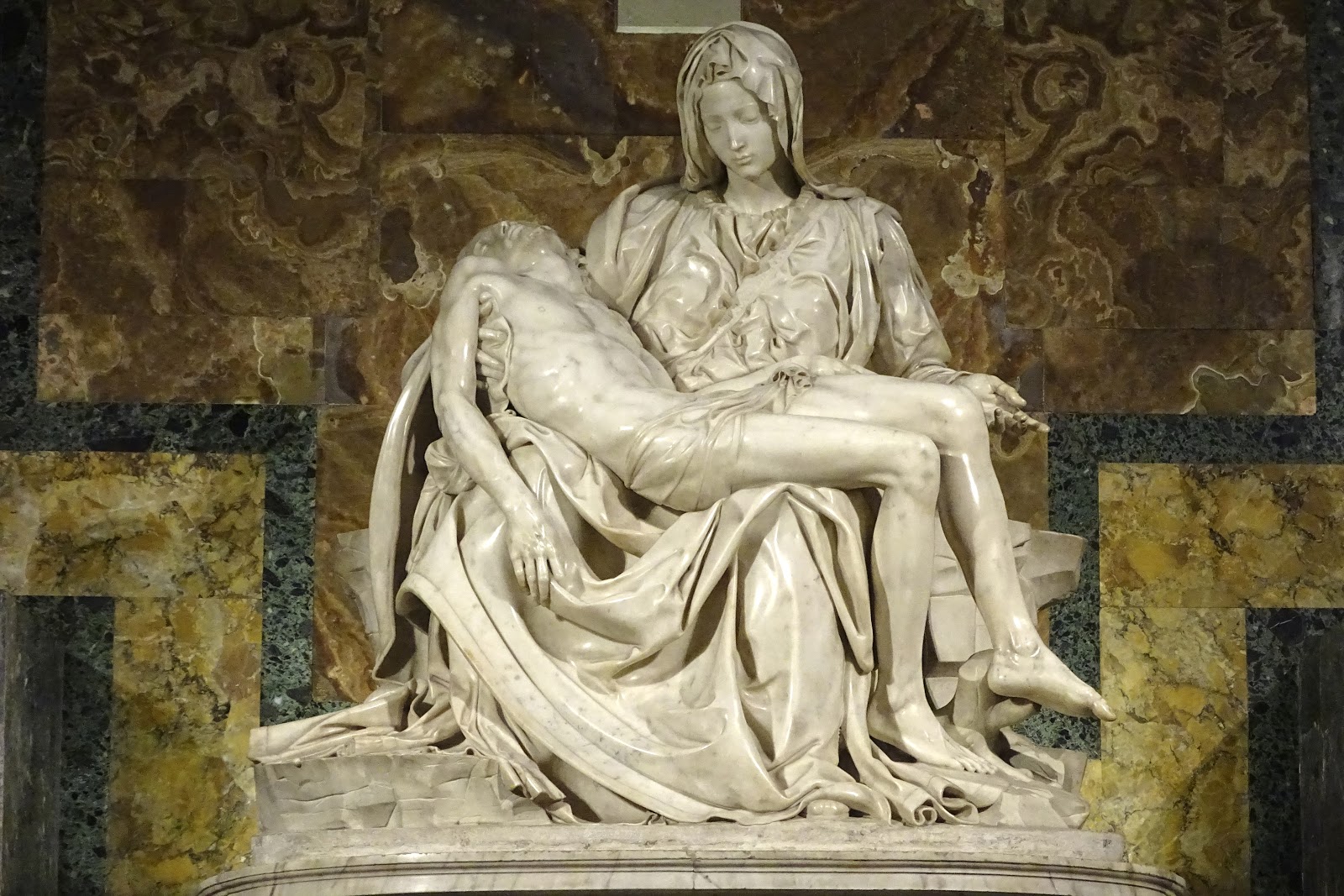
Michelangelo | La pietà / The Pity, 1498-1499

Michelangelo | La pietà / The Pity, 1498-1499

The Pietà is a work of Renaissance sculpture by Michelangelo Buonarroti, housed in St. Peter's Basilica, Vatican City. It is the first of a number of works of the same theme by the artist.
The statue was commissioned for the French Cardinal Jean de Bilhères, who was a representative in Rome.
The sculpture, in Carrara marble, was made for the cardinal's funeral monument, but was moved to its current location, the first chapel on the right as one enters the basilica, in the 18th century. It is the only piece Michelangelo ever signed.


Read More

Michelangelo | La pietà / The Pity, 1498-1499

The Pietà is a work of Renaissance sculpture by Michelangelo Buonarroti, housed in St. Peter's Basilica, Vatican City. It is the first of a number of works of the same theme by the artist.
The statue was commissioned for the French Cardinal Jean de Bilhères, who was a representative in Rome.
The sculpture, in Carrara marble, was made for the cardinal's funeral monument, but was moved to its current location, the first chapel on the right as one enters the basilica, in the 18th century. It is the only piece Michelangelo ever signed.


Michelangelo Buonarroti | Quotes

Michelangelo Buonarroti | Quotes

  • A man paints with his brains and not with his hands.
  • Every block of stone has a statue inside it and it is the task of the sculptor to discover it.
  • The greater danger for most of us lies not in setting our aim too high and falling short; but in setting our aim too low, and achieving our mark.
  • My soul can find no staircase to Heaven unless it be through Earth's loveliness.
Read More

Michelangelo Buonarroti | Quotes

  • A man paints with his brains and not with his hands.
  • Every block of stone has a statue inside it and it is the task of the sculptor to discover it.
  • The greater danger for most of us lies not in setting our aim too high and falling short; but in setting our aim too low, and achieving our mark.
  • My soul can find no staircase to Heaven unless it be through Earth's loveliness.
Alda Merini / Michelangelo | Bambino..

Alda Merini / Michelangelo | Bambino..

Bambino,
se trovi l'aquilone della tua fantasia
legalo con l'intelligenza del cuore.
Vedrai sorgere giardini incantati
e tua madre diventerà una pianta
che ti coprirà con le sue foglie.

Michelangelo Buonarroti 1475-1564 | La Madonna di Bruges 1503-1505
Michelangelo Buonarroti | La Madonna di Bruges 1503-1505

Read More

Alda Merini / Michelangelo | Bambino..

Bambino,
se trovi l'aquilone della tua fantasia
legalo con l'intelligenza del cuore.
Vedrai sorgere giardini incantati
e tua madre diventerà una pianta
che ti coprirà con le sue foglie.

Michelangelo Buonarroti 1475-1564 | La Madonna di Bruges 1503-1505
Michelangelo Buonarroti | La Madonna di Bruges 1503-1505

Michelangelo | Il risorto, 1520

Michelangelo | Il risorto, 1520

Il Risorto, conosciuto come il Cristo della Minerva, è una statua marmorea, h. 205 cm, di Michelangelo Buonarroti 1475-1564, realizzata nel 1519-1520 circa, oggi conservata nella Basilica di Santa Maria sopra Minerva a Roma.

Basilica di santa Maria sopra Minerva, Roma
Read More

Michelangelo | Il risorto, 1520

Il Risorto, conosciuto come il Cristo della Minerva, è una statua marmorea, h. 205 cm, di Michelangelo Buonarroti 1475-1564, realizzata nel 1519-1520 circa, oggi conservata nella Basilica di Santa Maria sopra Minerva a Roma.

Basilica di santa Maria sopra Minerva, Roma