

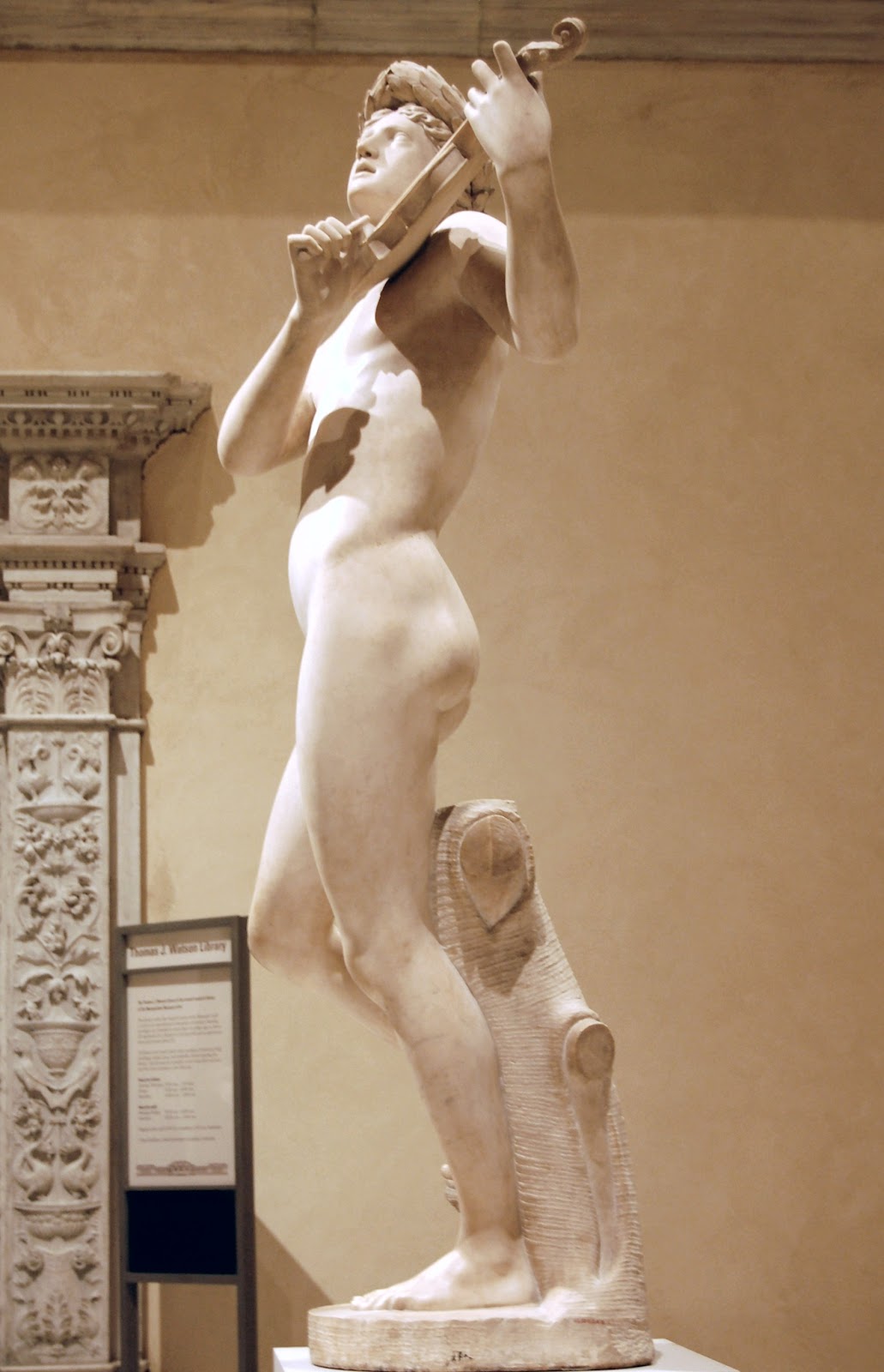
Orpheus by Italian sculptor Cristoforo Stati / Cristofano da Bracciano (1556-1619), famous for taming beasts with his music, is here shown entertaining himself, his body swaying to the sound of the lira da braccio.
The statue was carved for the Palazzo Corsi, Florence. | © The Metropolitan Museum of Art

Orfeo é un marmo realizzato tra il 1600-1601 dallo scultore Italiano Cristoforo Stati, noto anche come Cristofano da Bracciano (1556-1619).
Attualmente presso il Metropolitan Museum di New York, questo lavoro è stato originariamente realizzato per il Palazzo Corsi di Firenze.
Cristoforo Stati was an Italian sculptor and restorer, also called Cristofano da Bracciano.
He was a little-known sculptor who also worked on the restoration of marble works excavated from archaeological sites.
He trained in Florence in the circle of Bartolomeo Ammanati and Giambologna.
This provided a Mannerist environment in which Stati acquired a good command of his craft and a certain elegance of style.
Only a few of his works have been identified.
These suggest that he was imbued with Classical culture, and wanted to recreate the artistic period that was recognized as a model of perfection: the Classicism of the age of Hadrian.
During his time in Florence, between 1604 and October 1607, he carved the fountain with Samson Stopping the Lion's Mouth (Aranjuez, Jardín de la Isla).

This formed a pair with another group, by Giambologna (Samson and a Philistine, 1565-70; London, Victoria and Albert Museum), which has been identified with a work in the gardens of Aranjuez Palace in Spain.
During the same period he carved the group of Venus and Adonis (Bracciano, Palazzo) which was presented by the artist to his native town, as is attested by an original document held in the Archivio Comunale in Bracciano.
The figure of Adonis takes its inspiration from a Roman copy of a statue of Antinous, while the Venus recalls a Classical type elaborated by Giambologna.

Cristoforo Stati | Venere e Adone, 1600-1610
"Venere e Adone" è una celebre scultura in marmo realizzata dall'artista barocco Cristoforo Stati, databile tra il 1600 ed il 1610 circa.
L'opera è custodita ed esposta all'interno del Museo Civico di Bracciano, presumibilmente donata dallo scultore stesso alla sua città natale..

La scultura ritrae un momento intimo tratto dalle Metamorfosi di Ovidio: l'amore tra la dea della bellezza Venere ed il giovane e bellissimo cacciatore Adone.
Al contrario di altre trasposizioni artistiche focalizzate sul tragico distacco prima della caccia mortale del giovane, l'opera di Stati cattura una dimensione di profonda tenerezza e vicinanza fisica tra i due corpi.

 Facebook
 X
X
 LinkedIn
 Telegram
 WhatsApp
 Iscriviti al canale