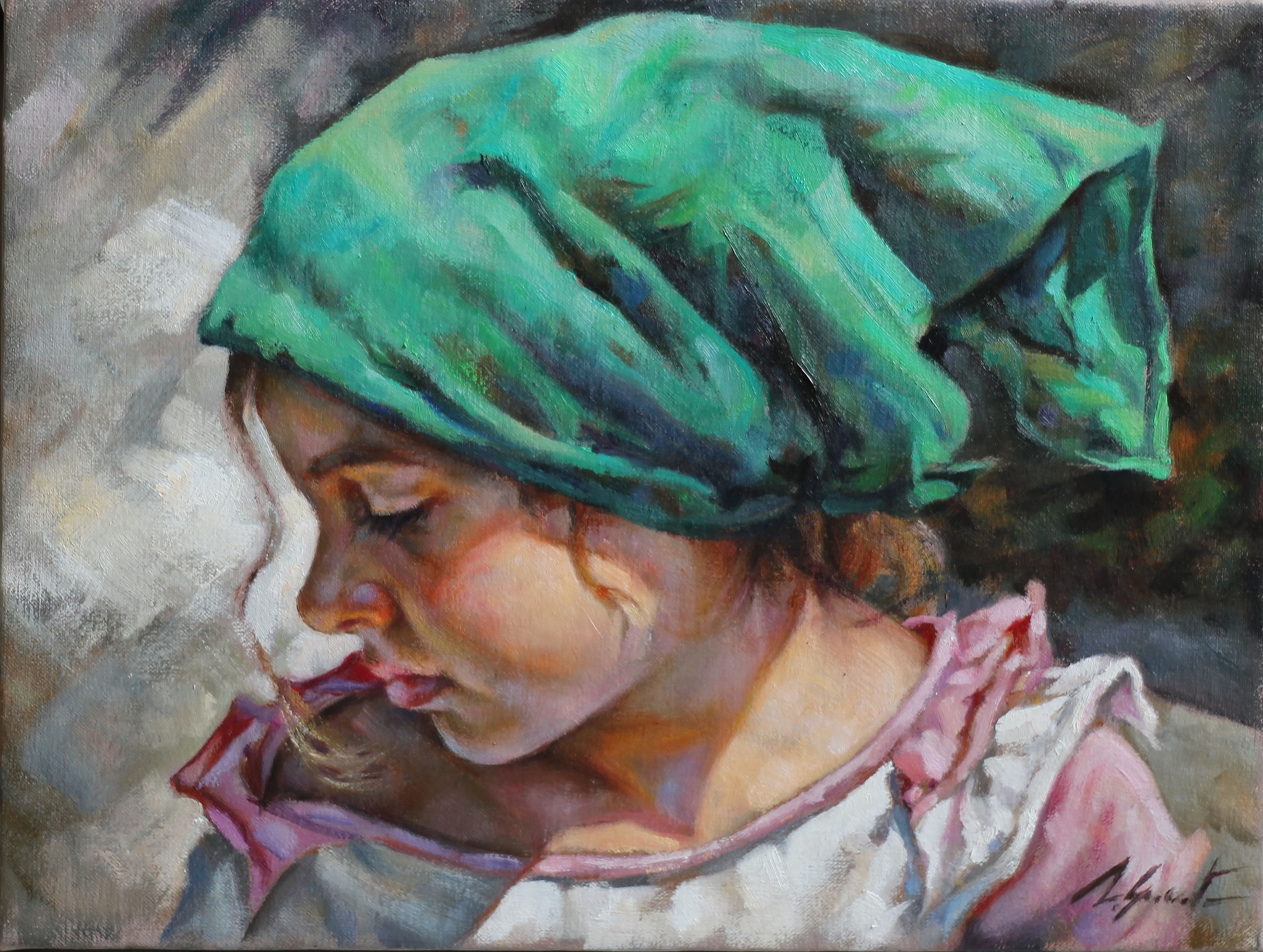
Alessandro Granata | Genre painter

Alessandro Granata | Genre painter


Neapolitan artist🎨 Alessandro Granata was born in Salerno. He showed a strong passion for painting from an early age. He graduated at the Art High School in Naples.
He was awarded the "Alfonso Gatto" award🎨 the graphic and painting section, by the Province of Salerno.
The artist made large-scale sacred-themed paintings.
In 2020 he participated in the collective exhibition "Le Madonna di Raffaello" at the diocesan museum of Salerno, where he received the "Special Jury" award.

Read More

Alessandro Granata | Genre painter


Neapolitan artist🎨 Alessandro Granata was born in Salerno. He showed a strong passion for painting from an early age. He graduated at the Art High School in Naples.
He was awarded the "Alfonso Gatto" award🎨 the graphic and painting section, by the Province of Salerno.
The artist made large-scale sacred-themed paintings.
In 2020 he participated in the collective exhibition "Le Madonna di Raffaello" at the diocesan museum of Salerno, where he received the "Special Jury" award.

Merab Gagiladze, 1972 | Fantasy / Surrealist painter

Merab Gagiladze, 1972 | Fantasy / Surrealist painter


Georgian artist Merab Gagiladze was born in Tbilisi.
In 1987 he began his formal art education at the Tbilisi College of Art, School of Ceramics.
In 1990 he continued his studies at the prestigious Tbilisi State Academy of Fine Arts and graduated in 1996 with a degree in Graphic Art.

Read More

Merab Gagiladze, 1972 | Fantasy / Surrealist painter


Georgian artist Merab Gagiladze was born in Tbilisi.
In 1987 he began his formal art education at the Tbilisi College of Art, School of Ceramics.
In 1990 he continued his studies at the prestigious Tbilisi State Academy of Fine Arts and graduated in 1996 with a degree in Graphic Art.

Mark Kostabi, 1960 | Pop Symbolism painter

Mark Kostabi, 1960 | Pop Symbolism painter


Painter and Composer Mark Kostabi was born in Los Angeles to Estonian immigrants. Raised in Whittier, California, he studied drawing and painting at California State University, Fullerton.
Kostabi moved to New York in 1982, and by 1984, emerged as a leading figure in the East Village art scene where he cultivated a provocative media persona by publishing self-interviews reflecting on the commodification of contemporary art.
By 1987, his work was widely exhibited in New York galleries as well as prominently throughout the United States, Japan, Germany and Australia.
He inspired extensive international press coverage in 1988 when he founded Kostabi World, his Manhattan art studio, which employs numerous painting assistants and idea people.
Beginning in the early 1990s Kostabi's work has been widely exhibited throughout Italy. Kostabi established a second home in Rome in 1996. Dividing his time between Rome and New York enabled him to dramatically enhance his presence in the Italian art scene.

Read More

Mark Kostabi, 1960 | Pop Symbolism painter


Painter and Composer Mark Kostabi was born in Los Angeles to Estonian immigrants. Raised in Whittier, California, he studied drawing and painting at California State University, Fullerton.
Kostabi moved to New York in 1982, and by 1984, emerged as a leading figure in the East Village art scene where he cultivated a provocative media persona by publishing self-interviews reflecting on the commodification of contemporary art.
By 1987, his work was widely exhibited in New York galleries as well as prominently throughout the United States, Japan, Germany and Australia.
He inspired extensive international press coverage in 1988 when he founded Kostabi World, his Manhattan art studio, which employs numerous painting assistants and idea people.
Beginning in the early 1990s Kostabi's work has been widely exhibited throughout Italy. Kostabi established a second home in Rome in 1996. Dividing his time between Rome and New York enabled him to dramatically enhance his presence in the Italian art scene.

Antonietta Varallo, 1954 | Landscape painter

Antonietta Varallo, 1954 | Landscape painter


Born in Talsamo (Taranto province, Southern Italy) and a livornese adoptee, Antonietta Varallo approaches painting when she was just fifteen. Varallo, for one year, attended at the Free Academy "Trossi-Uberti" directed by Voltolino Fontani, then the maestro Luciano Torsi has been her guide up to her artistic maturity after eighteen years of teaching.
On 1976 Varallo won the first prize🎨 "Chimera" held in the city of Arezzo (Tuscany).
Nowadays she’s still a honorary professor of the Academy of "Machiavello" in Florence as well as in the Academy "G. Marconi" in Bologna.

Read More

Antonietta Varallo, 1954 | Landscape painter


Born in Talsamo (Taranto province, Southern Italy) and a livornese adoptee, Antonietta Varallo approaches painting when she was just fifteen. Varallo, for one year, attended at the Free Academy "Trossi-Uberti" directed by Voltolino Fontani, then the maestro Luciano Torsi has been her guide up to her artistic maturity after eighteen years of teaching.
On 1976 Varallo won the first prize🎨 "Chimera" held in the city of Arezzo (Tuscany).
Nowadays she’s still a honorary professor of the Academy of "Machiavello" in Florence as well as in the Academy "G. Marconi" in Bologna.

Angelo Morbelli | For 80 cents!, 1895

Angelo Morbelli | For 80 cents!, 1895

Angelo Morbelli's work, one of the masterpieces of the Burgundy Museum, was purchased in 1912 at the Art Exhibition of the irrigated countryside held in Vercelli, a few years after the Museum opened to the public.
The painting, signed and dated 1895, underwent a long and tormented elaboration, as evidenced by the correspondence between the artist and his colleague Giuseppe Pellizza da Volpedo: begun in 1893, it was resumed before being exhibited in 1895 at the Venice Biennale.
The canvas assumes an important role for the collection, not only for its belonging to the pictorial current of Divisionism, but above all for the subject strongly connected to the Vercelli area.


Read More

Angelo Morbelli | For 80 cents!, 1895

Angelo Morbelli's work, one of the masterpieces of the Burgundy Museum, was purchased in 1912 at the Art Exhibition of the irrigated countryside held in Vercelli, a few years after the Museum opened to the public.
The painting, signed and dated 1895, underwent a long and tormented elaboration, as evidenced by the correspondence between the artist and his colleague Giuseppe Pellizza da Volpedo: begun in 1893, it was resumed before being exhibited in 1895 at the Venice Biennale.
The canvas assumes an important role for the collection, not only for its belonging to the pictorial current of Divisionism, but above all for the subject strongly connected to the Vercelli area.