Textual description of firstImageUrl

Albert Williams (1922-2010) Floral still-life painter


British painter🎨 Albert Williams was a painter of flowers in the tradition of the seventeenth century Flemish School of painters.
Williams was born in 1922 in Sussex, England. His father and grandfather were his first teachers.
As a boy in Brighton he attended Brighton School of Art, moving to London where he was employed by Sanderson's in their studio.


After the Second World War, he returned to Brighton to make a career as an artist.
Still life studies of flowers suited his natural abilities as a draughtsman and colourist.
His work has been exhibited at the Fine Art Society, the London galleries of Frost and Reed and the Omell Galleries and the Summer Exhibitions at the Royal Academy.
Albert Williams' paintings of flowers have a photographic realism, and each petal has lifelike detailed veins and coloring.
In 1955 he exhibited at the Paris Salon.


Il pittore Britannico🎨 Albert Williams è stato un pittore di fiori nella tradizione della scuola di pittori fiamminghi del XVII secolo.
Williams è nato nel 1922 nel Sussex, in Inghilterra.
Suo padre e suo nonno furono i suoi primi insegnanti.
Da ragazzo a Brighton ha frequentato la Brighton School of Art, trasferendosi a Londra dove è stato impiegato da Sanderson nel loro studio.
Il suo lavoro è stato esposto alla Fine Art Society, alle gallerie londinesi di Frost and Reed e alle Omell Galleries e alle mostre estive alla Royal Academy.
I dipinti di fiori di Albert Williams hanno un realismo fotografico e ogni petalo ha vene e colorazioni dettagliate realistiche. Nel 1955 espose al Salon di Parigi.


Textual description of firstImageUrl

Joan Marti Aragones (1936-2009) | Figurative / Genre painter

Joan Marti 1936-2009 | Spanish Figurative painter

Spanish painter🎨 Joan Marti Aragonés is one of the most important artists in Spain. Born in Barcelona, he began his artistic studies in 1950.
His artistic talent was developed and perfected first at the Academia de Valls and later at the Escuela de Bellas Artes de Sant Jordi in Barcelona. He studied with such renowned teachers as Nolase Valols, E. Santasusagna and Garcia Morales.
He held his first exhibition at Galeria Atenea in 1959 in Barcelona. He is one of the official portrait artists of the King of Spain, Juan Carlos I.

Textual description of firstImageUrl

Eduardo Naranjo, 1944 | Neorealist /Surrealist painter

Eduardo Naranjo, one of the great Spanish painters, was born in 1944 in Monastery (Badajoz).
Meet in 1957 his master Eduardo Acosta and joins the School of Arts and Crafts, where he studied until 1960.
That same year he entered the School of Fine Arts of St. Elizabeth of Hungary.
In 1961 he moved to study at the Escuela de Bellas Artes de San Fernando in Madrid, and that is where their education ends with paint.


Textual description of firstImageUrl

Paulo Coelho | Il Gioco degli Dei... / The Game of the Gods

Gli Dei lanciano i dadi, ma non domandano se vogliamo partecipare al gioco.
Non vogliono sapere se hai lasciato un uomo, una casa, un lavoro, una carriera, un sogno.
Gli dei non badano al fatto che tu vuoi avere una vita in cui ogni cosa sia al proprio posto,
in cui ogni desiderio si possa esaudire con il lavoro e la pertinacia.

Thor Lindeneg - Danish Surrealist painter

Textual description of firstImageUrl

Odilon Redon quotes: "True art lies in a reality that is felt"

"Black is the most essential of all colors. Above all, if I may say so, it draws its excitement and vitality from deep and secret sources of health... One must admire black. Nothing can debauch it".
"True art lies in a reality that is felt".


Textual description of firstImageUrl

Kei Mieno 三重野慶, 1985 | Realist painter

Kei Mieno is a Japanese artist born in Hiroshima who has been painting professionally for more than 10 years already.
In 2007 Mieno graduating from Hiroshima City University - Faculty of Arts, Department of Fine Arts, Department of Oil Painting.
This painter specializes in hyperrealism, and mostly uses oil paint to create his masterpieces.


Textual description of firstImageUrl

Claudio Bravo Camus' 83rd Birthday

Google decided to remember this Friday, November 8, the Chilean painter Claudio Bravo Camus.
This date corresponds to the birthday of the remembered artist, who would turn 83 today. Although he died in 2011, his legacy is still present in the art world.
Claudio Bravo, -Claudio Nelson Bravo Camus- (born Nov. 8, 1936, Valparaíso, Chile - died June 4, 2011, Taroudant, Mor.), initially established himself as a society portrait painter in Chile and Spain, but he became better known for his vibrant still lifes of such everyday items as packages, crumpled paper and draped fabric.


Textual description of firstImageUrl

Henri Fantin-Latour interprets Schumann, Wagner, Brahms and Berlioz


In the 1870s, Henri Fantin-Latour's (French painter and lithographer, 1836-1904) work shifted towards more literary themes that connected him with Symbolism.
In parallel with this development, his works reflected his discovery of the German contemporary music of Robert Schumann, Johannes Brahms, Richard Wagner and Hector Berlioz which also provided him with a source of inspiration.

Textual description of firstImageUrl

Joan Miró: "I painted in a frenzy.."

"You can look at a picture for a week and never think of it again. You can also look at the picture for a second and think of it all your life".
"Puoi guardare una pittura per una settimana e non pensarci mai più. Puoi anche guardare una pittura per un secondo e pensarci per tutta la vita".


"If you have any notion of where you are going, you will never get anywhere".
"Se hai idea di dove stai andando, non arriverai mai da nessuna parte".

Textual description of firstImageUrl

Daniel Ridgway Knight | A Halt, 1890


After Daniel Ridgway Knight’s first artistic successes in Paris, Jean-Louis-Ernest Meissioner invited him to move to Poissy, a rural town not far outside the city limits. The renowned Meissonier was impressed with Ridgway Knight's talent and offered his protégé advice and a challenge: to paint a large picture from a recent sketch.
Ridgway Knight boldly met his mentor's goal, and the resulting painting of 1875, Les Laveuses (sold in these rooms April 25, 2006, lot 142) set him in a new direction, informing a series of ambitious and complex multi-figural compositions, like the present work.

Textual description of firstImageUrl

Nina Reznichenko , 1973 | Abstract painter


Ukrainian painter Nina Reznichenko was born in Bukovyna. She graduated from Vyzhnytsia College of Applied Arts.
She is a member of the Ukrainian National Society of Artists, member of International association of Artists' Art without Borders.
Nina is a very poetic artist. Her painting is spontaneous, irrational and tends to abstraction. This is a play of light and deep shadows, textures of pasty strokes and transparency of oil paint drips, which turns into an image of bouquets and landscapes.
Nina Reznichenko took part in many exhibitions in Ukraine, Europe, UK, USA. Her paintings are in private collections in different countries.

Textual description of firstImageUrl

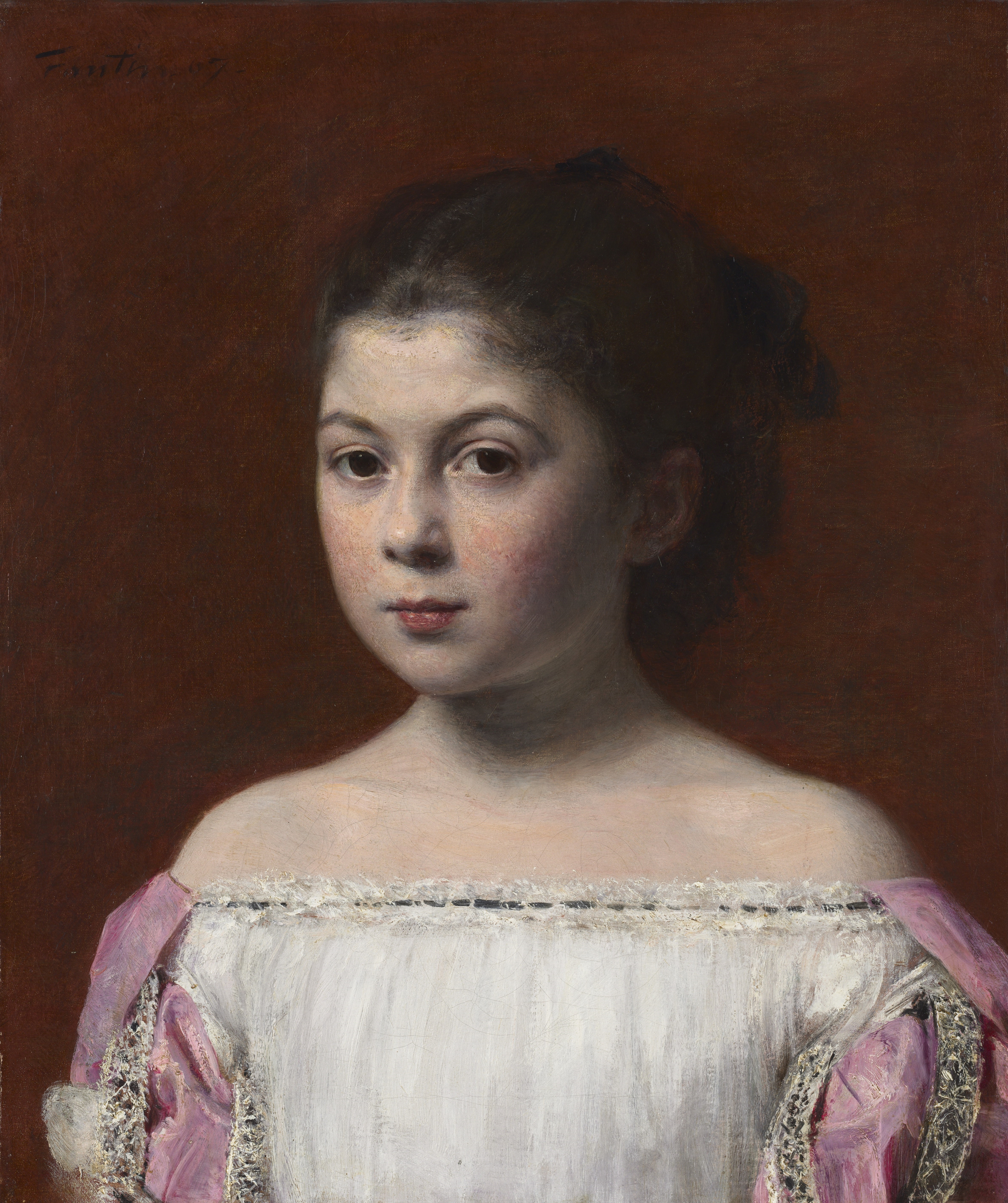
Henri Fantin-Latour | Marie-Yolande de Fitz-James, 1867

This portrait depicts Marie-Yolande de Fitz-James, the 12-year-old daughter of Édouard de Fitz-James (French soldier, politician, Peer of France, and 6th Duke of Fitz-James, who descended from the British House of Stuart, 1776-1838).
Fantin-Latour painted a series of portraits of her family members in preparation for a large group portrait that was never completed.
Although Fantin-Latour frequently exhibited with his close friend Édouard Manet and the Impressionists, he remained committed to traditional studio production and never painted outdoors.

Henri Fantin-Latour | Marie-Yolande de Fitz-James, 1867 | Cleveland Museum of Art

Henri Fantin-Latour (1836-1904), known for his portraits and flower still lifes, never shared the artistic viewpoint of his friends and contemporaries, the Impressionists.
He remained a traditional academic painter throughout his career and the style of this portrait reflects the romanticism of an earlier generation. | Cleveland Museum of Art

Textual description of firstImageUrl

Pascal Dagnan-Bouveret | Naturalist / Genre painter

Pascal-Adolphe-Jean Dagnan-Bouveret (January 7, 1852 - July 3, 1929), was one of the leading French artists of the Naturalist school, best known for his painstakingly detailed re-creations of peasant scenes.
He also created portraits and religious paintings.
He was born in Paris, the son of a tailor, and was raised by his grandfather after his father emigrated to Brazil.


Textual description of firstImageUrl

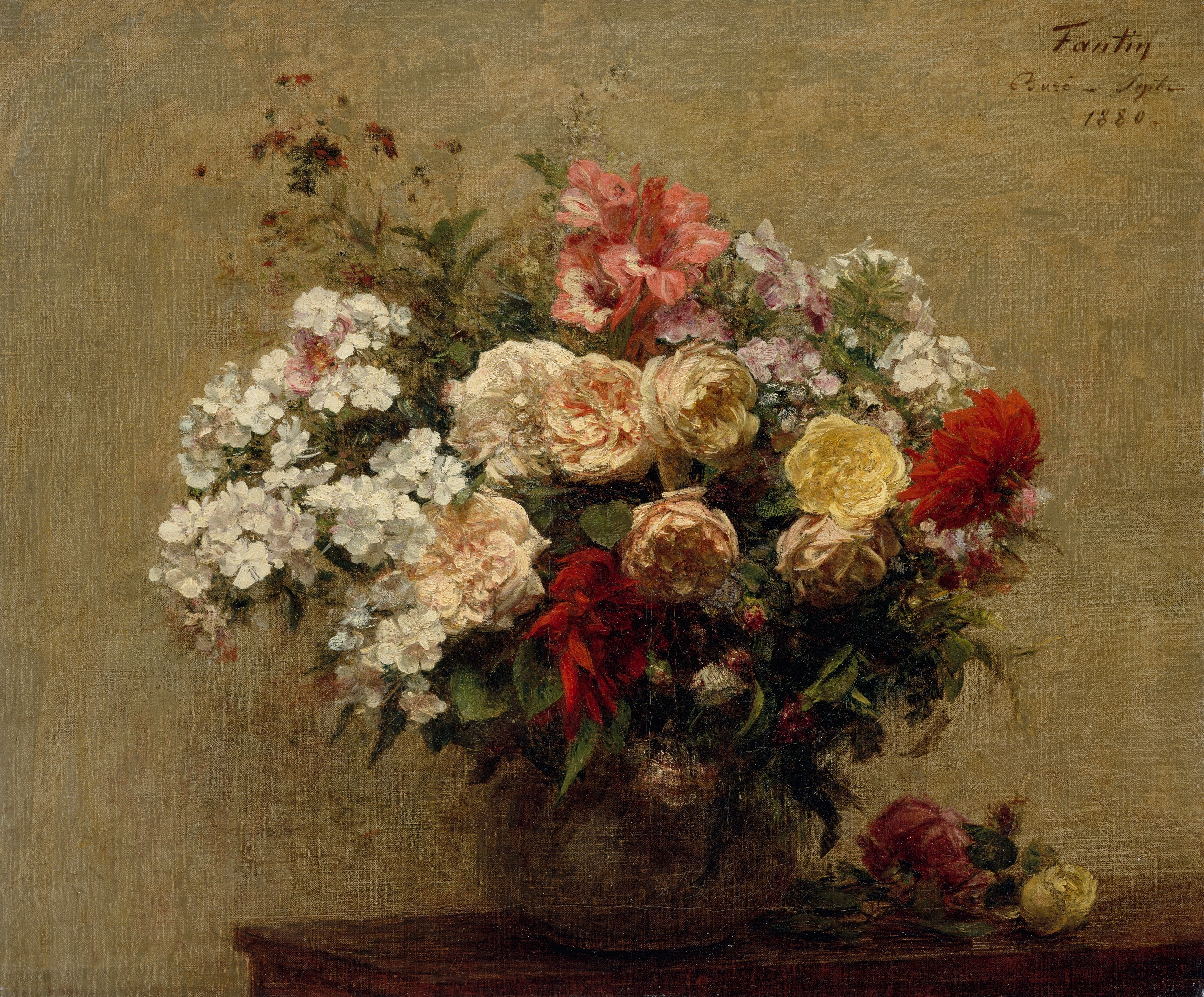
Henri Fantin-Latour | Summer Flowers, 1880

The inscription in the upper-right-hand corner indicates that Henri Fantin-Latour (1836-1904) completed this painting in September 1880 at the village of Buré in Normandy.
The dahlias, phlox, and roses in the bouquet were picked from the garden of the artist’s country house.
By this date, Fantin had established a steady clientele in Britain for his exquisite paintings of informal flower arrangements, set in modest vases and seen against a neutral ground. | Source: © The Metropolitan Museum of Art

Henri Fantin-Latour | Summer Flowers, 1880 | Metropolitan Museum of Art

Textual description of firstImageUrl

Ognian Kuzmanov, 1979 | Abstract painter


Ognian Kuzmanov/Огнян Кузманов is an Bulgarian professional artist who lives and works in Pleven, Bulgaria.
He has made many exhibitions in Europe: in France, Germany, Austria, Slovakia and Cheh Republic, Marocco, Serbia and Bulgaria.
Many of his art works are possession of different european private collectors.
He's also shown his artworks in the USA, Canada, Australia and Asia.
He paints mostly portraits, seascapes and abstracts in oil. His works nave been collected all around the world.

Textual description of firstImageUrl

Henri Fantin-Latour | The Anniversary (Homage to Hector Berlioz) 1877


Henri Fantin-Latour (French painter🎨, 1836-1904) underwent a striking evolution over the course of his career, starting out as a member of the Realist avant-garde before creating anti-Realist, fantastic compositions in the 1870s.
This masterful pastel honoring the late French Romantic composer Hector Berlioz is part of the proto-Symbolist “imaginative projects” developed by Fantin-Latour around 1875. | © The Art Institute of Chicago

Textual description of firstImageUrl

Albert Edelfelt | Academic / Genre painter

Albert Gustaf Aristides Edelfelt (1854-1905) was a Finnish painter. He lived in Grand Duchy of Finland and made Finnish culture visible abroad, before Finland gained full independence.

Biography

Edelfelt was born in Porvoo, son of Carl Albert Edelfelt, an architect, and Alexandra Edelfelt, née Brandt. His parents were Swedish-speaking Finns. He began his formal studies of art in 1869 at the Drawing School of the Finnish Art Society, and continued as a student of Adolf von Becker (1871-73).


Textual description of firstImageUrl

Vladimir Pervuninsky, 1957 | The Viennese Waltz


Vladimir Pervuninsky / Владимир Первунинский was born in the Russian town of Chelyabinsk. Recognized at an early age for his artistic talent, he went on to attend the Omsk Pedagogical Institute, where he majored in painting and graphics.
Vladimir, in search of a more focused and complete training, set off for Moscow, where he was accepted into the acclaimed V.I. Surikov Moscow State Art College. There, he studied under the tutelage of the well-known academician D.M. Mochalsky.
Vladimir, always, was fascinated by Impressionism and Belle Epoque painting, the strict curriculum of the Soviet Ministry of Culture allowed no latitude for students or instructors to stray from the state sanctioned style of Socialist Realism.


Despite these restrictions to his personal style, Vladimir’s work flourished under the Soviet System and he gained entry to the Union of Artists, the official Soviet umbrella system.
With the Union, he participated in All-Union, Republic, and Moscow exhibitions, as well as the Urals Exhibition in the town of Kurgan in 1992, the exhibition "Landscape of Russia" in 1989, and the "Memorials of the Motherland" exhibition of 1990-1991.
During the dissolution of the Soviet Union, Vladimir took advantage of the loosening regulations on travel and went to Paris. There, he was exposed to a wider variety and more expressive type of painting than he had experienced in Russia.
Over time, he incorporated a more gay, light Salon style to his compositions, using the works of the La Belle Epoque painters of the turn of the century for inspiration.


His work was very well received in Paris and throughout Europe, and Vladimir began to exhibit and sell his paintings in the annual Parisian art auctions at Arcole.
He now enjoys enormous popularity in Europe, and particularly Vienna, where the artist resides.​
Vladimir’s paintings executed in an Impressionist manner, call to mind eras past.
His paintings engage the viewer in scenes from the last century, and transport one to the streets of Old Moscow, the rivers cafes of turn-of-the-century France, and the Grand Balls of nineteenth century Vienna. His use of color and light creates paintings of an unusual and rare beauty.
His works can be found in private collections throughout Russia, Europe and America.


Vladimir Pervuninsky / Владимир Первунинский è nato nella città russa di Chelyabinsk.
Riconosciuto in tenera età per il suo talento artistico, ha continuato a frequentare l'Istituto pedagogico di Omsk, dove si è specializzato in pittura e grafica.
Vladimir, alla ricerca di un addestramento più mirato e completo, partì per Mosca, dove fu accettato nell'acclamato V.I. Surikov Moscow State Art College. Lì, ha studiato sotto la guida del noto accademico D.M. Mochalsky.
Vladimir, da sempre, era affascinato dall'impressionismo e dalla pittura di Belle Epoque, il rigoroso curriculum del Ministero della Cultura sovietico non consentiva a nessuno studente o istruttore di lasciare spazio allo stile sanzionato dallo stato del realismo socialista.
Durante lo scioglimento dell'Unione Sovietica, Vladimir approfittò delle allentati normative sui viaggi ed andò a Parigi. Lì, fu esposto ad una varietà più ampia ed un tipo di pittura più espressiva di quanto avesse sperimentato in Russia.
Il suo lavoro è stato accolto molto bene a Parigi e in tutta Europa, e Vladimir inizia ad esporre e vendere i suoi dipinti nelle aste d'arte parigine annuali ad Arcole.
Ora gode di enorme popolarità in Europa, ed in particolare a Vienna, dove risiede l'artista.
I dipinti di Vladimir eseguiti in maniera impressionista, ricordano il passato.
I suoi dipinti coinvolgono lo spettatore in scene del secolo scorso e ne trasportano uno per le strade della vecchia Mosca, i caffè dei fiumi della Francia di inizio secolo e le Grand Ball della Vienna del XIX secolo.
Il suo uso del colore e della luce crea dipinti di una bellezza insolita e rara. Le sue opere sono presenti in collezioni private in Russia, Europa ed America.



Textual description of firstImageUrl

Francesco Trevisani (1656-1746) | Rococo painter


Francesco Trevisani was an Italian painter🎨, active in the period called either early Rococo or late Baroque (barochetto).
Born in Capodistria, Istria (modern Koper now in Slovenia, then part of the Republic of Venice), he was the son of Antonio Trevisani, an architect, by whom he was instructed in the first rudiments of design. He then studied in Venice under Antonio Zanchi.
He moved to Rome, where he remained until his death, in 1746. His brother, Angelo Trevisani remained a prominent painter in Venice.

Textual description of firstImageUrl

Nicola Simbari | Pittore Astratto

Nicola Simbari (13 luglio 1927 - 11 dicembre 2012) è stato un pittore Italiano. Le opere di Simbari sono caratterizzate da strisce di colori pastello brillanti per formare rappresentazioni stilizzate di persone e luoghi.
Nicola Simbari è nato a San Lucido, in Calabria e cresciuto a Roma, dove suo padre era architetto per il Vaticano. Studia all'Accademia di Belle Arti di Roma e negli anni '40 inizia a dedicarsi alla pittura in uno studio di via del Babuino nel centro di Roma.
La prima esposizione di Simbari al mondo dell'architettura ebbe un'impressione duratura sulla sua arte, poiché incorporò forme geometriche e strutture architettoniche in quasi tutti i suoi dipinti.