Visualizzazione post con etichetta 19th century Art. Mostra tutti i post
Ernst Barlach, lo scultore censurato dai nazisti

Ernst Barlach, lo scultore censurato dai nazisti

Ernst Barlach (1870-1938) è stato uno dei più importanti scultori, grafici e scrittori Tedesci, appartenente al movimento Espressionista.
Barlach nacque a Wedel nella Germania settentrionale, il più anziano di quattro figli della coppia formata da Johanna Luise Barlach e dal dottore Georg Barlach.
Frequentò i primi corsi di studio a Ratzeburg.
Restò orfano di padre durante questo periodo, nel 1884.


Franz Marc: "Art is nothing but the expression of our dream"!

Franz Marc: "Art is nothing but the expression of our dream"!

👉 "Blue is the male principle, stern and spiritual. Yellow the female principle, gentle, cheerful and sensual. Red is matter, brutal and heavy and always the colour which must be fought and vanquished by the other two".
👉 "Il blu rappresenta il principio maschile, austero e spirituale. Il giallo il principio femminile, gentile, allegro e sensuale. Il rosso è materia, brutale e pesante, ed è sempre il colore che deve essere combattuto e sconfitto dagli altri due".


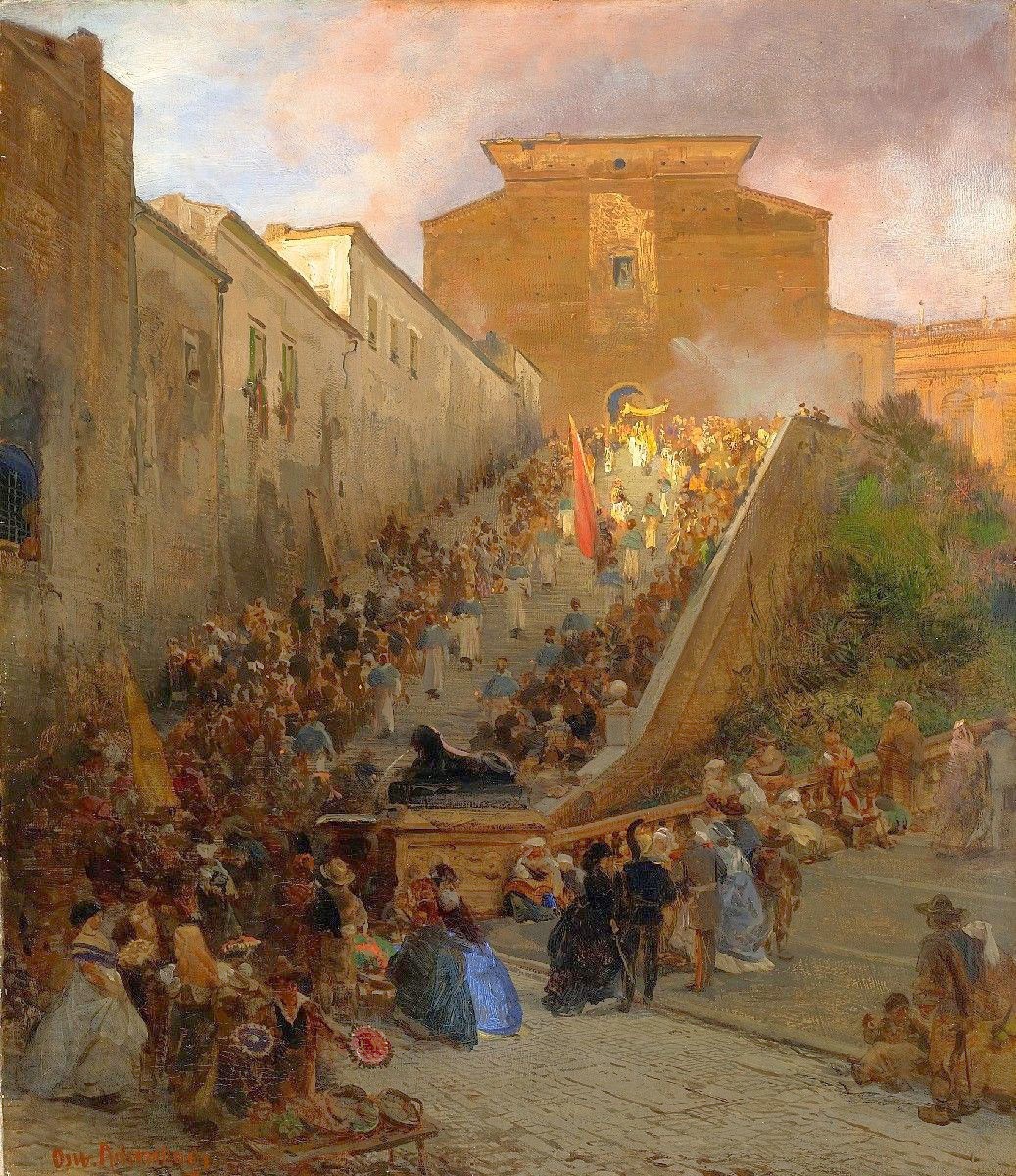
Oswald Achenbach | Düsseldorf school of painting

Oswald Achenbach | Düsseldorf school of painting

Oswald Achenbach (1827-1905) was a German painter associated with the Düsseldorf school of painting.
Though little known today, during his lifetime he was counted among the most important landscape painters of Europe.
Through his teaching activities, he influenced the Kunstakademie Düsseldorf.
His brother, Andreas Achenbach, who was twelve years older, was also among the most important German landscape painters of the 19th century.
The two brothers were humorously called "the A and O of Landscapes" (a reference to their initials matching a common German reference to the Alpha and Omega).


Eliseu Visconti | Impressionist / Art Nouveau painter

Eliseu Visconti | Impressionist / Art Nouveau painter

Eliseu Visconti (born Eliseo d'Angelo; July 30, 1866 – October 15, 1944) was an Italian-born Brazilian painter, designer, and educator widely celebrated for introducing Impressionism and Art Nouveau to Brazil.
Spanning a highly transitional era between academic traditions and early modernism, he remains one of the most versatile and influential visual artists in Brazilian history.
He entered in 1884 the Liceu de Artes e Ofícios do Rio de Janeiro, where studied under Victor Meireles.


Julien Stappers | Still life with Flowers painter

Julien Stappers | Still life with Flowers painter

Julien Stappers (1875-1960) was an Belgian flower painter, celebrated for his radiant and technically superb floral still lifes.
Part of the traditional Belgian school, his signature style is defined by a cool, delicate palette and a highly diffusive, luminous management of light that gives his floral arrangements an energetic yet soothing quality.
Training at the The Royal Academy of Fine Arts Antwerp in Juliaan De Vriendt (1894-1899) and at the Higher Institute of Fine Arts in Antwerp (1899-1901). First exhibition in 1903.
A presentation to the "Rubens" Gallery in Brussels in 1959 and 1960, the "Jordaens" gallery in Ghent in 1957, 1959 and 1960.


Francesco Gioli | Macchiaioli painter

Francesco Gioli | Macchiaioli painter

Francesco Gioli (June 29, 1846 - February 4, 1922) was a prominent Italian painter associated with the Macchiaioli movement and Tuscan Naturalism.
Born into a wealthy family in San Frediano a Settimo (Pisa), he became celebrated for his elegant depictions of rural Tuscan life, atmospheric landscapes and intimate portraits.
Gioli initially trained under academic masters like Antonio Ciseri and Enrico Pollastrini, starting his career with traditional historical paintings.


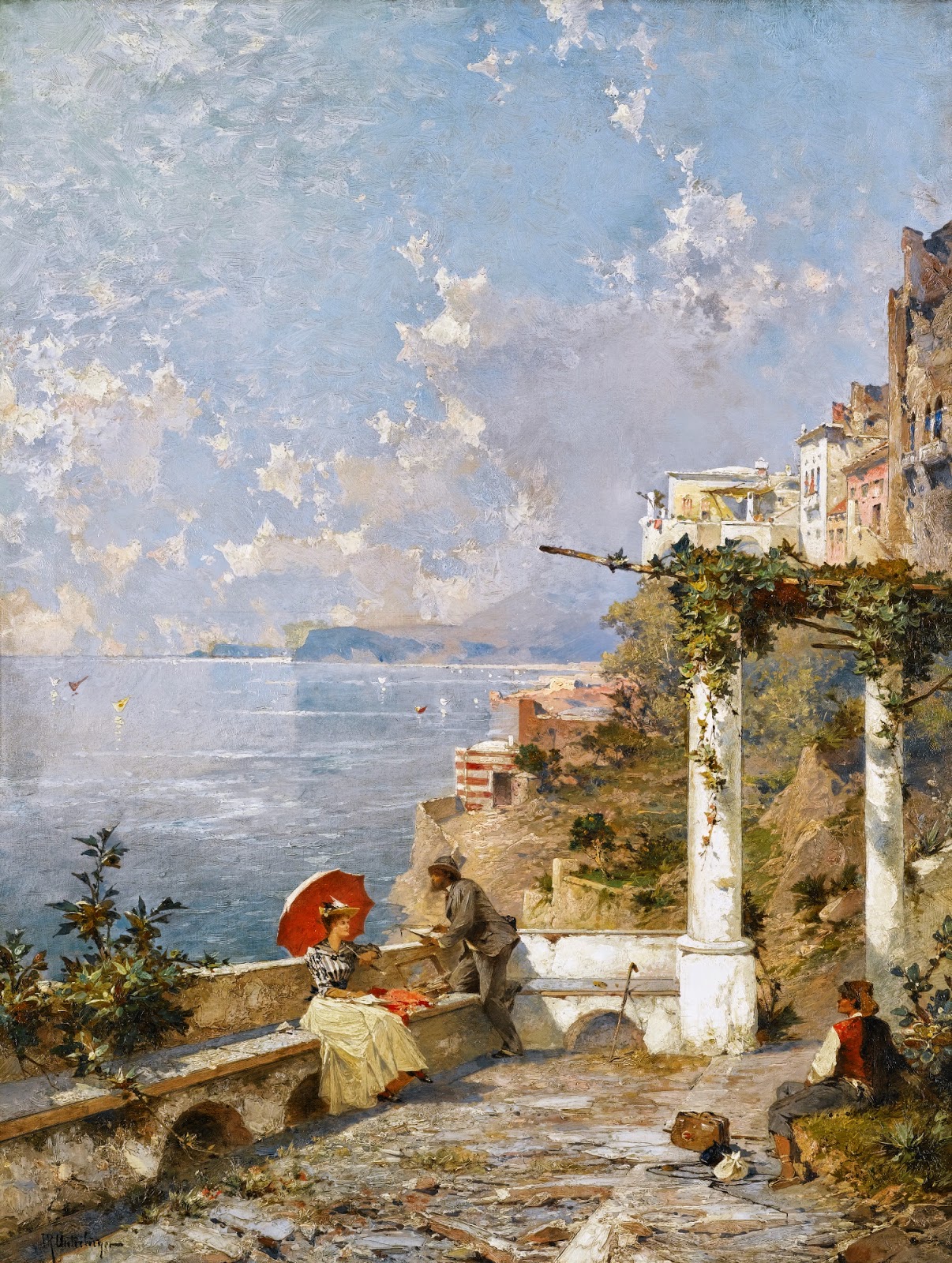
Franz Richard Unterberger | Romantic painter of waterscapes

Franz Richard Unterberger | Romantic painter of waterscapes

Austrian painter Franz Richard Unterberger (1838-1902), a Romantic style painter of waterscapes, landscapes, architecture and Genre, was born in Innsbruck, in what was then the Austro-Hungarian Empire, on 15th August 1838, one of eleven children of a wealthy bourgeois family.
He decided to pursue a career as an artist at a relatively young age and enrolled in the Academy in Munich.
Here he studied with Albert Zimmerman (1808-1888) a professor and landscape painter at the Academy and with Julius Lange (1817-1878).


Love Letter from Auguste Rodin to Camille Claudel, 1886

Love Letter from Auguste Rodin to Camille Claudel, 1886

"My ferocious friend".... "Mia feroce amica"...

Thus begins Rodin’s desperate cry of love to Camille Claudel in the early years of their relationship.
Rodin was soon captivated by this pupil who became his assistant, mistress and muse, while Claudel outwardly remained in complete control of her feelings.
Consumed and tormented by an obsessive love, he implores her - “on his knees” - to ease his suffering from beginning to end of this letter, written in a muddled style, with erroneous syntax and imperfect spelling.


Vilhelm Hammershøi | Interior painter

Vilhelm Hammershøi | Interior painter

Vilhelm Hammershøi (1864-1916) was a Danish painter. He is known for his poetic, subdued portraits and interiors.
In 1997, Denmark issued a postage stamp in his honour.
Vilhelm Hammershøi was born iin Copenhagen, Denmark.
The son of a well-to-do merchant, Christian Hammershøi, and his wife, Frederikke (née Rentzmann), Hammershøi studied drawing from the age of eight with Niels Christian Kierkegaard and Holger Grønvold, as well as painting with Vilhelm Kyhn, before embarking on studies with Frederik Vermehren and others at the Royal Danish Academy of Fine Arts.


Rainer Maria Rilke / Rodin | Love Song, 1907

Rainer Maria Rilke / Rodin | Love Song, 1907

How shall I hold my soul and yet not touch
It with your own? How shall I ever place
It clear of you on anything beyond?
Oh gladly I would stow it next to such
Things in the darkness as are never found
Down in an alien and silent space
That does not resonate when you resound.

Auguste Rodin - Fugit Amor, 1881

Rainer Maria Rilke | La sera / The evening

Rainer Maria Rilke | La sera / The evening

Come una indefinibile fata d'ombre...
Vien da lungi la Sera, camminando
per l'abetaia tacita e nevosa.

Johan August Malmström (1829-1901) | Dancing Fairies, 1866

Nadežda Petrović | Expressionist / Fauve painter

Nadežda Petrović | Expressionist / Fauve painter

Nadežda Petrović / Надежда Петровић (1873-1915) was a Serbian painter and one of the women war photography pioneers in the region.
Considered Serbia's most famous Expressionist and Fauvist, she was the most important Serbian female painter of the period.
Born in the town of Čačak, Petrović moved to Belgrade in her youth and attended the women's school of higher education there.
In 1893, she became an art teacher at the school and later taught at the women's university in Belgrade.


Ivan Aivazovsky | Romantic painter

Ivan Aivazovsky | Romantic painter

Ivan Konstantinovich Aivazovsky / Ива́н Константи́нович Айвазо́вский (1817-1900) became the most prolific Russian painter of his time.
Early in his career, he was elected a member of five Academies of Fine Arts, including those of St. Petersburg (his Alma Mater) Rome, Florence, Stuttgart and Amsterdam.
He was an Academician at 27 and Professor of Marine Painting at the Academy of Fine Arts, St. Petersburg, at the age of 30.


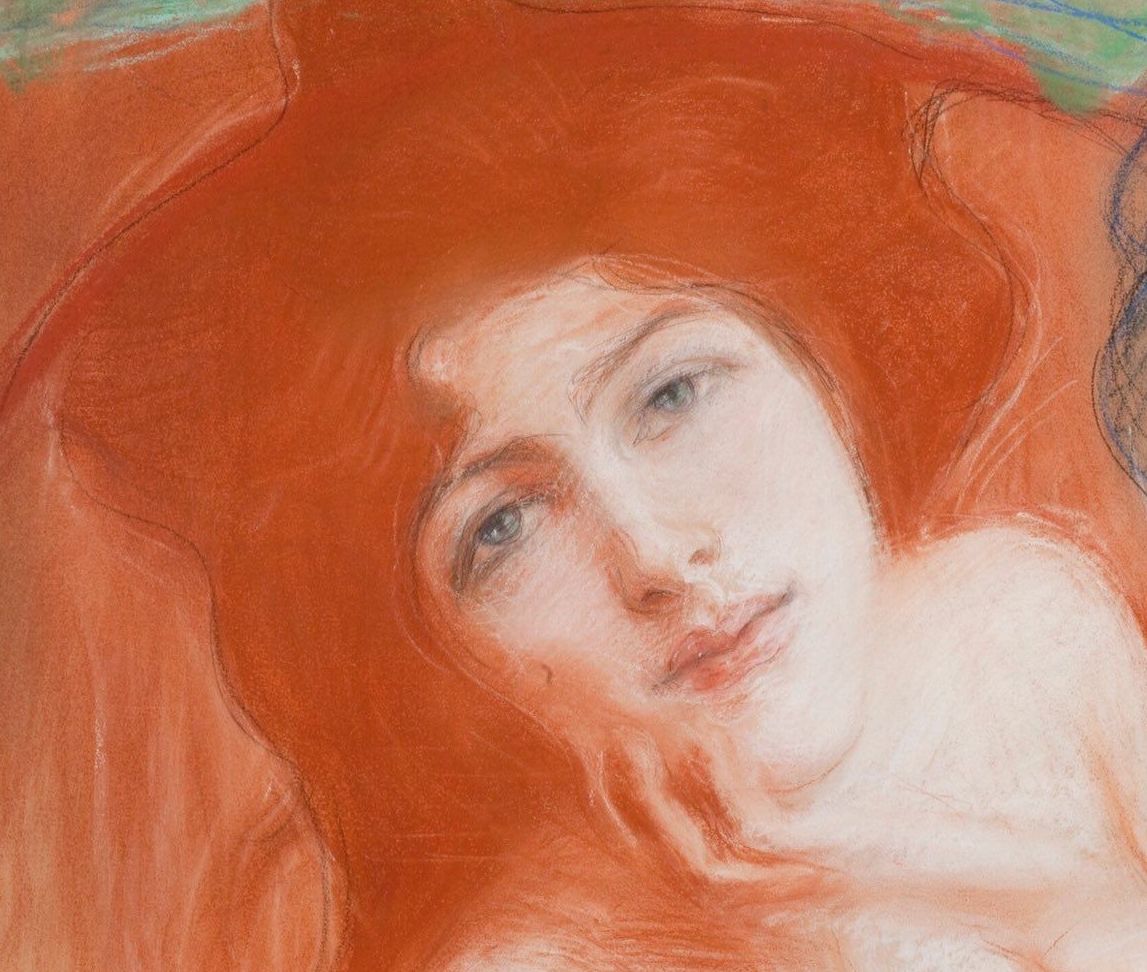
Teodor Axentowicz | Academic painter

Teodor Axentowicz | Academic painter

Teodor Axentowicz (1859-1938) was a Polish-Armenian painter and university professor.
A renowned artist of his times, he was also the rector of the Academy of Fine Arts in Kraków.
As an artist, Axentowicz was famous for his portraits and subtle scenes of Hutsul life, set in the Carpathians.
In Paris, he received the prestigious title of Officier d'Académie Ordre des Palmes Académiques and Member of Académie des Beaux-Arts.
In 1904 at the St. Louis World's Fair, Axentowicz received a Special Commemorative Award in recognition of distinguished service in connection with various national sections of the Department of Art.


José Malhoa | Naturalist painter

José Malhoa | Naturalist painter

José Vital Branco Malhoa, known simply as José Malhoa (28 April 1855 - 26 October 1933) was a Portuguese painter.
Malhoa was, with Columbano Bordalo Pinheiro, the leading name in Portuguese naturalist painting in the second half of the 19th century.
They were both members of the Grupo do Leão (Lion Group), a group of artists and writers in the 1880s.
He often painted popular scenes and subjects, like his two most famous paintings: The Drunks (1907) and Fado (1910).


Randolph Rogers | Nydia, the Blind Flower Girl of Pompeii, 1859

Randolph Rogers | Nydia, the Blind Flower Girl of Pompeii, 1859

"Nydia, the Blind Flower Girl of Pompeii" by Randolph Rogers (Waterloo, New York 1825-1892 Rome) was the most popular American sculpture of the nineteenth century.
According to Rogers, it was replicated 167 times in two sizes.
The subject was drawn from "The Last Days of Pompeii" (1834), a widely read novel by Lord Edward Bulwer-Lytton, which ends with the eruption of Mount Vesuvius in a.d. 79.
Rogers’s evocative portrayal of Nydia highlights her heroic attempt to lead two companions out of the burning, ash-covered city.


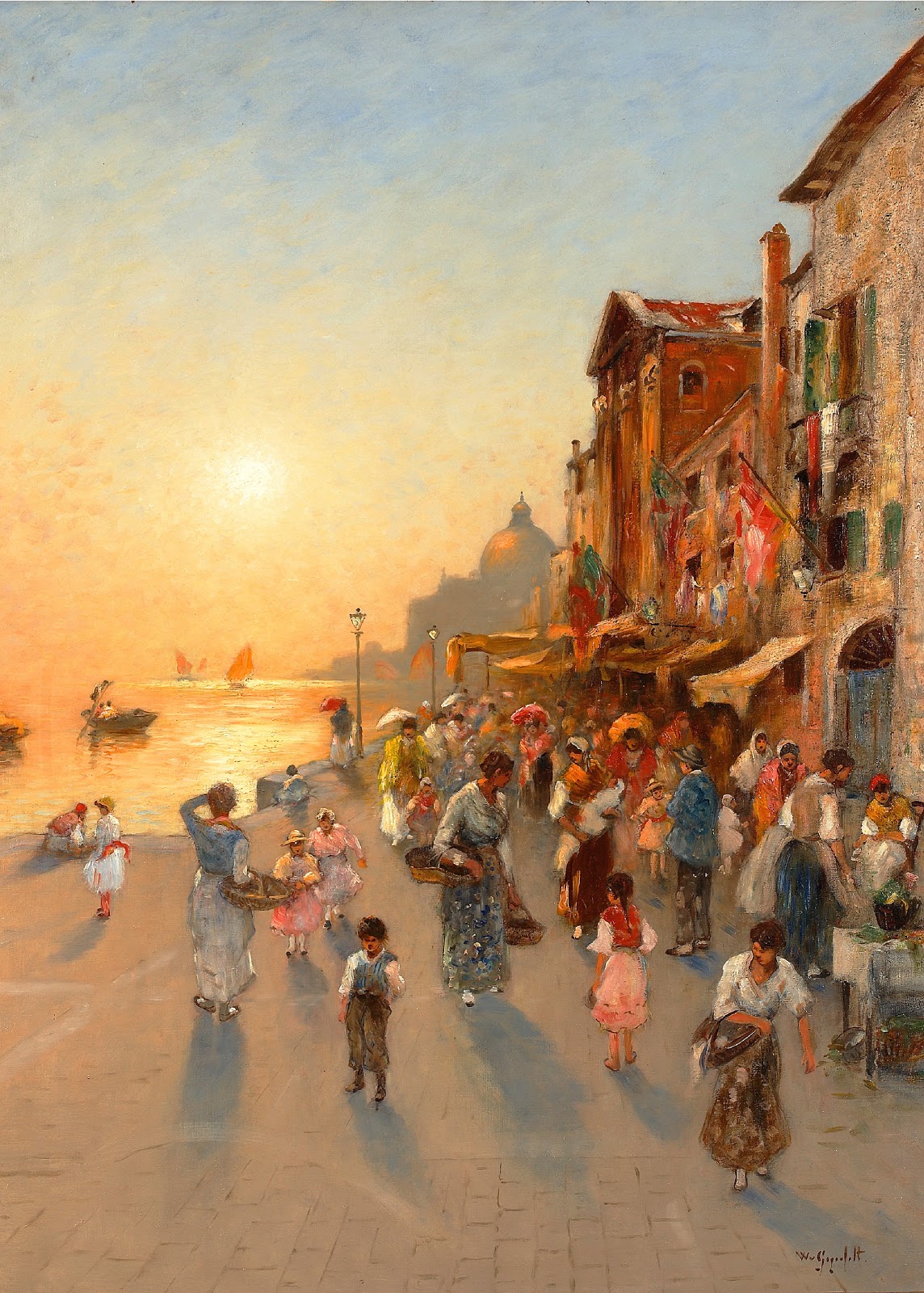
Wilhelm von Gegerfelt | Post-Impressionist painter

Wilhelm von Gegerfelt | Post-Impressionist painter

Swedish painter Wilhelm von Gegerfelt (1844-1920) painted landscapes with motifs from Venice, Brittany, Swedish coastal landscapes and from Gotland in Sweden.
Gegerfelt studied at the Royal Danish Academy from 1861-1863, at the Royal Swedish Academy from 1864-1867, and thereafter in Düsseldorf until 1872.
He then went to Paris where he developed a new technique joining Alfred Wahlberg as one of the first Swedes to represent the Modern Breakthrough in Nordic art.


Gerardine Jacoba | Still life painter of flowers

Gerardine Jacoba | Still life painter of flowers


Came from an artistic family, the still life Dutch painter Gerardina Jacoba Van de Sande Bakhuyzen (1826-1895), was a 19th-century painter from the Northern Netherlands.
Her father was the painter Hendrik Van de Sande Bakhuyzen, and her brother was the painter Julius Jacobus Van de Sande Bakhuyzen.
Gerardina was taught by her father, as were all her numerous sisters.
She achieved great success with her oils and watercolours of flowers and still lives, winning numerous medals between 1870-1880, in which year she had an exhibition at the Grafton Gallery in London.

Paul Signac | Neo-impressionist painter

Paul Signac | Neo-impressionist painter

French painter Paul Signac (1863-1935) was born in Paris.
He followed a course of training in architecture before deciding at the age of 18 to pursue a career as a painter.
He sailed around the coasts of Europe, painting the landscapes he encountered.
He also painted scenes of cities in France in his later years.


Tranquillo Cremona | Romantic painter

Tranquillo Cremona | Romantic painter

Tranquillo Cremona (10 April 1837 - 10 June 1878) was an Italian painter.
He was born in Pavia and was the brother of the mathematician Luigi Cremona.
He trained as a young man with Giovanni Carnovali. He lived in Venice from 1852-1859.
Cremona moved to Milan and he became part of the Scapigliatura movement which was characterized by bohemian attitudes and included poets, writers, musicians and artists infused with a combination of rebellious, and later anti-academic and anarchic, tendencies.


Test Your Art Knowledge 🎨
Discover the hidden names of great artists