Howard Behrens | Palette knife painter

Howard Behrens | Palette knife painter


American painter Howard Behrens (August 20, 1933 - April 14, 2014) - the world's most renowned palette knife artist. As a landscape and seascape artist, Behrens has painted the idyllic lakes of Italy to the gardens of New England.
He has had over 150 one-man shows from coast-to-coast since becoming a professional artist in 1980. Behrens was born in Chicago, Illinois in 1933. He grew up near Washington, DC. He began drawing at age seventeen after being confined to bed following a sledding accident.

Read More

Howard Behrens | Palette knife painter


American painter Howard Behrens (August 20, 1933 - April 14, 2014) - the world's most renowned palette knife artist. As a landscape and seascape artist, Behrens has painted the idyllic lakes of Italy to the gardens of New England.
He has had over 150 one-man shows from coast-to-coast since becoming a professional artist in 1980. Behrens was born in Chicago, Illinois in 1933. He grew up near Washington, DC. He began drawing at age seventeen after being confined to bed following a sledding accident.

Nicola Vietti, 1945 | Figurative painter

Nicola Vietti, 1945 | Figurative painter

Nicola Vietti was born in Marseille to Italian parents emigrated from Apulia in France at the beginning of the century. Numerous solo and group exhibitions. And 'present in catalogs and magazines. He currently lives and works in Milan, after a long period spent in Paris.
The figures of maidens Nicola Vietti, you can look on each side, three-quarter profile, facing away.
The style might defer to their fathers, that should not be forgotten at this point, as the International Botero and Bueno Nicola Vietti that offer a hint of a departure of style attempted with disenchantment.


Read More

Nicola Vietti, 1945 | Figurative painter

Nicola Vietti was born in Marseille to Italian parents emigrated from Apulia in France at the beginning of the century. Numerous solo and group exhibitions. And 'present in catalogs and magazines. He currently lives and works in Milan, after a long period spent in Paris.
The figures of maidens Nicola Vietti, you can look on each side, three-quarter profile, facing away.
The style might defer to their fathers, that should not be forgotten at this point, as the International Botero and Bueno Nicola Vietti that offer a hint of a departure of style attempted with disenchantment.


Masaaki Sasamoto 笹本正明, 1966

Masaaki Sasamoto 笹本正明, 1966


Japanese artist Masaaki Sasamoto was born in 1966 in Tokyo. He graduated from Tokyo National University of Fine Arts and Music, specializing in Japanese painting.
He has been a permanent participant of solo and group art exhibitions throughout Japan. Masaaki Sasamoto currently lives and works in Yamanashi Prefecture, on the island of Honshu, Japan. The artworks of Masaaki Sasamoto are exhibited at Art Prefectural Gallery of Yamanashi Museum.

Read More

Masaaki Sasamoto 笹本正明, 1966


Japanese artist Masaaki Sasamoto was born in 1966 in Tokyo. He graduated from Tokyo National University of Fine Arts and Music, specializing in Japanese painting.
He has been a permanent participant of solo and group art exhibitions throughout Japan. Masaaki Sasamoto currently lives and works in Yamanashi Prefecture, on the island of Honshu, Japan. The artworks of Masaaki Sasamoto are exhibited at Art Prefectural Gallery of Yamanashi Museum.

Ludivine Corominas, 1976 | Still life painter

Ludivine Corominas, 1976 | Still life painter

Ludivine Corominas 1976 | France | Still life

French painter Ludivine Corominas is a self-taught artist, acquired her first notion of art by her father. With many elegance, fines and exquisite delicacy, Ludivine declines colors of rainbow by creating tones and nuances which light up the sun of her brushes.
The redcurrants, the luscious grapes, crystalline transparency, fine porcelains are the principal subjects of this artist: The still life.

Read More

Ludivine Corominas, 1976 | Still life painter

Ludivine Corominas 1976 | France | Still life

French painter Ludivine Corominas is a self-taught artist, acquired her first notion of art by her father. With many elegance, fines and exquisite delicacy, Ludivine declines colors of rainbow by creating tones and nuances which light up the sun of her brushes.
The redcurrants, the luscious grapes, crystalline transparency, fine porcelains are the principal subjects of this artist: The still life.

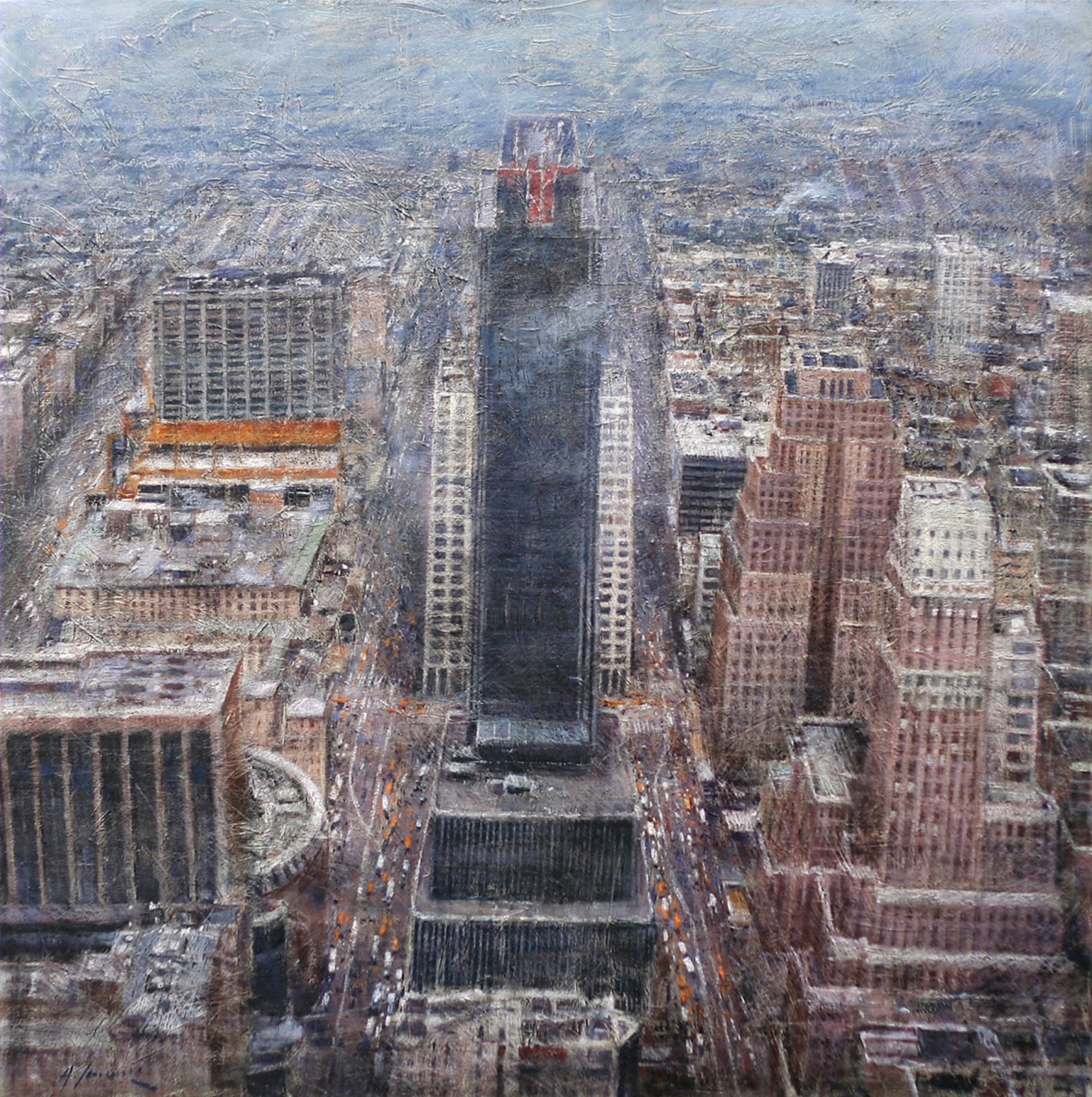
Antonio Sannino, 1959 | Abstract /Cityscape painter

Antonio Sannino, 1959 | Abstract /Cityscape painter


Antonio Sannino was born in Naples in 1959. He lives and works in Naples and Rome.
He is been focusing for years in portraying "landscapes". Sannino has been able to create new representations of the landscape, by searching new framing, re-drawing the space and its contents. He uses his camera to catch the best light in his pictures, that moment when everything seems to be frozen and timeless. His sea surfaces do not only reproduce water but they emphasize the transparency and light.

Read More

Antonio Sannino, 1959 | Abstract /Cityscape painter


Antonio Sannino was born in Naples in 1959. He lives and works in Naples and Rome.
He is been focusing for years in portraying "landscapes". Sannino has been able to create new representations of the landscape, by searching new framing, re-drawing the space and its contents. He uses his camera to catch the best light in his pictures, that moment when everything seems to be frozen and timeless. His sea surfaces do not only reproduce water but they emphasize the transparency and light.

Roberto Ferri, 1978 | Drawings / Study

Roberto Ferri, 1978 | Drawings / Study


Inspired by Baroque painters -Caravaggio in particular- and other old masters, Roberto Ferri is an Italian painter known for working also in the Baroque Era style.
Ferri was born in Fontanaviva, Taranto, Italy in 1978.

For biographical notes -in english and italian- and other works by Roberto Ferri see:

Read More

Roberto Ferri, 1978 | Drawings / Study


Inspired by Baroque painters -Caravaggio in particular- and other old masters, Roberto Ferri is an Italian painter known for working also in the Baroque Era style.
Ferri was born in Fontanaviva, Taranto, Italy in 1978.

For biographical notes -in english and italian- and other works by Roberto Ferri see:

Carolyn Biggio, 1958 | Still life painter

Carolyn Biggio, 1958 | Still life painter


Born in Columbus, Ohio in 1958, Carolyn Biggio grew up in Baton Rouge, Louisiana. Her formal schooling earned her a Bachelor of Sciences degree; but she later took up studies in art with Henry Hensche at the Cape School of Art. Other classes with his followers deepened her commitment, and her career path shifted to painting. Ms. Biggio's paintings are pure light and color, primarily of still life. The thick impasto paint is laid on with a palette knife to create intense masses of color; shadows are equally vibrant, creating dimension with brilliant shifts in hue and value, rather than just local color. Ms. Biggio has exhibited her work nationally, receiving numerous awards.

Read More

Carolyn Biggio, 1958 | Still life painter


Born in Columbus, Ohio in 1958, Carolyn Biggio grew up in Baton Rouge, Louisiana. Her formal schooling earned her a Bachelor of Sciences degree; but she later took up studies in art with Henry Hensche at the Cape School of Art. Other classes with his followers deepened her commitment, and her career path shifted to painting. Ms. Biggio's paintings are pure light and color, primarily of still life. The thick impasto paint is laid on with a palette knife to create intense masses of color; shadows are equally vibrant, creating dimension with brilliant shifts in hue and value, rather than just local color. Ms. Biggio has exhibited her work nationally, receiving numerous awards.

Edward Hopper: "More of me comes out when I improvise"

Edward Hopper: "More of me comes out when I improvise"

"What I wanted to do was to paint sunlight on the side of a house".

"After all, we are not French and never can be, and any attempt to be so is to deny our inheritance and to try to impose upon ourselves a character that can be nothing but a veneer upon the surface".


Read More

Edward Hopper: "More of me comes out when I improvise"

"What I wanted to do was to paint sunlight on the side of a house".

"After all, we are not French and never can be, and any attempt to be so is to deny our inheritance and to try to impose upon ourselves a character that can be nothing but a veneer upon the surface".


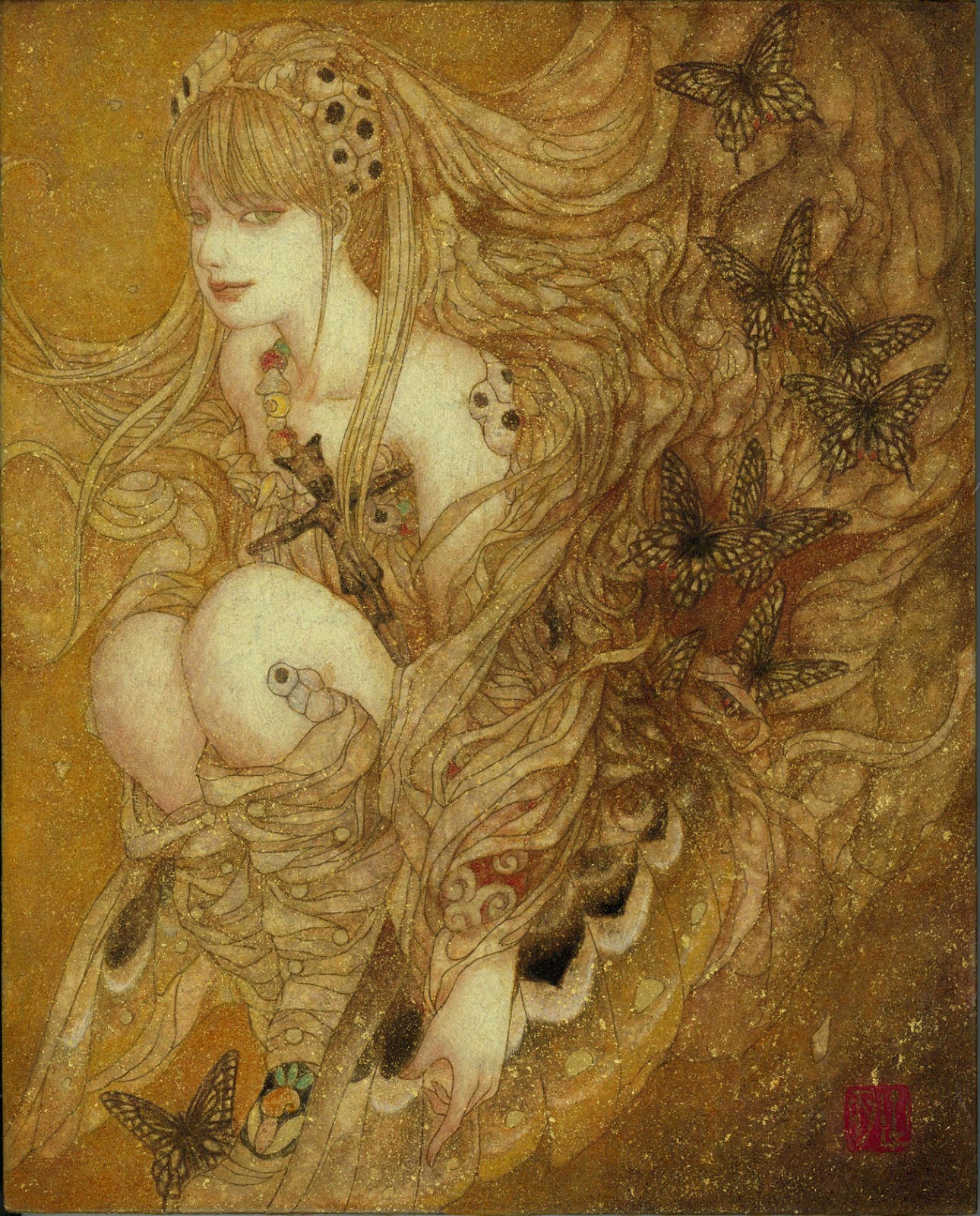
Albena Vatcheva, 1967 | Fantasy painter

Albena Vatcheva, 1967 | Fantasy painter

Albena Vatcheva is an French artist of Bulgarian origin who advances in a spectacular way.
Her painting has inherited various traditions, including that of masters of the icon.
Using different oriental sources, she has created a world of troubling fairy, which is a real fascination for the eye, as her glowing colors create magic.
Tender, loving, her characters live in a world of peace, harmony and mutual consolation.


Read More

Albena Vatcheva, 1967 | Fantasy painter

Albena Vatcheva is an French artist of Bulgarian origin who advances in a spectacular way.
Her painting has inherited various traditions, including that of masters of the icon.
Using different oriental sources, she has created a world of troubling fairy, which is a real fascination for the eye, as her glowing colors create magic.
Tender, loving, her characters live in a world of peace, harmony and mutual consolation.


Ryo Shiotani / 塩谷 亮, 1975 | Figurative painter

Ryo Shiotani / 塩谷 亮, 1975 | Figurative painter

"I paint realist paintings because I can make new discoveries as I thoroughly look at my subject. That is enjoyable".

Award winning Japanese painter Ryo Shiotani 塩谷 亮 was born in Tokyo.
After graduating from Musashino Art University, Ryo Shiotani spent one year studying in Florence on an Agency for Cultural Affairs scholarship, where he had a chance to copy the works of Leonardo da Vinci.


Read More

Ryo Shiotani / 塩谷 亮, 1975 | Figurative painter

"I paint realist paintings because I can make new discoveries as I thoroughly look at my subject. That is enjoyable".

Award winning Japanese painter Ryo Shiotani 塩谷 亮 was born in Tokyo.
After graduating from Musashino Art University, Ryo Shiotani spent one year studying in Florence on an Agency for Cultural Affairs scholarship, where he had a chance to copy the works of Leonardo da Vinci.


Leonardo da Vinci | A treatise on painting

Leonardo da Vinci | A treatise on painting


Science of painting

Leonardo’s advocacy of a science of painting is best displayed in his notebook writings under the general heading “On Painting”.
The notebooks provide evidence that, among many projects he planned, he intended to write a treatise discussing painting.
After inheriting Leonardo’s vast manuscript legacy in 1519, it is believed that, sometime before 1542, Melzi extracted passages from them and organized them into the Trattato della pittura [In italian] ➤ (“Treatise on Painting”) that is attributed to Leonardo.

Read More

Leonardo da Vinci | A treatise on painting


Science of painting

Leonardo’s advocacy of a science of painting is best displayed in his notebook writings under the general heading “On Painting”.
The notebooks provide evidence that, among many projects he planned, he intended to write a treatise discussing painting.
After inheriting Leonardo’s vast manuscript legacy in 1519, it is believed that, sometime before 1542, Melzi extracted passages from them and organized them into the Trattato della pittura [In italian] ➤ (“Treatise on Painting”) that is attributed to Leonardo.

Leonardo da Vinci | Dell'obbligo che ha la scultura col lume, e non la pittura

Leonardo da Vinci | Dell'obbligo che ha la scultura col lume, e non la pittura

Trattato della Pittura
Parte prima | Capitolo 38


Se la scultura avrà il lume di sotto parrà cosa mostruosa e strana; questo non accade alla pittura, che tutte le parti porta con sé.


Read More

Leonardo da Vinci | Dell'obbligo che ha la scultura col lume, e non la pittura

Trattato della Pittura
Parte prima | Capitolo 38


Se la scultura avrà il lume di sotto parrà cosa mostruosa e strana; questo non accade alla pittura, che tutte le parti porta con sé.


Leonardo da Vinci | Dell'orizzonte

Leonardo da Vinci | Dell'orizzonte

Trattato della Pittura - Parte ottava | Capitoli 235-258


Indice
927. Qual sia il vero sito dell'orizzonte.
928. Dell'orizzonte.
929. Del vero orizzonte.
930. Dell'orizzonte.
931. Dell'orizzonte.
932. Se l'occhio che vede l'orizzonte marittimo, stando co' piedi alla pelle di esso mare, vede esso orizzonte più basso di sé.
933. Dell'orizzonte specchiato nell'acqua corrente.
934. Dove l'orizzonte si specchia nell'onda.
935. Perché l'aria grossa vicina all'orizzonte si fa rossa.


Read More

Leonardo da Vinci | Dell'orizzonte

Trattato della Pittura - Parte ottava | Capitoli 235-258


Indice
927. Qual sia il vero sito dell'orizzonte.
928. Dell'orizzonte.
929. Del vero orizzonte.
930. Dell'orizzonte.
931. Dell'orizzonte.
932. Se l'occhio che vede l'orizzonte marittimo, stando co' piedi alla pelle di esso mare, vede esso orizzonte più basso di sé.
933. Dell'orizzonte specchiato nell'acqua corrente.
934. Dove l'orizzonte si specchia nell'onda.
935. Perché l'aria grossa vicina all'orizzonte si fa rossa.


Leonardo da Vinci | Degli alberi e delle verdure

Leonardo da Vinci | Degli alberi e delle verdure

Trattato della Pittura - Parte sesta | Capitoli 812-840


Indice
812. Discorso delle qualità de' fiori nelle ramificazioni delle erbe.
813. Della ramificazione delle piante.
814. Della ramificazione delle piante.
815. Della ramificazione delle piante.
816. Delle minori ramificazioni delle piante.
817. Della proporzione che hanno infra loro le ramificazioni delle piante.


Read More

Leonardo da Vinci | Degli alberi e delle verdure

Trattato della Pittura - Parte sesta | Capitoli 812-840


Indice
812. Discorso delle qualità de' fiori nelle ramificazioni delle erbe.
813. Della ramificazione delle piante.
814. Della ramificazione delle piante.
815. Della ramificazione delle piante.
816. Delle minori ramificazioni delle piante.
817. Della proporzione che hanno infra loro le ramificazioni delle piante.


Leonardo da Vinci | Delle ombrosità e chiarezze de' monti

Leonardo da Vinci | Delle ombrosità e chiarezze de' monti

Trattato della Pittura - Parte quinta | Capitoli 780-798


Indice
780. Prospettiva comune.
781. Delle cime de' monti vedute di sopra in giú.
782. Dell'aria che mostra piú chiare le radici de' monti che le loro cime.
783. Perché i monti distanti mostrano piú oscure le sommità che le loro basi.
784. Delle cime de' monti che si scoprono all'occhio l'una piú alta dell'altra, che le proporzioni delle distanze non sono colle proporzioni de' colori.
785. Delle cime de' monti che non diminuiscono ne' colori secondo la distanza delle cime loro.
786. Dell'inganno del pittore nella grandezza degli alberi e degli altri corpi delle campagne.
787. Perché i monti in lunga distanza si dimostrano piú scuri nella cima che nella base.
788. Perché i monti paiono avere piú oscure le cime che le basi in lunga distanza.
789. Come non si deve figurar le montagne cosí azzurre il verno come l'estate.
790. Come i monti ombrati dai nuvoli partecipano del colore azzurro.
791. Dell'aria che infra i monti si dimostra.
792. De' monti e loro divisione in pittura.
793. Pittura che mostra la necessaria figurazione delle alpi, monti e colli.
794. Pittura e come i monti crescono.
795. Pittura nel figurare le qualità e membri de' paesi montuosi.
796. De' monti.
797. De' monti.
798. Precetto.

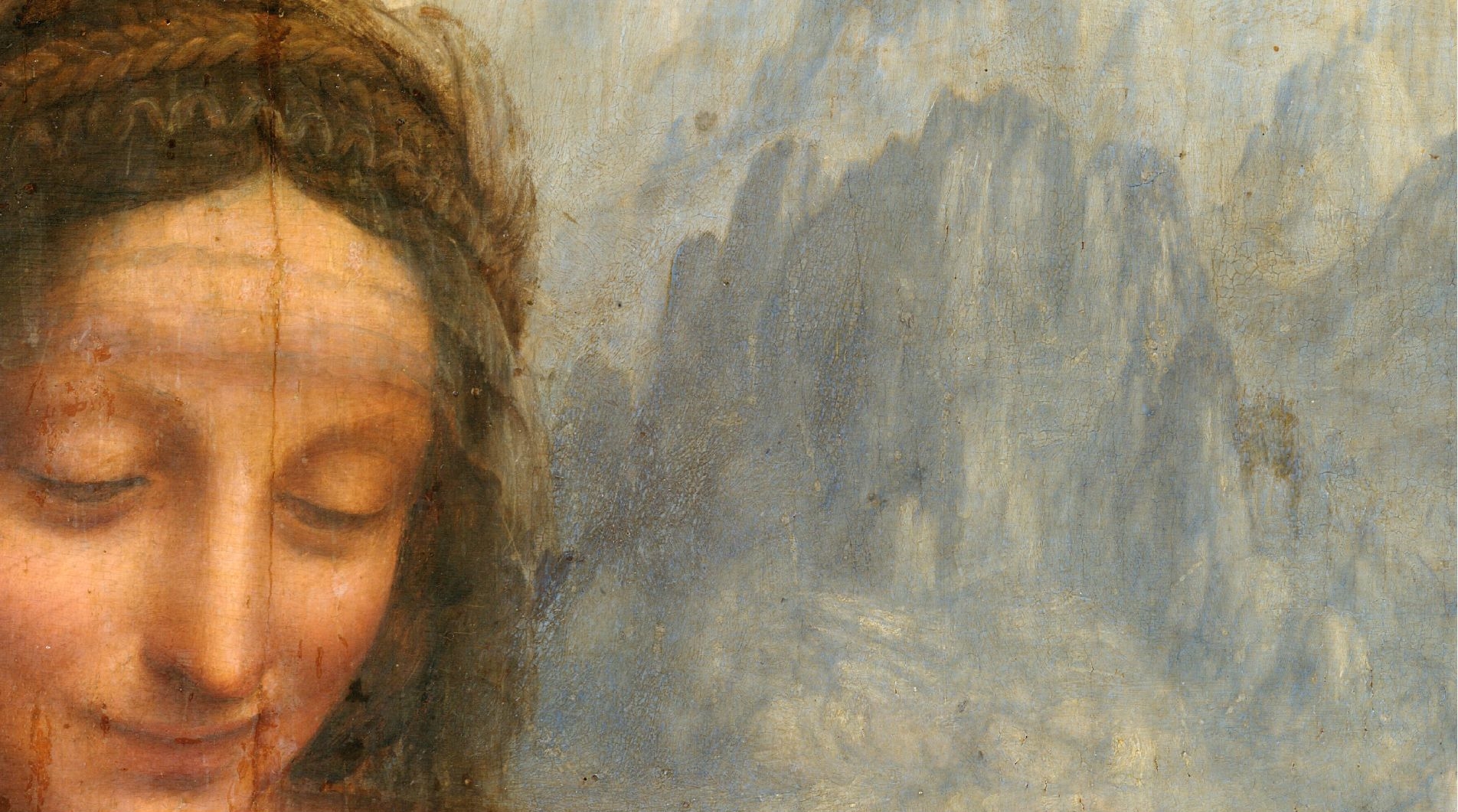
Leonardo da Vinci | Sant'Anna, la Vergine e il Bambino con l'agnellino, 1510-1513 (detail)

Read More

Leonardo da Vinci | Delle ombrosità e chiarezze de' monti

Trattato della Pittura - Parte quinta | Capitoli 780-798


Indice
780. Prospettiva comune.
781. Delle cime de' monti vedute di sopra in giú.
782. Dell'aria che mostra piú chiare le radici de' monti che le loro cime.
783. Perché i monti distanti mostrano piú oscure le sommità che le loro basi.
784. Delle cime de' monti che si scoprono all'occhio l'una piú alta dell'altra, che le proporzioni delle distanze non sono colle proporzioni de' colori.
785. Delle cime de' monti che non diminuiscono ne' colori secondo la distanza delle cime loro.
786. Dell'inganno del pittore nella grandezza degli alberi e degli altri corpi delle campagne.
787. Perché i monti in lunga distanza si dimostrano piú scuri nella cima che nella base.
788. Perché i monti paiono avere piú oscure le cime che le basi in lunga distanza.
789. Come non si deve figurar le montagne cosí azzurre il verno come l'estate.
790. Come i monti ombrati dai nuvoli partecipano del colore azzurro.
791. Dell'aria che infra i monti si dimostra.
792. De' monti e loro divisione in pittura.
793. Pittura che mostra la necessaria figurazione delle alpi, monti e colli.
794. Pittura e come i monti crescono.
795. Pittura nel figurare le qualità e membri de' paesi montuosi.
796. De' monti.
797. De' monti.
798. Precetto.

Leonardo da Vinci | Sant'Anna, la Vergine e il Bambino con l'agnellino, 1510-1513 (detail)