Textual description of firstImageUrl

Paul Signac (1863-1935) | Art Quotes


 "Art is a creation of a higher order than a copy of nature which is governed by chance..."- Paul Signac
• "The art of the colorist has in some ways elements of mathematics and music". - Paul Signac
 "Divisionism is a complex system of harmony, an aesthetic rather than a technique". - Paul Signac
 "The golden age has not passed; it lies in the future". - Paul Signac
"The anarchist painter is not the one who will create anarchist pictures, but the one who will fight with all his individuality against official conventions". - Paul Signac


"The Neo-Impressionist does not stipple, he divides. And dividing involves... guaranteeing all benefits of light". - Paul Signac

"The Pointillist chooses a means of expression by which he applies colour on a canvas in small dots rather than spreading it flat". - Paul Signac


Textual description of firstImageUrl

Paul Signac | Neo-Impressionist painter

Paul Victor Jules Signac (1863-1935) was a French Neo-Impressionist painter who, working with Georges Seurat, helped develop the Pointillist style.
Paul Signac was born in Paris. He followed a course of training in architecture before deciding at the age of 18 to pursue a career as a painter after attending an exhibit of Monet's work.
He sailed around the coasts of Europe, painting the landscapes he encountered.
He also painted a series of watercolors of French harbor cities in later years.


Textual description of firstImageUrl

Cao Yong, 1962 | Tibet painter


Chinese artist Cao Yong 曹勇 spent a year alone in the mountains of Tibet, and the paintings he produced were exhibited in Beijing in early 1989.
Cao Yong's canvases evoke the essence of some of the most delightful places on earth. Although Cao Yong was formally educated in China, the artist achieved maturity during seven years of self-exile in Tibet.
Then he left for Japan, where he quickly became that nation's most honored muralist. Later, he immigrated to America, in this nation know for her freedom of expression, Cao Yong has transferred to an artist who dedicates to the love of nature and passion for life through artwork.


In 1962, at the height of the great famine in China, an extraordinarily gifted child was born into hardship in Xinxian, a small town in Henan Province. Cao Yong's family, already struggling to find enough to eat, was suspected of disloyalty to the new government simply because a great-grandparent had once owned land, real estate, and banks, and because a grandparent had been a warlord.
During the Cultural Revolution, this background singled the family out for harsh treatment by the Chinese authorities. Cao Yong's family was ostracized, refused residency permits, and even denied food. While other young children of his age started kindergarten, little Cao Yong began working. At age five, Cao Yong found himself ferrying heavy baskets of gravel at a construction site.
One day a rock pit caved in, nearly crushing the tiny boy to death under the rubble. Luckily, Cao Yong survived. It was through drawing that Cao Yong found peace and consolation in those difficult years, and at age eleven his talent was recognized.


Il pittore Cinese Cao Yong 曹勇 è nato in un piccolo paese della Cina nel 1962, al tempo della grande carestia. Vita tribolata la sua, perchè la sua famiglia non era gradita al regime e il giovane Yong, tra mille difficoltà e umiliazioni, ha potuto iniziare la sua formazione in pittura che aveva solo 11 anni.
Un talento precoce. Ha trascorso un anno da solo tra le montagne del Tibet, e le pitture che ha prodotto sono state esposte a Pechino all’inizio del 1989. E’ stato arrestato dalle autorità cinesi e la polizia di Pechino ha bruciato ben sette dei suoi dipinti.
Così è fuggito dapprima in Giappone e poi, nel 1994, ha deciso di trasferirsi negli Stati Uniti, per poter esprimere liberamente la propria arte.


Il tempo vissuto in Tibet, in una sorta di auto-esilio, ha impresso un segno molto forte alla sua personalità di artista e di uomo. Per copiare i resti di antichi dipinti tibetani murali, Cao Yong, accompagnato solo da un cavallo, un cane e un fucile per la caccia, ha vissuto in completa solitudine dentro grotte di montagna primitive per quasi un anno intero. Un’esperienza epica, leggendaria, che gli ha permesso di sviluppare una profonda comprensione del collegamento tra il naturale e l’umano, così come tra il secolare e lo spirituale. È questa comprensione, questa fusione di opposti, che si respira nei suoi bellissimi dipinti, e fa sì che il suo lavoro sia molto potente e, nel senso più classico, romantico.

Textual description of firstImageUrl

Henri Le Sidaner | Intimist painter

Henri Eugene Augustin Le Sidaner (1862-1939) was an French painter, known for working in the Intimist style.
Le Sidaner began his career around 1880 as a young apprentice of Alexandre Cabanel at the École des Beaux-Arts in Paris. Soon he was seduced by the Parisian artistic fervour, particularly the works of both the Impressionists and the post-Impressionists.
After a few months, repressed by the academic milieu, the painter abruptly decided to settle in Étaples, a small village near Pas-de-Calais, where he finished his training in solitude.


Textual description of firstImageUrl

Henry Moret (1856-1913)

Henry Moret è stato un pittore Francese.
Di impostazione Impressionista, virò stilisticamente verso il Simbolismo.
Fu uno dei più interessanti artisti che, sotto la guida di Paul Gauguin, costituirono la Scuola di Pont-Aven.


Textual description of firstImageUrl

Rubens Santoro | Genre / Marine scenes painter


Rubens Santoro🎨 (1859-1941) was an Neapolitan painter of genre and marine scenes, particularly well-known today for his views of Venice.
He was born in Mongrassano and studied under Giovanni Battista at the Naples Academy.
He then won numerous prices🎨, like a silver medal in Barcelona during the Universal Exhibition in 1911.
He also received two gold medals🎨 in 1891 and 1892. The two paintings exhibited there were acquired by the King of Italy Umberto I.
For biographical notes -in english and italian- and other works by Santoro see:

Textual description of firstImageUrl

Gustave Loiseau | Scenes of Paris streets

Loiseau was born in Paris on 3 October 1865 into an affluent commercial family.
He was largely self-taught and during his youth he worked with a decorator, painting the outskirts of Paris in his free time.
An inheritance from his grandmother provided him with a certain degree of financial comfort and independence that allowed him to concentrate fully on paining and to move to Montmartre.
Here he met Maxime Maufra, with whom he remained friends for the rest of his life.
He enrolled at the École des Arts Décoratifs for a year, the only training in colour and drawing which he received.


Textual description of firstImageUrl

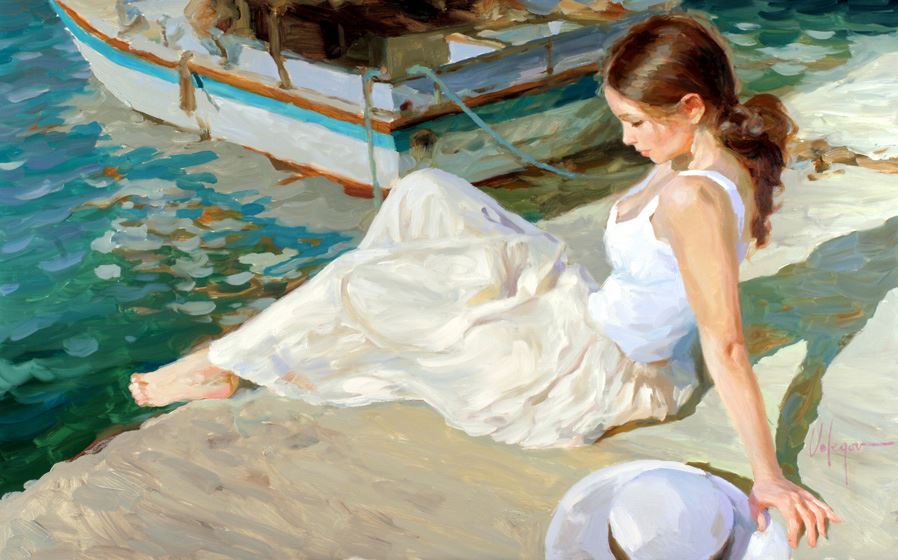
Vladimir Volegov, 1957 | Romantic painter


Russian painter Владимир Волегов is famous for his figurative paintings with his dramatic use of color and texture he creates a portrait-like treatment of the female form, captured in a frozen, yet living moment, with the surrounding bursts of color and scenery.
Born in Khabarovsk, Russia, Volegov began painting at the age of three and his talent would be noted repeatedly throughout his adolescence.
After having attended the art school, "Krivoj rog" and having served in the army, Volegov was admitted to the lvov polygraphic institute in the former soviet union.

Textual description of firstImageUrl

Henry Moret (1856-1913) | Impressionist painter


Henry Moret🎨 was a Normandy-born artist with a Breton soul devoted most of his work to Brittany, whose ever-wild landscapes and stormy seas still attract numerous artists seeking fresh inspiration.
He exhibited at the Salon des Indépendants and the Salon d’Automne.
Moret’s Breton landscapes of the early 1890s have often been mistaken for those of Gauguin🎨.

Textual description of firstImageUrl

Andrei Markin, 1976 | Figurative painter

Russian professional artist Andrei Markin / Андрей Маркин was born in the village Andreevka of the Solnechnogorsk region in a family of the artist Victor Markin.
In 1991 he finished Zelenograd painting school and entered Moscow Art College "In the memory of the revolution of 1905", where he was taught by the Honoured artist of Russia Mikhail Kugach.
In 1994 Andrei entered the Russian Academy of Art, Sculpture and Architecture, the dean of which is the People's artist of the USSR Ilia Glazunov.
In 2000 he graduated from the Russian Academy with honours, his diploma was a portrait of the People's actor of the USSR Victor F. Stepanov.


Textual description of firstImageUrl

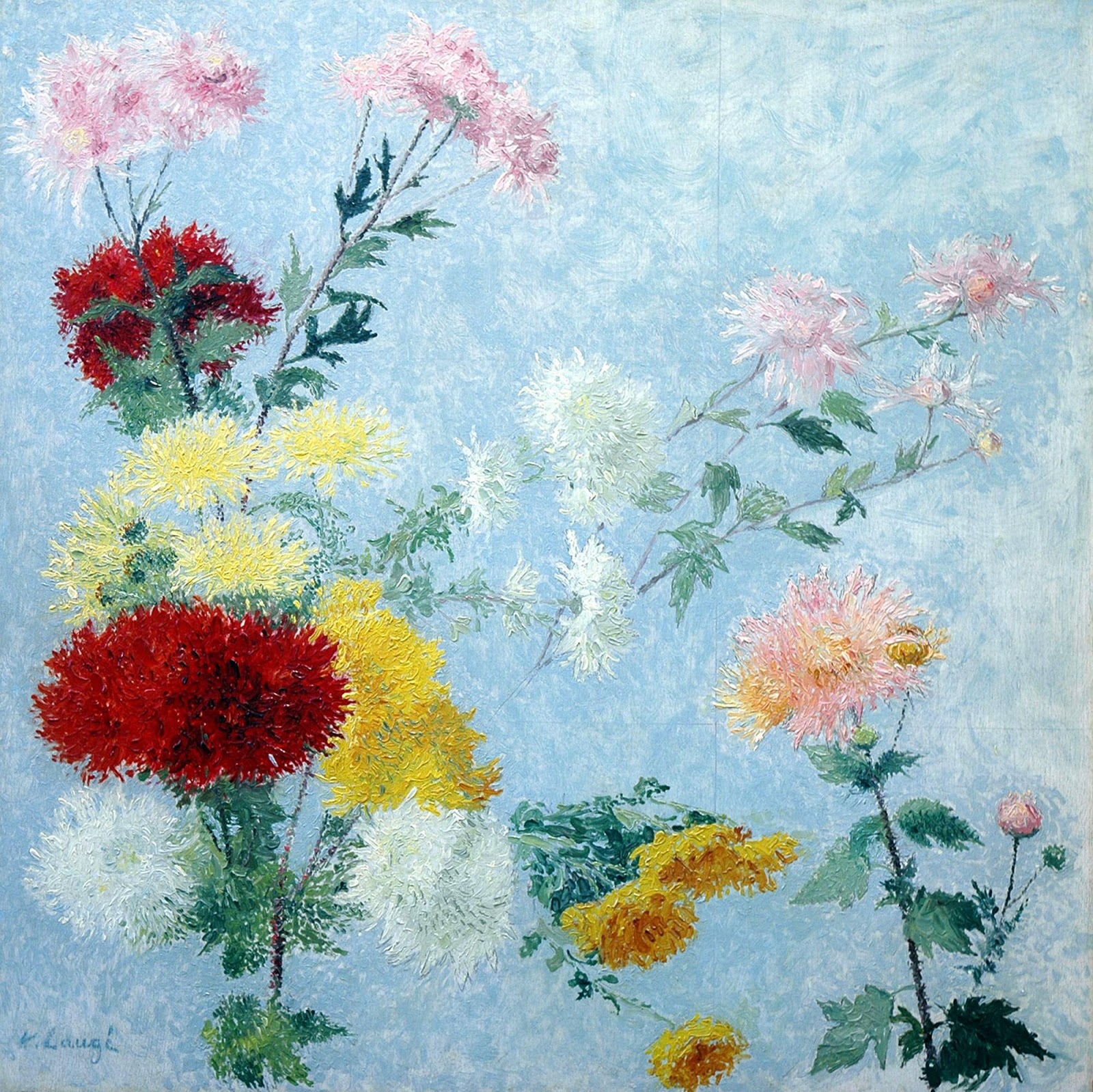
Laugé Achille (1861-1944) | Floral still life painting


Achille Laugé🎨 (1861-1944) was a French Neo-Impressionist painter who became well known for his beautiful landscapes and Floral still lifes.
Achille Laugé was born in Arzens in the Aude region of southern France, at the foot of the Pyrenees.

For biographical notes -in english and italian- and other works by Laugé see:
Textual description of firstImageUrl

Richard Macneil, 1956 | Romantic painter


Born in Worcester, Richard Macneil started his working life at Worcester Royal Porcelain and has always worked in the fields of sculpture, ceramics and graphics both in the UK and internationally.
With over 20 years of design experience in the creative industry, British painter🎨 Richard Macneil has enjoyed huge success and worldwide notoriety for his very distinctive style, composition and rich colour palette.
For biographical notes -in english and italian- and other works by Macneil see:
Textual description of firstImageUrl

Egisto Ferroni | Genre painter

Egisto Ferroni (14 December 1835 - 25 May 1912) was an Italian painter, depicting pastoral, rural and genre subjects.
He was born in Lastra a Signa near Florence in Tuscany, Italy.


Textual description of firstImageUrl

François Gall (1912-1987) | Ballet dancers


Hungarian by birth - born in Kolozsvar in the former region of Transylvania - François Gall (1912-1987) became an impressionist painter🎨 in the pure French tradition after he moved to Paris in 1936.
He studied at the Royal Academy of Fine Arts in Rome while working to secure a living.
The artist participated in various Salon exhibitions in Paris.
Support came in 1939 when the Hungarian government awarded🎨 Gall with a scholarship. Received the Medaille🎨 de Vermeil de la Ville de Paris in 1974.
Appointed Chevalier dans l’Odre des Arts des Lettres in 1976.
In 1963, he was honored with the Francis Smith Prize🎨.

Textual description of firstImageUrl

Barry Yang | Children in art


Barry Yang was born in China and began to paint at the early age of six. His interest in art led to an opportunity to study with a well-established artist in the area, before eventually being accepted to the local college of fine art.
Barry then found employment with the state owned newspaper as the Editor for Art and Design Barry has traveled throughout China and has visited much of Europe and the United States.
Because he prefers the simplicity of rural communities to the loud noises of city life, Barry frequents small villages in the countryside. Many of his paintings are from his travels to rural Tibet.

Textual description of firstImageUrl

Jim Morrison / Pino Daeni


"I'll stop loving you only when a deaf painter
manages to paint the noise of a rose petal
falling on a glass floor of a castle never existed..."

Jim Morrison

Textual description of firstImageUrl

Vittorio Gussoni (1893-1968) | Figurative painter


Vittorio Gussoni (1893-1968) was an Italian painter🎨, born in Milano, Italy into a family of artists.
He learned the first bases of drawing from his father, he enrolled at the Academy of Brera, where he was a pupil of Cesare Tallone before the world war, and of Ambrogio Alciati🎨 afterwards.
From the very beginning in Brera and the Famiglia Artistica in 1922, he provided proof of a solid figurative connotation characterized by a precise personality, not deaf to the calls of the twentieth century.

Textual description of firstImageUrl

Egon Schiele | Expressionist painter


Egon Schiele, (1890, Tulln, near Vienna - 1918, Vienna), Austrian Expressionist painter, draftsman and printmaker noted for the eroticism of his figurative works.
As a student at the Vienna Academy of Fine Arts (1907-09), Schiele was strongly influenced by the Jugendstil movement, the German Art Nouveau.
He met Gustav Klimt, leader of the Vienna Sezession group, and the linearity and subtlety of Schiele’s work owe much to Klimt’s decorative elegance.