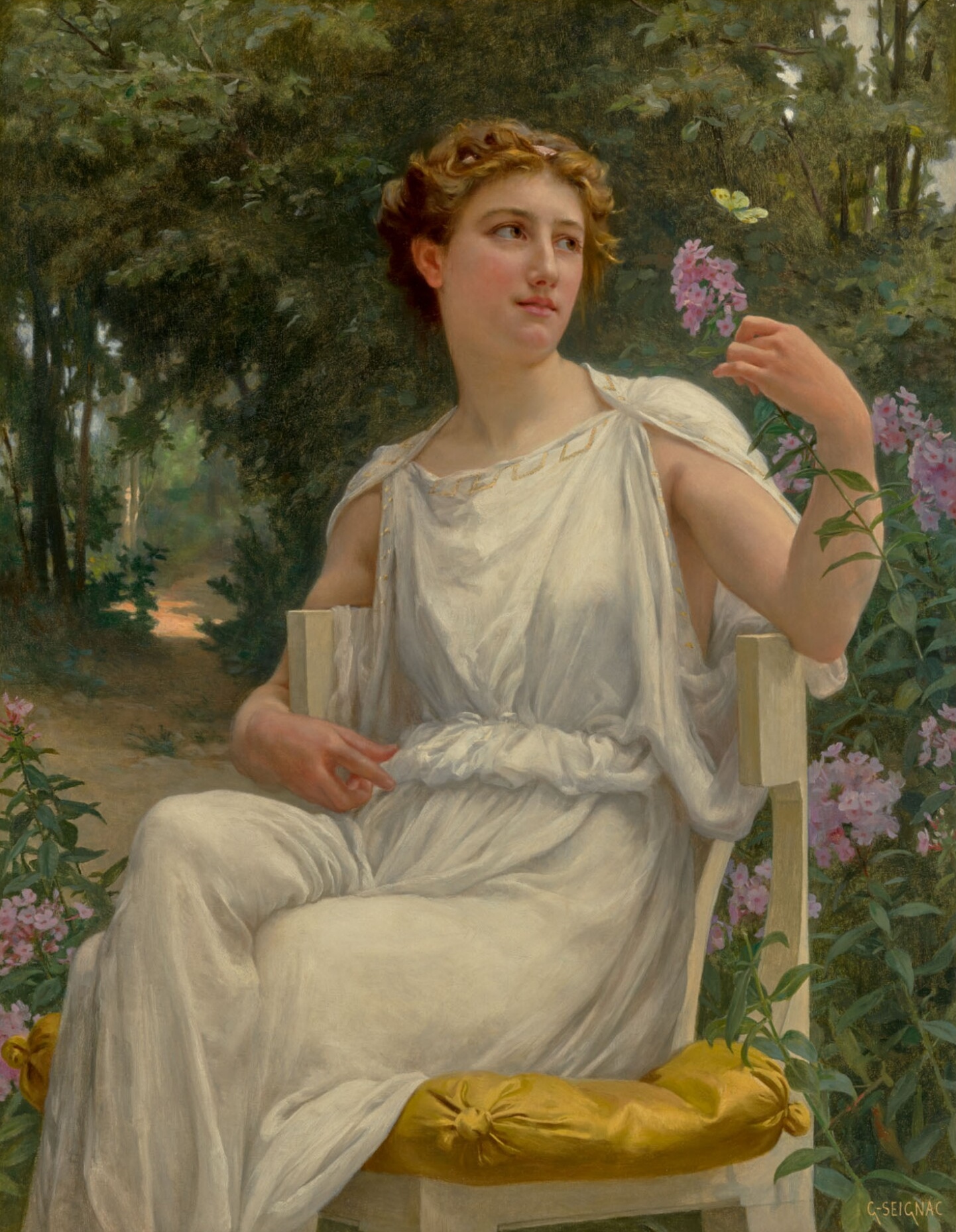
Guillaume Seignac | A beauty of nature, 1900

Guillaume Seignac | A beauty of nature, 1900

Guillaume Seignac’s graceful model reflects the Academic ideals that earned his fame in the nineteenth century, and those of his teacher at the Académie Julien, William Bouguereau.
Embracing the classical subject matter and technical mastery of the Renaissance, the nineteenth century production of allegorical scenes of beautiful women in classical dress found critical success at the Paris Salons, and Seignac’s work earned a place in the great private collections of Europe and America.

Guillaume Seignac | A beauty of nature, 1900 | Sotheby's

Read More

Guillaume Seignac | A beauty of nature, 1900

Guillaume Seignac’s graceful model reflects the Academic ideals that earned his fame in the nineteenth century, and those of his teacher at the Académie Julien, William Bouguereau.
Embracing the classical subject matter and technical mastery of the Renaissance, the nineteenth century production of allegorical scenes of beautiful women in classical dress found critical success at the Paris Salons, and Seignac’s work earned a place in the great private collections of Europe and America.

Guillaume Seignac | A beauty of nature, 1900 | Sotheby's

Guillaume Seignac (1870-1924) | Academic painter

Guillaume Seignac (1870-1924) | Academic painter


Guillaume was born in Rennes, France. He started training at the Académie Julian in Paris, where he spent 1889 through 1895. He had many teachers there, including Gabriel Ferrier, William-Adolphe Bouguereau and Tony Robert-Fleury.
In addition to his training in the academic style, much of Seignac's work displayed classical themes and style, for example, his use of diaphanous drapery covering a woman's body is reminiscent of classical style, in particular the sculptor Phidias.

Read More

Guillaume Seignac (1870-1924) | Academic painter


Guillaume was born in Rennes, France. He started training at the Académie Julian in Paris, where he spent 1889 through 1895. He had many teachers there, including Gabriel Ferrier, William-Adolphe Bouguereau and Tony Robert-Fleury.
In addition to his training in the academic style, much of Seignac's work displayed classical themes and style, for example, his use of diaphanous drapery covering a woman's body is reminiscent of classical style, in particular the sculptor Phidias.

Bryan Larsen, 1975

Bryan Larsen, 1975

Bryan Lamont Larsen Jr. è un pittore realista Americano, nato a Salt Lake City, nello Utah.
Larsen è stato ispirato dalle opere figurative dei pittori pre-Raphaelite, William-Adolphe Bouguereau, Lawrence Alma-Tadema e altri pittori europei del XIX secolo.
Ha studiato alla Utah State University ed alla Grand Central Academy Summer Intensives.


Read More

Bryan Larsen, 1975

Bryan Lamont Larsen Jr. è un pittore realista Americano, nato a Salt Lake City, nello Utah.
Larsen è stato ispirato dalle opere figurative dei pittori pre-Raphaelite, William-Adolphe Bouguereau, Lawrence Alma-Tadema e altri pittori europei del XIX secolo.
Ha studiato alla Utah State University ed alla Grand Central Academy Summer Intensives.


Robert Doesburg, 1945 | Square style painter

Robert Doesburg, 1945 | Square style painter


Dutch painter🎨 Robert Doesburg is playing with styles, colours and light. He is working out of his feeling and intuition.
His speciality is the square style.

Read More

Robert Doesburg, 1945 | Square style painter


Dutch painter🎨 Robert Doesburg is playing with styles, colours and light. He is working out of his feeling and intuition.
His speciality is the square style.

Ancient Egyptian Sculpture

Ancient Egyptian Sculpture

The culture and monuments of ancient Egypt have left a lasting legacy on the world.
The cult of the goddess Isis, for example, became popular in the Roman Empire, as obelisks and other relics were transported back to Rome.
The Romans also imported building materials from Egypt to erect Egyptian-style structures.
Early historians such as Herodotus, Strabo, and Diodorus Siculus studied and wrote about the land, which Romans came to view as a place of mystery.


Read More

Ancient Egyptian Sculpture

The culture and monuments of ancient Egypt have left a lasting legacy on the world.
The cult of the goddess Isis, for example, became popular in the Roman Empire, as obelisks and other relics were transported back to Rome.
The Romans also imported building materials from Egypt to erect Egyptian-style structures.
Early historians such as Herodotus, Strabo, and Diodorus Siculus studied and wrote about the land, which Romans came to view as a place of mystery.


Thutmose | The Sculptor of the bust of Nefertiti

Thutmose | The Sculptor of the bust of Nefertiti

The King's Favourite and Master of Works, the Sculptor Thutmose - (also spelled Djhutmose and Thutmosis), flourished 1350 BC, is thought to have been the official court sculptor of the Egyptian Pharaoh Akhenaten in the latter part of his reign.
German archaeological expedition digging in Akhenaten's deserted city of Akhetaten, at Amarna, found a ruined house and studio complex (labeled P47.1-3) in early December 1912; the building was identified as that of Thutmose based on an ivory horse blinker found in a rubbish pit in the courtyard inscribed with his name and job title.


Read More

Thutmose | The Sculptor of the bust of Nefertiti

The King's Favourite and Master of Works, the Sculptor Thutmose - (also spelled Djhutmose and Thutmosis), flourished 1350 BC, is thought to have been the official court sculptor of the Egyptian Pharaoh Akhenaten in the latter part of his reign.
German archaeological expedition digging in Akhenaten's deserted city of Akhetaten, at Amarna, found a ruined house and studio complex (labeled P47.1-3) in early December 1912; the building was identified as that of Thutmose based on an ivory horse blinker found in a rubbish pit in the courtyard inscribed with his name and job title.