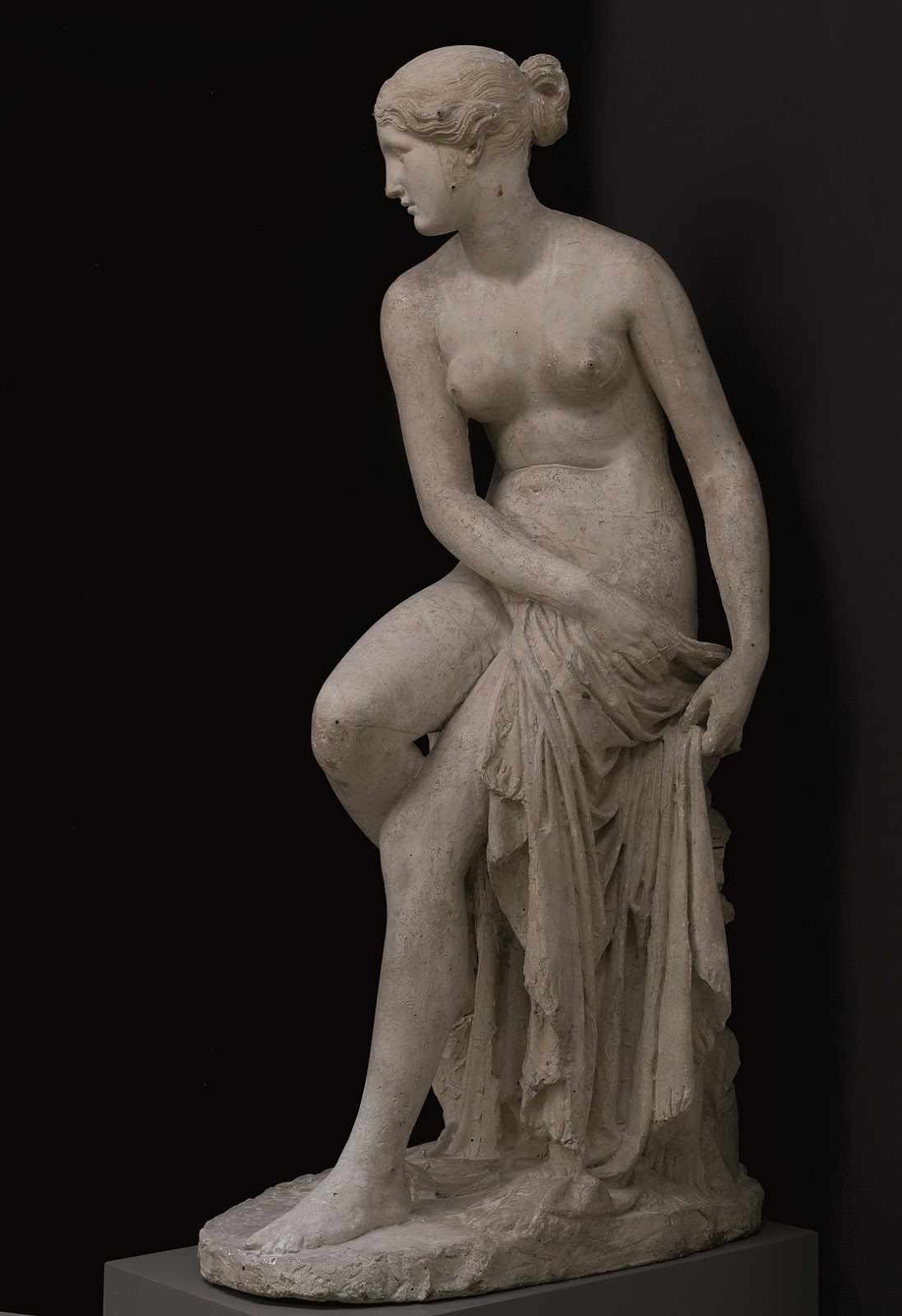
Lorenzo Bartolini | The Nymph Arnina, 1825

Lorenzo Bartolini | The Nymph Arnina, 1825

For the first time ever, the original marble The Nymph Arnina by Lorenzo Bartolini (1777-1850), was exposed to the public for the first time on 18 November until February 8th 2015, accompanied by his beautiful plaster cast, owned by the Academy Gallery, returned after being deposited for a few decades at the Civic Museum of Prato, and together with some documents aimed to evoke the complex history of the work that Bartolini, in this version, shows the dedication to Giovanni degli Alessandri, leading figure in the cultural life of the early nineteenth century Florentine.

Read More

Lorenzo Bartolini | The Nymph Arnina, 1825

For the first time ever, the original marble The Nymph Arnina by Lorenzo Bartolini (1777-1850), was exposed to the public for the first time on 18 November until February 8th 2015, accompanied by his beautiful plaster cast, owned by the Academy Gallery, returned after being deposited for a few decades at the Civic Museum of Prato, and together with some documents aimed to evoke the complex history of the work that Bartolini, in this version, shows the dedication to Giovanni degli Alessandri, leading figure in the cultural life of the early nineteenth century Florentine.


Pio Fedi | The Rape of Polyxena, 1865

Pio Fedi | The Rape of Polyxena, 1865

The Rape of Polyxena is a marble statue located in the Loggia dei Lanzi, the open-air museum in Florence, Italy’s Piazza della Signoria.
It was sculpted in 1868 by Italian sculptor who worked chiefly in the Romantic style, Pio Fedi (1815-1892), but it was placed alongside several sculptures from the Renaissance.
The Rape of Polyxena embodies Hellenistic, Renaissance, Baroque and Neoclassicist mannerisms regarding its style and theme.


Read More

Pio Fedi | The Rape of Polyxena, 1865

The Rape of Polyxena is a marble statue located in the Loggia dei Lanzi, the open-air museum in Florence, Italy’s Piazza della Signoria.
It was sculpted in 1868 by Italian sculptor who worked chiefly in the Romantic style, Pio Fedi (1815-1892), but it was placed alongside several sculptures from the Renaissance.
The Rape of Polyxena embodies Hellenistic, Renaissance, Baroque and Neoclassicist mannerisms regarding its style and theme.


Giambologna | The Rape of Sabine, 1579-83

Giambologna | The Rape of Sabine, 1579-83

The manneristic celebrated group Rape of the Sabines by the Flemish artist Jean Boulogne, better known as Giambologna (1529-1608), is part of the statuary under the Loggia dei Lanzi in Florence’s Piazza Signoria.
The massive statue is 4.10 meters high (statues became much bigger after Michelangelo’s David) and depicts a young man lifting a girl up over his shoulder, as an older man is crouched at his feet in complete dismay.


Read More

Giambologna | The Rape of Sabine, 1579-83

The manneristic celebrated group Rape of the Sabines by the Flemish artist Jean Boulogne, better known as Giambologna (1529-1608), is part of the statuary under the Loggia dei Lanzi in Florence’s Piazza Signoria.
The massive statue is 4.10 meters high (statues became much bigger after Michelangelo’s David) and depicts a young man lifting a girl up over his shoulder, as an older man is crouched at his feet in complete dismay.


Giambologna | The Appennine Colossus, 1579-1580

Giambologna | The Appennine Colossus, 1579-1580

Shrouded within the park of Villa Demidoff, in Medici Villas (Unesco World Heritage List, 2013), Pratolino, Vaglia, Tuscany, just 7 miles north of Florence, Italy, there sits a gigantic 16th century sculpture - 14-meter-tall masterpiece statue - known as Colosso dell'Appennino, or the Appennine Colossus. The brooding structure was first erected in 1580 by Flemish sculptor Giambologna, pseudonym of Jean de Boulogne (Douai, 1529 - Florence, 1608).
Read More

Giambologna | The Appennine Colossus, 1579-1580

Shrouded within the park of Villa Demidoff, in Medici Villas (Unesco World Heritage List, 2013), Pratolino, Vaglia, Tuscany, just 7 miles north of Florence, Italy, there sits a gigantic 16th century sculpture - 14-meter-tall masterpiece statue - known as Colosso dell'Appennino, or the Appennine Colossus. The brooding structure was first erected in 1580 by Flemish sculptor Giambologna, pseudonym of Jean de Boulogne (Douai, 1529 - Florence, 1608).
Antonio Canova | Psyché et l'Amour, 1788-1793

Antonio Canova | Psyché et l'Amour, 1788-1793

"Psyche Revived by Cupid's Kiss" is a sculpture by Antonio Canova first commissioned in 1787 by Colonel John Campbell. It is regarded as a masterpiece of Neoclassical sculpture, but shows the mythological lovers at a moment of great emotion, characteristic of the emerging movement of Romanticism.
It represents the god Cupid in the height of love and tenderness, immediately after awakening the lifeless Psyche with a kiss. The story of Cupid and Psyche is taken from Lucius Apuleius' Latin novel The Golden Ass and was popular in art.
- Joachim Murat acquired the first or prime version (pictured) in 1800. After his death the statue entered the Louvre Museum in Paris, France in 1824;


Read More

Antonio Canova | Psyché et l'Amour, 1788-1793

"Psyche Revived by Cupid's Kiss" is a sculpture by Antonio Canova first commissioned in 1787 by Colonel John Campbell. It is regarded as a masterpiece of Neoclassical sculpture, but shows the mythological lovers at a moment of great emotion, characteristic of the emerging movement of Romanticism.
It represents the god Cupid in the height of love and tenderness, immediately after awakening the lifeless Psyche with a kiss. The story of Cupid and Psyche is taken from Lucius Apuleius' Latin novel The Golden Ass and was popular in art.
- Joachim Murat acquired the first or prime version (pictured) in 1800. After his death the statue entered the Louvre Museum in Paris, France in 1824;


Bahram Dabiri, 1950 | Surrealist Romantic painter

Bahram Dabiri, 1950 | Surrealist Romantic painter


Bahram Dabiri [بهرام دبیری] was born in the city of Shiraz, Iran in the year of the Tiger, 1950, under the sign of Sagittarius, whose symbol, the Centaur with bow and arrow figure greatly in his works.
Looking at the reliefs and sculptures on the walls of nearby Persopolis and the splendid inscription of the Naqsheh Rustam Monument, are amongst the artist’s treasured childhood memories.
At the age of twelve, without encouragement or tutelage but strictly on his own, Dabiri started his career in what he likes to call “The Paintings”.

Read More

Bahram Dabiri, 1950 | Surrealist Romantic painter


Bahram Dabiri [بهرام دبیری] was born in the city of Shiraz, Iran in the year of the Tiger, 1950, under the sign of Sagittarius, whose symbol, the Centaur with bow and arrow figure greatly in his works.
Looking at the reliefs and sculptures on the walls of nearby Persopolis and the splendid inscription of the Naqsheh Rustam Monument, are amongst the artist’s treasured childhood memories.
At the age of twelve, without encouragement or tutelage but strictly on his own, Dabiri started his career in what he likes to call “The Paintings”.

Leonardo da Vinci | Conclusione infra il Poeta ed il Pittore

Leonardo da Vinci | Conclusione infra il Poeta ed il Pittore

Trattato della Pittura
Parte prima | Capitolo 24


Poiché noi abbiamo concluso la poesia essere in sommo grado di comprensione ai ciechi, e che la pittura fa il medesimo ai sordi, noi diremo tanto di piú valere la pittura che la poesia, quanto la pittura serve a miglior senso e piú nobile che la poesia, la qual nobiltà è provata esser tripla alla nobiltà di tre altri sensi; perché è stato eletto di volere piuttosto perdere l'udito ed odorato e tatto, che il senso del vedere; perché chi perde il vedere, perde la veduta e bellezza dell'universo, e resta a similitudine di uno che sia chiuso in vita in una sepoltura, nella quale abbia moto e vita.

Read More

Leonardo da Vinci | Conclusione infra il Poeta ed il Pittore

Trattato della Pittura
Parte prima | Capitolo 24


Poiché noi abbiamo concluso la poesia essere in sommo grado di comprensione ai ciechi, e che la pittura fa il medesimo ai sordi, noi diremo tanto di piú valere la pittura che la poesia, quanto la pittura serve a miglior senso e piú nobile che la poesia, la qual nobiltà è provata esser tripla alla nobiltà di tre altri sensi; perché è stato eletto di volere piuttosto perdere l'udito ed odorato e tatto, che il senso del vedere; perché chi perde il vedere, perde la veduta e bellezza dell'universo, e resta a similitudine di uno che sia chiuso in vita in una sepoltura, nella quale abbia moto e vita.

Leonardo da Vinci | Arguizione del Poeta contro il Pittore

Leonardo da Vinci | Arguizione del Poeta contro il Pittore

Trattato della Pittura
Parte prima | Capitolo 22


Tu dici, o pittore, che la tua arte è adorata, ma non imputare a te tal virtú, ma alla cosa di che tal pittura è rappresentatrice.
Qui il pittore risponde: O tu, poeta, che ti fai ancora tu imitatore, perché non rappresenti tu colle tue parole cose che le lettere tue contenitrici di tali parole ancora esse sieno adorate?
Ma la natura ha piú favorito il pittore che il poeta, e meritamente le opere del favorito debbono essere piú onorate, che quelle di chi non è in favore.

Read More

Leonardo da Vinci | Arguizione del Poeta contro il Pittore

Trattato della Pittura
Parte prima | Capitolo 22


Tu dici, o pittore, che la tua arte è adorata, ma non imputare a te tal virtú, ma alla cosa di che tal pittura è rappresentatrice.
Qui il pittore risponde: O tu, poeta, che ti fai ancora tu imitatore, perché non rappresenti tu colle tue parole cose che le lettere tue contenitrici di tali parole ancora esse sieno adorate?
Ma la natura ha piú favorito il pittore che il poeta, e meritamente le opere del favorito debbono essere piú onorate, che quelle di chi non è in favore.

Leonardo da Vinci | Risposta del re Mattia ad un poeta che gareggiava con un pittore

Leonardo da Vinci | Risposta del re Mattia ad un poeta che gareggiava con un pittore

Trattato della Pittura
Parte prima | Capitolo 23


Portando il dí del natale del re Mattia un poeta un'opera fattagli in laude del giorno ch'esso re era nato a benefizio del mondo, ed un pittore presentandogli un ritratto della sua innamorata, subito il re rinchiuse il libro del poeta, e voltossi alla pittura, ed a quella fermò la vista con grande ammirazione.
Allora il poeta forte isdegnato disse: O re, leggi, leggi, e sentirai cosa di maggior sostanza che una muta pittura.

Read More

Leonardo da Vinci | Risposta del re Mattia ad un poeta che gareggiava con un pittore

Trattato della Pittura
Parte prima | Capitolo 23


Portando il dí del natale del re Mattia un poeta un'opera fattagli in laude del giorno ch'esso re era nato a benefizio del mondo, ed un pittore presentandogli un ritratto della sua innamorata, subito il re rinchiuse il libro del poeta, e voltossi alla pittura, ed a quella fermò la vista con grande ammirazione.
Allora il poeta forte isdegnato disse: O re, leggi, leggi, e sentirai cosa di maggior sostanza che una muta pittura.