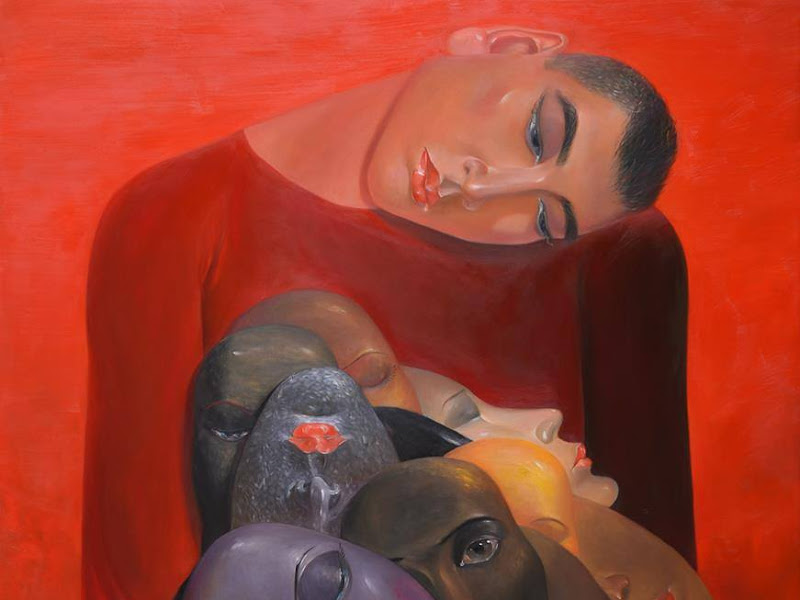
Nguyen Khac Chinh, 1984 | Symbolist / Surrealist painter

Nguyen Khac Chinh, 1984 | Symbolist / Surrealist painter

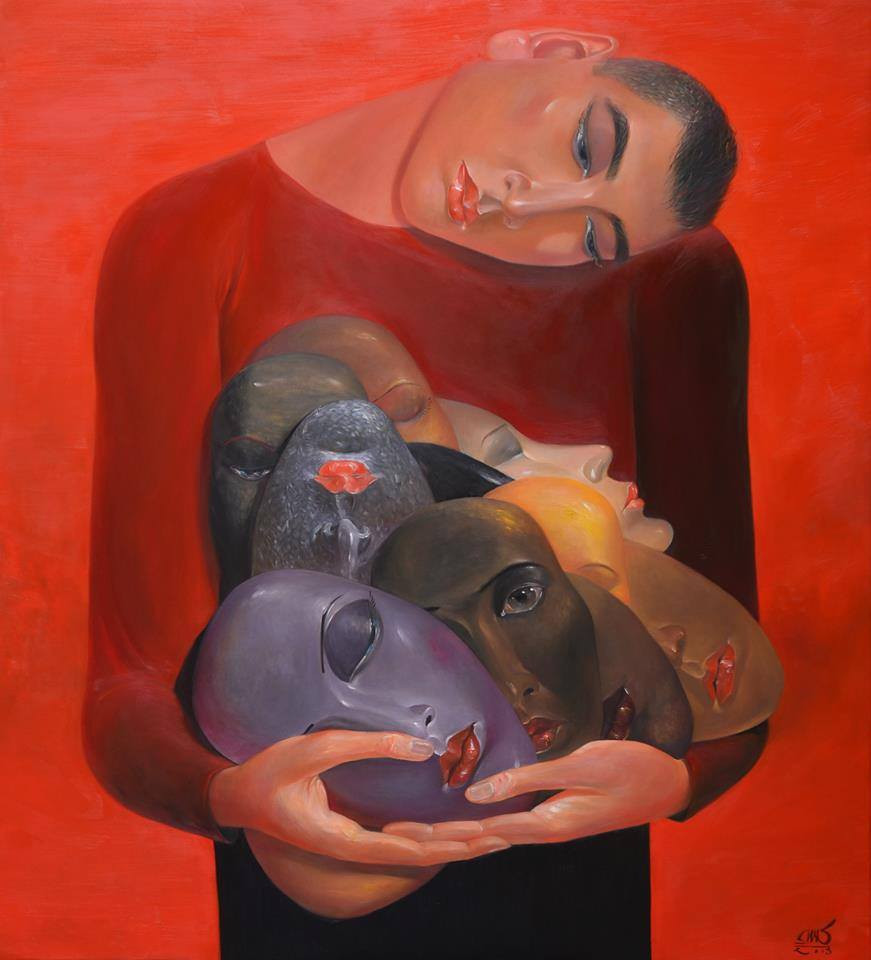
With a harmonious combination of colours, both modern and imbued with Eastern culture, the set of paintings entitled "The Life of Mannequins" by artist Nguyen Khac Chinh brought to viewers a unique, interesting perspective on life and humans in a contemporary art space.
Born in 1984 in Hanoi, Vietnam, Nguyen Khac Chinh graduated from the Hanoi University of Fine Arts in 2006, and is a highly skilled artist in oil painting thanks to his participation in group exhibitions since he was a student.
During his years of studying and taking part in art exhibitions of different forms, such as installation, performance, video art, oil painting and lacquer painting, he accumulated a thorough knowledge and experience of art.

Read More

Nguyen Khac Chinh, 1984 | Symbolist / Surrealist painter

With a harmonious combination of colours, both modern and imbued with Eastern culture, the set of paintings entitled "The Life of Mannequins" by artist Nguyen Khac Chinh brought to viewers a unique, interesting perspective on life and humans in a contemporary art space.
Born in 1984 in Hanoi, Vietnam, Nguyen Khac Chinh graduated from the Hanoi University of Fine Arts in 2006, and is a highly skilled artist in oil painting thanks to his participation in group exhibitions since he was a student.
During his years of studying and taking part in art exhibitions of different forms, such as installation, performance, video art, oil painting and lacquer painting, he accumulated a thorough knowledge and experience of art.


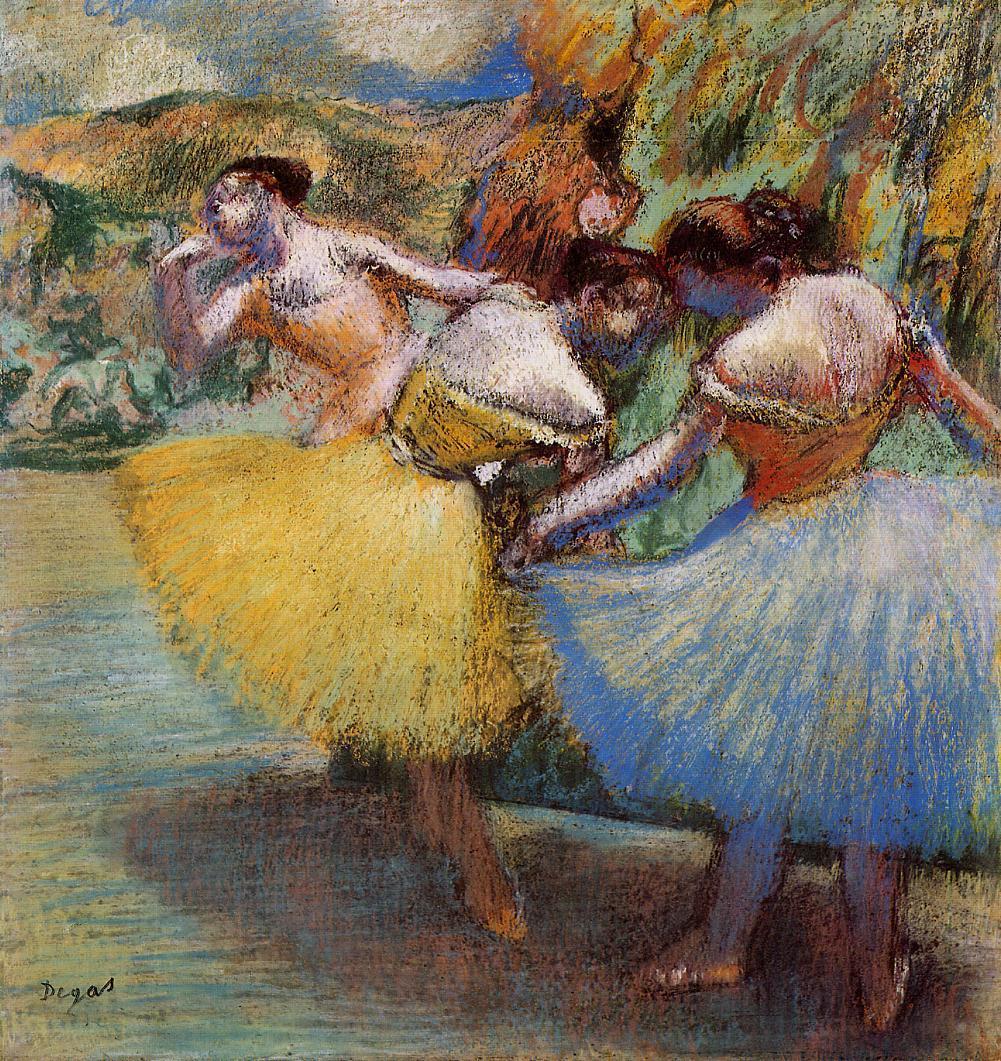
Edgar Degas: "Copiare e ricopiare i maestri.."

Edgar Degas: "Copiare e ricopiare i maestri.."

Per comprendere adeguatamente il profilo artistico di Degas è indispensabile coglierne le connessioni con gli immensi depositi culturali del passato. Degas, infatti, fu meno disposto di altri suoi colleghi ad accantonare l'eredità dei grandi maestri, ai quali si riferì sempre con appassionata devozione. Non a caso egli considerava i musei come il luogo congeniale alla formazione di un artista, ed a tutti coloro che gli chiedevano consigli per migliorare le proprie tecniche egli ricordava caparbiamente l'importanza di copiare i capolavori del passato.
È comunque considerato uno de maestri dell'Ottocento ed ha lasciato il segno con il suo stile innovativo.

Una delle sue massime:
«Bisogna copiare e ricopiare i maestri, e soltanto dopo aver fornito tutte le prove di un buon copista vi si potrà ragionevolmente permettere di dipingere un ravanello dal vero» - Edgar Degas.

Lo stesso Degas, stimolato dai numerosi viaggi in Italia e dall'erudizione del padre, meditò con molta attenzione sulle pitture conservate al Louvre, e soprattutto sui primitivi del Rinascimento.


Read More

Edgar Degas: "Copiare e ricopiare i maestri.."

Per comprendere adeguatamente il profilo artistico di Degas è indispensabile coglierne le connessioni con gli immensi depositi culturali del passato. Degas, infatti, fu meno disposto di altri suoi colleghi ad accantonare l'eredità dei grandi maestri, ai quali si riferì sempre con appassionata devozione. Non a caso egli considerava i musei come il luogo congeniale alla formazione di un artista, ed a tutti coloro che gli chiedevano consigli per migliorare le proprie tecniche egli ricordava caparbiamente l'importanza di copiare i capolavori del passato.
È comunque considerato uno de maestri dell'Ottocento ed ha lasciato il segno con il suo stile innovativo.

Una delle sue massime:
«Bisogna copiare e ricopiare i maestri, e soltanto dopo aver fornito tutte le prove di un buon copista vi si potrà ragionevolmente permettere di dipingere un ravanello dal vero» - Edgar Degas.

Lo stesso Degas, stimolato dai numerosi viaggi in Italia e dall'erudizione del padre, meditò con molta attenzione sulle pitture conservate al Louvre, e soprattutto sui primitivi del Rinascimento.


Edgar Degas e l'Impressionismo

Edgar Degas e l'Impressionismo

Degas viene giustamente inserito nella genealogia dell'Impressionismo.
Egli, in effetti, partecipò con grande assiduità a tutte le mostre del gruppo, fatta eccezione per quella del 1882, e come i suoi colleghi nutriva un'appassionata devozione per le opere di Édouard Manet, pittore che per primo si era emancipato dalle piacevolezze borghesi ed era approdato ad una grande libertà espressiva e ad una costante quanto disinibita rappresentazione della sua contemporaneità.


Read More

Edgar Degas e l'Impressionismo

Degas viene giustamente inserito nella genealogia dell'Impressionismo.
Egli, in effetti, partecipò con grande assiduità a tutte le mostre del gruppo, fatta eccezione per quella del 1882, e come i suoi colleghi nutriva un'appassionata devozione per le opere di Édouard Manet, pittore che per primo si era emancipato dalle piacevolezze borghesi ed era approdato ad una grande libertà espressiva e ad una costante quanto disinibita rappresentazione della sua contemporaneità.


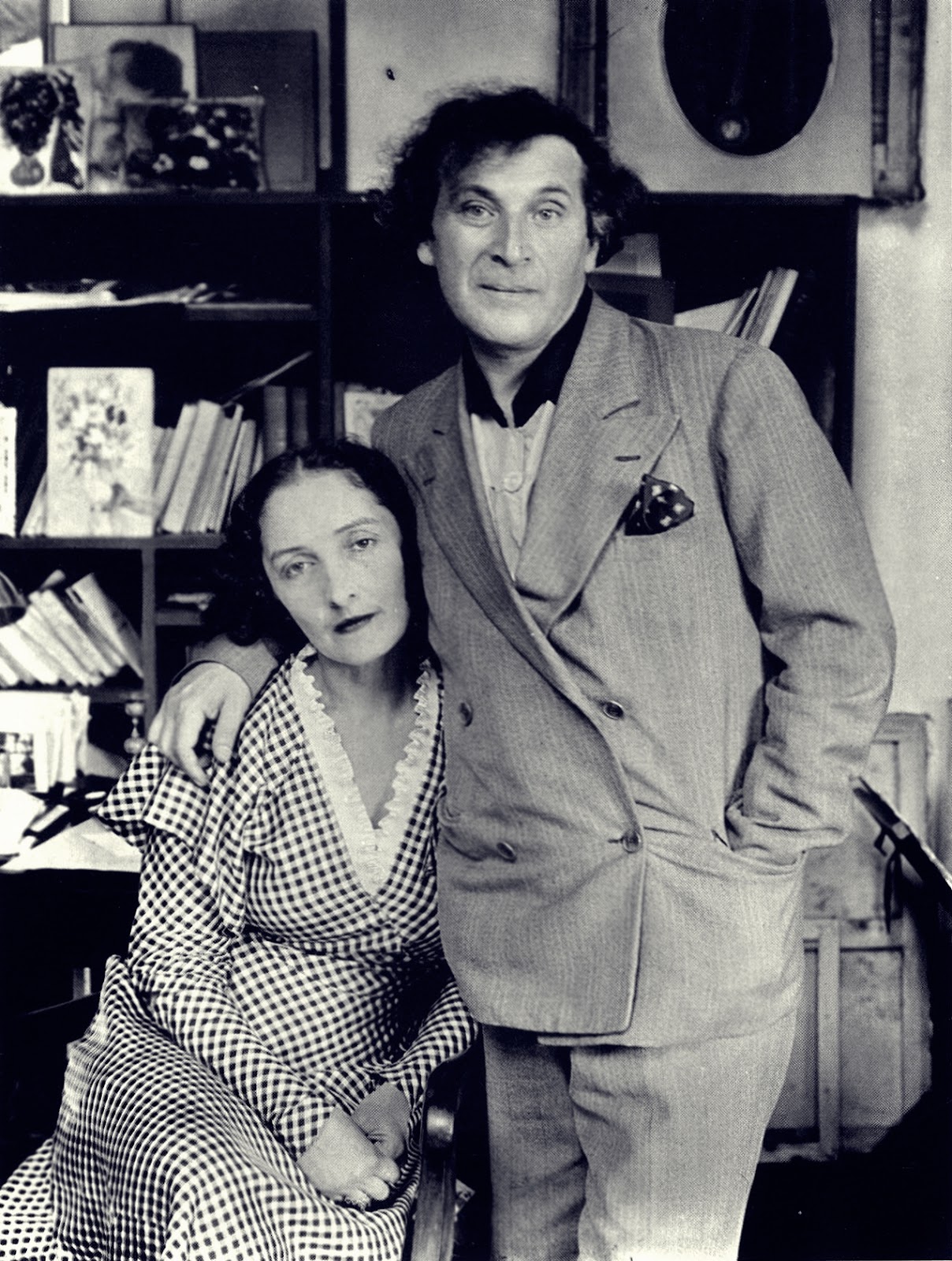
Marc Chagall | Birthday / Il Compleanno, 1915

Marc Chagall | Birthday / Il Compleanno, 1915

"Do not move. Stay just as you are", he commanded with what I can only call hot urgency...
He put a fresh canvas on his easel, snatched up brushes, and flung himself at it so passionately that the easel shook. Dabs of red, blue, white, and black flew through the air and swept me up with them. Up and up. I looked down and he was standing on tiptoe on one foot. He lifted me off the ground, leapt up himself, and glided with me up to the ceiling..


Marc and first wife Bella Rosenfeld Chagall, Paris, 1929 by André Kertész

Read More

Marc Chagall | Birthday / Il Compleanno, 1915

"Do not move. Stay just as you are", he commanded with what I can only call hot urgency...
He put a fresh canvas on his easel, snatched up brushes, and flung himself at it so passionately that the easel shook. Dabs of red, blue, white, and black flew through the air and swept me up with them. Up and up. I looked down and he was standing on tiptoe on one foot. He lifted me off the ground, leapt up himself, and glided with me up to the ceiling..


Marc and first wife Bella Rosenfeld Chagall, Paris, 1929 by André Kertész

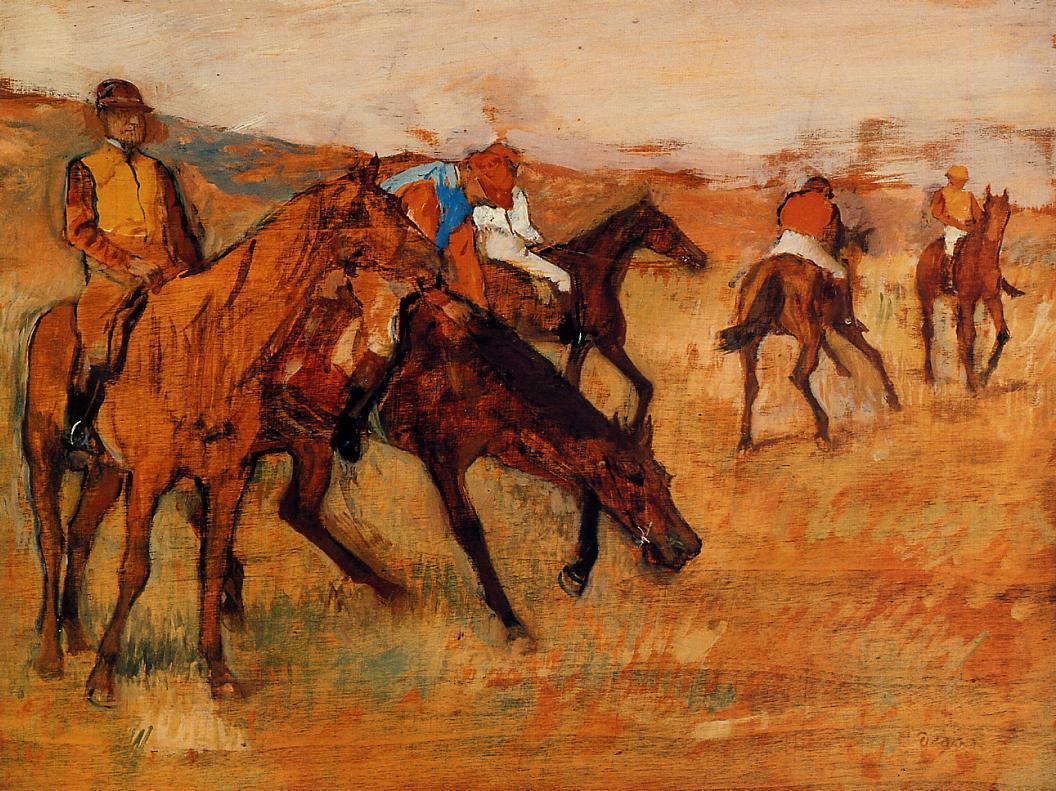
Edgar Degas | Horse racing /Corse di cavalli

Edgar Degas | Horse racing /Corse di cavalli

French Impressionist painter, Edgar Degas (1834-1917), began painting scenes with horses in the 1860s.
For biographical notes -in english and italian- and other works by Degas see Edgar Degas | Realist/Impressionist painter and sculptor.

Other from Edgar Degas:


Read More

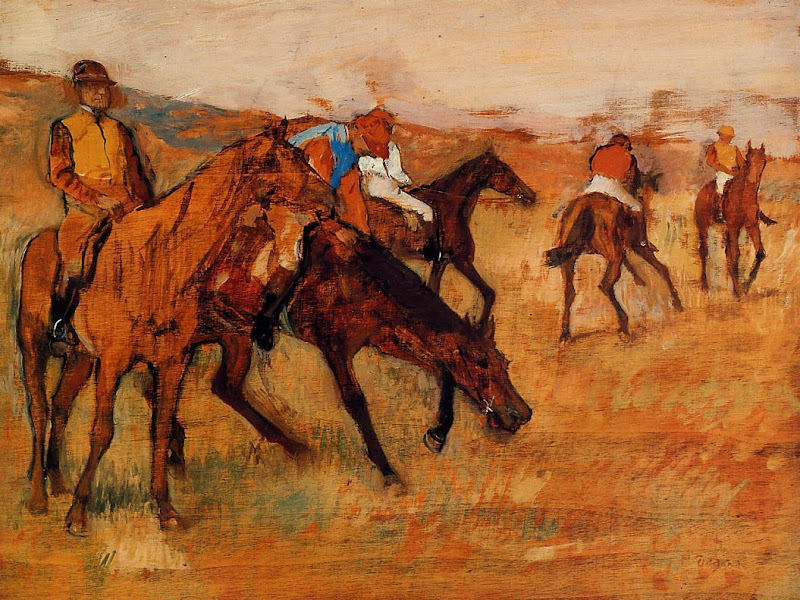
Edgar Degas | Horse racing /Corse di cavalli

French Impressionist painter, Edgar Degas (1834-1917), began painting scenes with horses in the 1860s.
For biographical notes -in english and italian- and other works by Degas see Edgar Degas | Realist/Impressionist painter and sculptor.

Other from Edgar Degas:


Leonardo da Vinci | Escusazione dello Scultore

Leonardo da Vinci | Escusazione dello Scultore

Trattato della Pittura
Parte prima | Capitolo 37


Dice lo scultore, che s'esso leva piú marmo che non deve, non può ricorreggere il suo errore, come fa il pittore; al quale si risponde, che chi leva piú che non deve non è maestro, perché maestro si dimanda quello che ha vera scienza della sua operazione.
Risponde lo scultore, che lavorando il marmo si scopre una rottura, che ne fu causa essa e non il maestro di tale errore; rispondesi tale scultore essere in questo caso come il pittore a cui si rompe ed offende la tavola donde egli dipinge.


Read More

Leonardo da Vinci | Escusazione dello Scultore

Trattato della Pittura
Parte prima | Capitolo 37


Dice lo scultore, che s'esso leva piú marmo che non deve, non può ricorreggere il suo errore, come fa il pittore; al quale si risponde, che chi leva piú che non deve non è maestro, perché maestro si dimanda quello che ha vera scienza della sua operazione.
Risponde lo scultore, che lavorando il marmo si scopre una rottura, che ne fu causa essa e non il maestro di tale errore; rispondesi tale scultore essere in questo caso come il pittore a cui si rompe ed offende la tavola donde egli dipinge.


Edgar Degas | Landscapes

Edgar Degas | Landscapes

Edgar Degas (1834-1917) was a French artist famous for his paintings, sculptures, prints and drawings.
For biographical notes -in english and italian- and other works by Degas see Edgar Degas | Realist/Impressionist painter and sculptor.

Other from Edgar Degas:


Read More

Edgar Degas | Landscapes

Edgar Degas (1834-1917) was a French artist famous for his paintings, sculptures, prints and drawings.
For biographical notes -in english and italian- and other works by Degas see Edgar Degas | Realist/Impressionist painter and sculptor.

Other from Edgar Degas:


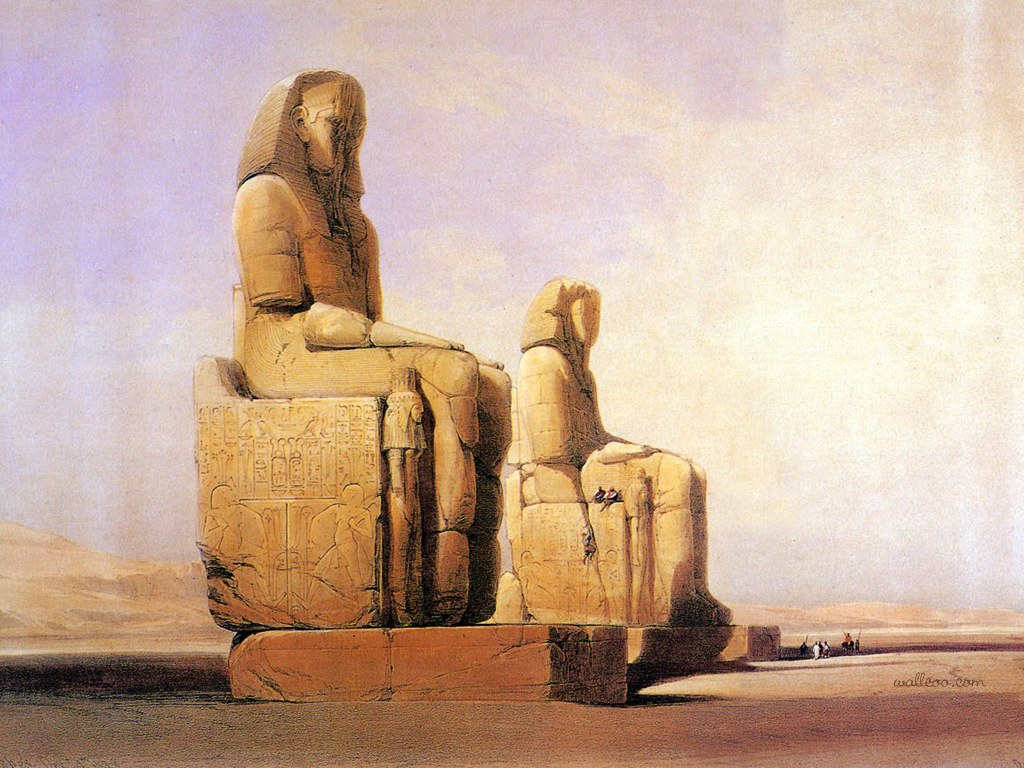
David Roberts RA | Romantic Orientalist painter

David Roberts RA | Romantic Orientalist painter

Artist David Roberts and Near Eastern Archaeology

by Dr. Patrick Hunt


Scottish artist David Roberts (1796-1864) was instrumental in helping to stimulate a growing fascination with the Near East by Europeans, especially within British society where biblical accounts of the rise and fall of empires were familiar, as much intellectual fare as anything else and staple bread and butter for religious imagination. The Romantic Movement’s eschewing of Enlightenment ideals turned instead to exotic themes and ruins, also replacing Neoclassicism with Orientalism.


Read More

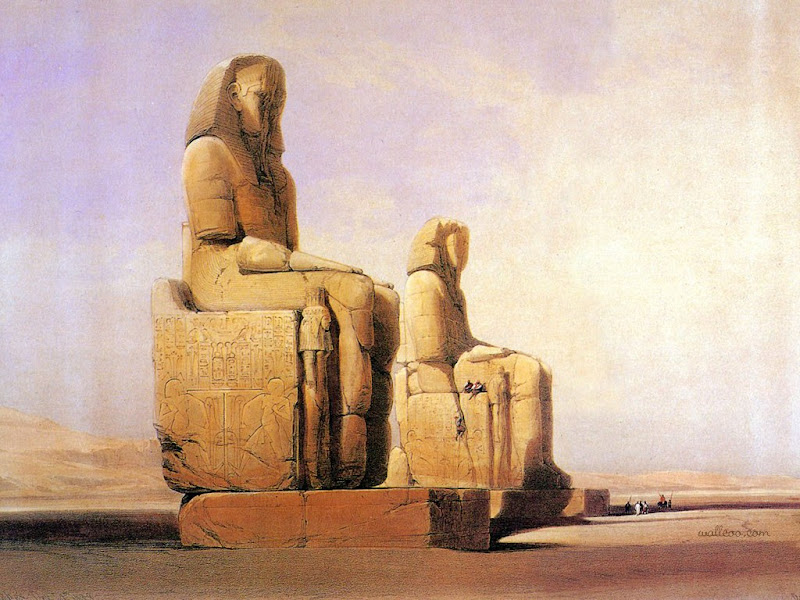
David Roberts RA | Romantic Orientalist painter

Artist David Roberts and Near Eastern Archaeology

by Dr. Patrick Hunt


Scottish artist David Roberts (1796-1864) was instrumental in helping to stimulate a growing fascination with the Near East by Europeans, especially within British society where biblical accounts of the rise and fall of empires were familiar, as much intellectual fare as anything else and staple bread and butter for religious imagination. The Romantic Movement’s eschewing of Enlightenment ideals turned instead to exotic themes and ruins, also replacing Neoclassicism with Orientalism.


Giorgione | Judith, 1504 | Hermitage Museum

Giorgione | Judith, 1504 | Hermitage Museum

Author: Giorgione
Painting, Oil on canvas, 144x68 cm
Origin: Italy, 1504
Personage: Judith
Source of entry: Collection of baron L.A. Crozat de Tierra, Paris, 1772
School: Venetian
Theme: The Bible and Christianity


Read More

Giorgione | Judith, 1504 | Hermitage Museum

Author: Giorgione
Painting, Oil on canvas, 144x68 cm
Origin: Italy, 1504
Personage: Judith
Source of entry: Collection of baron L.A. Crozat de Tierra, Paris, 1772
School: Venetian
Theme: The Bible and Christianity


Jinnie May | Abstract Watercolour painter

Jinnie May | Abstract Watercolour painter

Jinnie May has always had an appreciation for art, but it wasn’t until she retired in 2000 that she began to seriously pursue art. Currently Jinnie is interested in the use of watercolor for its spontaneity, portability and indecisiveness. Her initial inspiration comes from studying California Watercolor artists from the 1940’s and 50’s, who painted genre paintings on large paper using big brushes and bold colors.


Read More

Jinnie May | Abstract Watercolour painter

Jinnie May has always had an appreciation for art, but it wasn’t until she retired in 2000 that she began to seriously pursue art. Currently Jinnie is interested in the use of watercolor for its spontaneity, portability and indecisiveness. Her initial inspiration comes from studying California Watercolor artists from the 1940’s and 50’s, who painted genre paintings on large paper using big brushes and bold colors.


Correggio | Mannerist painter

Correggio | Mannerist painter

Correggio, byname of Antonio Allegri (born August 1494, Correggio [now in Emilia-Romagna, Italy]-died March 5, 1534, Correggio), most important Renaissance painter of the school of Parma, whose late works influenced the style of many Baroque and Rococo artists.
His first important works are the convent ceiling of San Paolo (c. 1519), Parma, depicting allegories on humanist themes, and the frescoes in San Giovanni Evangelista, Parma (1520-23), and the cathedral of Parma (1526-30).
The Mystic Marriage of St. Catherine (c. 1526) is among the finest of his poetic late oil paintings.


Read More

Correggio | Mannerist painter

Correggio, byname of Antonio Allegri (born August 1494, Correggio [now in Emilia-Romagna, Italy]-died March 5, 1534, Correggio), most important Renaissance painter of the school of Parma, whose late works influenced the style of many Baroque and Rococo artists.
His first important works are the convent ceiling of San Paolo (c. 1519), Parma, depicting allegories on humanist themes, and the frescoes in San Giovanni Evangelista, Parma (1520-23), and the cathedral of Parma (1526-30).
The Mystic Marriage of St. Catherine (c. 1526) is among the finest of his poetic late oil paintings.


Paolo Veronese | Assessment

Paolo Veronese | Assessment

An artist's biography of Paolo Veronese (1528-1588) was included in the second edition of the Lives of the Most Excellent Painters, Sculptors and Architects (1568), by Giorgio Vasari, with improved coverage of the painters of the Venetian school.
A fuller biography of Veronese had to await Le maraviglie dell'Arte ovvero, Le vite degli Illustri Pittori Veneti and dello Stato (1648), by Carlo Ridolfi, a compilation of the Venetian School painters.
Ridolfi said that Veronese's painting of The Feast in the House of Levi (1573) is "by far, the most important source for our knowledge of his art", because "it gave rein to joy, made beauty majestic, made laughter, itself, more festive".


Read More

Paolo Veronese | Assessment

An artist's biography of Paolo Veronese (1528-1588) was included in the second edition of the Lives of the Most Excellent Painters, Sculptors and Architects (1568), by Giorgio Vasari, with improved coverage of the painters of the Venetian school.
A fuller biography of Veronese had to await Le maraviglie dell'Arte ovvero, Le vite degli Illustri Pittori Veneti and dello Stato (1648), by Carlo Ridolfi, a compilation of the Venetian School painters.
Ridolfi said that Veronese's painting of The Feast in the House of Levi (1573) is "by far, the most important source for our knowledge of his art", because "it gave rein to joy, made beauty majestic, made laughter, itself, more festive".


Bartholomeus Spranger (1546-1611)

Bartholomeus Spranger (1546-1611)

Bartholomaeus Spranger, also spelled Bartholomeus Sprangers, or Sprangerson (March 21, 1546, Antwerp, Hapsburg Netherlands-August 1611, Prague), Antwerp painter noted for his paintings of nudes executed in the late Mannerist style.
In his efforts to develop a Northern artistic canon of the human figure, Spranger employed mannered poses, slender, elongated bodies, and a gleaming, brittle texture in his work.
The figures smile invitingly, and the influence of Parmigianino and Correggio is evident in their voluptuous contours.


Read More

Bartholomeus Spranger (1546-1611)

Bartholomaeus Spranger, also spelled Bartholomeus Sprangers, or Sprangerson (March 21, 1546, Antwerp, Hapsburg Netherlands-August 1611, Prague), Antwerp painter noted for his paintings of nudes executed in the late Mannerist style.
In his efforts to develop a Northern artistic canon of the human figure, Spranger employed mannered poses, slender, elongated bodies, and a gleaming, brittle texture in his work.
The figures smile invitingly, and the influence of Parmigianino and Correggio is evident in their voluptuous contours.


Jacob Ferdinand Saeys | Architectural Fantasies painter

Jacob Ferdinand Saeys | Architectural Fantasies painter

Jacobus Ferdinandus Saey or Jacob Ferdinand Saeys (1658 - after 1726) was a Flemish painter who specialized in architectural paintings depicting gallant companies amidst imaginary Renaissance and Baroque palaces and buildings. After starting his career in Flanders, he moved to Vienna, where he stayed for the rest of his life.


Read More

Jacob Ferdinand Saeys | Architectural Fantasies painter

Jacobus Ferdinandus Saey or Jacob Ferdinand Saeys (1658 - after 1726) was a Flemish painter who specialized in architectural paintings depicting gallant companies amidst imaginary Renaissance and Baroque palaces and buildings. After starting his career in Flanders, he moved to Vienna, where he stayed for the rest of his life.


Salvador Dali and the Science

Salvador Dali and the Science

Dalí was a versatile artist. Some of his more popular works are sculptures and other objects, and he is also noted for his contributions to theater, fashion, and photography, among other areas.
Dalí's life-long interest in science and mathematics was often reflected in his work.
His soft watches have been interpreted as references to Einstein's theory of the relativity of time and space.
Images of atomic particles appeared in his work soon after the atomic bombing of Hiroshima and Nagasaki and strands of D.N.A. appeared from the mid-1950s.


Read More

Salvador Dali and the Science

Dalí was a versatile artist. Some of his more popular works are sculptures and other objects, and he is also noted for his contributions to theater, fashion, and photography, among other areas.
Dalí's life-long interest in science and mathematics was often reflected in his work.
His soft watches have been interpreted as references to Einstein's theory of the relativity of time and space.
Images of atomic particles appeared in his work soon after the atomic bombing of Hiroshima and Nagasaki and strands of D.N.A. appeared from the mid-1950s.