Visualizzazione post con etichetta Sculptor. Mostra tutti i post
Randolph Rogers | Nydia, the Blind Flower Girl of Pompeii, 1859

Randolph Rogers | Nydia, the Blind Flower Girl of Pompeii, 1859

"Nydia, the Blind Flower Girl of Pompeii" by Randolph Rogers (Waterloo, New York 1825-1892 Rome) was the most popular American sculpture of the nineteenth century.
According to Rogers, it was replicated 167 times in two sizes.
The subject was drawn from "The Last Days of Pompeii" (1834), a widely read novel by Lord Edward Bulwer-Lytton, which ends with the eruption of Mount Vesuvius in a.d. 79.
Rogers’s evocative portrayal of Nydia highlights her heroic attempt to lead two companions out of the burning, ash-covered city.


Read More

Randolph Rogers | Nydia, the Blind Flower Girl of Pompeii, 1859

"Nydia, the Blind Flower Girl of Pompeii" by Randolph Rogers (Waterloo, New York 1825-1892 Rome) was the most popular American sculpture of the nineteenth century.
According to Rogers, it was replicated 167 times in two sizes.
The subject was drawn from "The Last Days of Pompeii" (1834), a widely read novel by Lord Edward Bulwer-Lytton, which ends with the eruption of Mount Vesuvius in a.d. 79.
Rogers’s evocative portrayal of Nydia highlights her heroic attempt to lead two companions out of the burning, ash-covered city.


Michael Parkes, 1944 | Sculptures

Michael Parkes, 1944 | Sculptures

Michael Parkes is an American-born artist living in Spain who is best known for work in the areas of fantasy art and magic realism.
He specializes in painting, stone lithography and sculpture.
He also creates limited-edition Giclée images.
He studied graphic art and painting at the University of Kansas and then travelled for three years throughout Asia and Europe.
Numerous international exhibitions underline the importance of Parkes' work.


Read More

Michael Parkes, 1944 | Sculptures

Michael Parkes is an American-born artist living in Spain who is best known for work in the areas of fantasy art and magic realism.
He specializes in painting, stone lithography and sculpture.
He also creates limited-edition Giclée images.
He studied graphic art and painting at the University of Kansas and then travelled for three years throughout Asia and Europe.
Numerous international exhibitions underline the importance of Parkes' work.


Le Gallerie di Piazza Scala, Milano

Le Gallerie di Piazza Scala, Milano

Situato nel cuore di Milano, il complesso espositivo Gallerie di Piazza Scala propone un viaggio affascinante nell'arte del XIX e XX secolo.
Il polo museale si snoda attraverso quattro edifici storici della città.
Negli storici Palazzo Anguissola e Palazzo Brentani sono esposti 197 dipinti e sculture che partono da bassorilievi neoclassici di Antonio Canova, per toccare quindi le altre correnti che hanno caratterizzato le arti figurative italiane ottocentesche:

Ferrari Arturo - Via San Bernardino in Milano

Read More

Le Gallerie di Piazza Scala, Milano

Situato nel cuore di Milano, il complesso espositivo Gallerie di Piazza Scala propone un viaggio affascinante nell'arte del XIX e XX secolo.
Il polo museale si snoda attraverso quattro edifici storici della città.
Negli storici Palazzo Anguissola e Palazzo Brentani sono esposti 197 dipinti e sculture che partono da bassorilievi neoclassici di Antonio Canova, per toccare quindi le altre correnti che hanno caratterizzato le arti figurative italiane ottocentesche:

Ferrari Arturo - Via San Bernardino in Milano

Gustav Vigeland | Figurative sculptor

Gustav Vigeland | Figurative sculptor

Gustav Vigeland (1869-1943), born as Adolf Gustav Thorsen, was a Norwegian sculptor.
Gustav Vigeland occupies a special position among Norwegian sculptors, both in the power of his creative imagination and in his productivity.
He is most associated with the Vigeland installation (Vigelandsanlegget) in Frogner Park, Oslo.
The Vigeland installation made Frogner Park into Norway's most popular tourist attraction, and the park also contains Frogner Manor with the Oslo Museum and the Henriette Wegner Pavilion.
Vigeland was also the designer of the Nobel Peace Prize medal.


Read More

Gustav Vigeland | Figurative sculptor

Gustav Vigeland (1869-1943), born as Adolf Gustav Thorsen, was a Norwegian sculptor.
Gustav Vigeland occupies a special position among Norwegian sculptors, both in the power of his creative imagination and in his productivity.
He is most associated with the Vigeland installation (Vigelandsanlegget) in Frogner Park, Oslo.
The Vigeland installation made Frogner Park into Norway's most popular tourist attraction, and the park also contains Frogner Manor with the Oslo Museum and the Henriette Wegner Pavilion.
Vigeland was also the designer of the Nobel Peace Prize medal.


Cristoforo Stati | Orpheus with Violin, 1600-1601

Cristoforo Stati | Orpheus with Violin, 1600-1601

Orpheus by Italian sculptor Cristoforo Stati / Cristofano da Bracciano (1556-1619), famous for taming beasts with his music, is here shown entertaining himself, his body swaying to the sound of the lira da braccio.
The statue was carved for the Palazzo Corsi, Florence. | © The Metropolitan Museum of Art


Read More

Cristoforo Stati | Orpheus with Violin, 1600-1601

Orpheus by Italian sculptor Cristoforo Stati / Cristofano da Bracciano (1556-1619), famous for taming beasts with his music, is here shown entertaining himself, his body swaying to the sound of the lira da braccio.
The statue was carved for the Palazzo Corsi, Florence. | © The Metropolitan Museum of Art


Leon Richman | Figurative sculptor

Leon Richman | Figurative sculptor


Beginning in medium to large-scale marble figures, his passion to explore the beauty of the human form in all dimensions soon led him to a more pliable medium, allowing more freedom in the creative process.
The result has been an inspired body of work, each piece possessing its own unique spirit and personality.
Leon Richman is a California artist with a formal education from the renowned Art Center College of Design in Pasadena, and years of practical experience in the field of commercial art, but his soul and passion have always been deeply rooted in the finer arts.

Read More

Leon Richman | Figurative sculptor


Beginning in medium to large-scale marble figures, his passion to explore the beauty of the human form in all dimensions soon led him to a more pliable medium, allowing more freedom in the creative process.
The result has been an inspired body of work, each piece possessing its own unique spirit and personality.
Leon Richman is a California artist with a formal education from the renowned Art Center College of Design in Pasadena, and years of practical experience in the field of commercial art, but his soul and passion have always been deeply rooted in the finer arts.

Carl Payne, 1969 | Figurative sculptor

Carl Payne, 1969 | Figurative sculptor

British sculptor Carl Payne was born in Staffordshire.
During his education he studied Figurative Sculpture and began on his first commission in 2000.
Since then, Payne has compiled an extensive ensemble of commissions including 'Ride a Cock Horse to Banbury Cross' and 'King George and Queen Mary' which were unveiled by George Best, Bobby Moore and Pele and by Princess Anne at Banbury respectively.
Today he has a wide variety of collectors throughout the world.


Read More

Carl Payne, 1969 | Figurative sculptor

British sculptor Carl Payne was born in Staffordshire.
During his education he studied Figurative Sculpture and began on his first commission in 2000.
Since then, Payne has compiled an extensive ensemble of commissions including 'Ride a Cock Horse to Banbury Cross' and 'King George and Queen Mary' which were unveiled by George Best, Bobby Moore and Pele and by Princess Anne at Banbury respectively.
Today he has a wide variety of collectors throughout the world.


Antonio Canova | Drawing

Antonio Canova | Drawing

Antonio Canova (1757-1822) used graphic drawings as the essential foundation for his Neoclassical marble masterpieces.
His sketches acted as a direct window into his creative process, transitioning from rapid, emotional thoughts into highly calculated, geometric structures.
Unlike his highly polished marbles, his initial sketches features rapid, loose, and gestural ink strokes.
He heavily used charcoal wash and cross-hatching to map out how light would fall on the three-dimensional stone surface.


Read More

Antonio Canova | Drawing

Antonio Canova (1757-1822) used graphic drawings as the essential foundation for his Neoclassical marble masterpieces.
His sketches acted as a direct window into his creative process, transitioning from rapid, emotional thoughts into highly calculated, geometric structures.
Unlike his highly polished marbles, his initial sketches features rapid, loose, and gestural ink strokes.
He heavily used charcoal wash and cross-hatching to map out how light would fall on the three-dimensional stone surface.


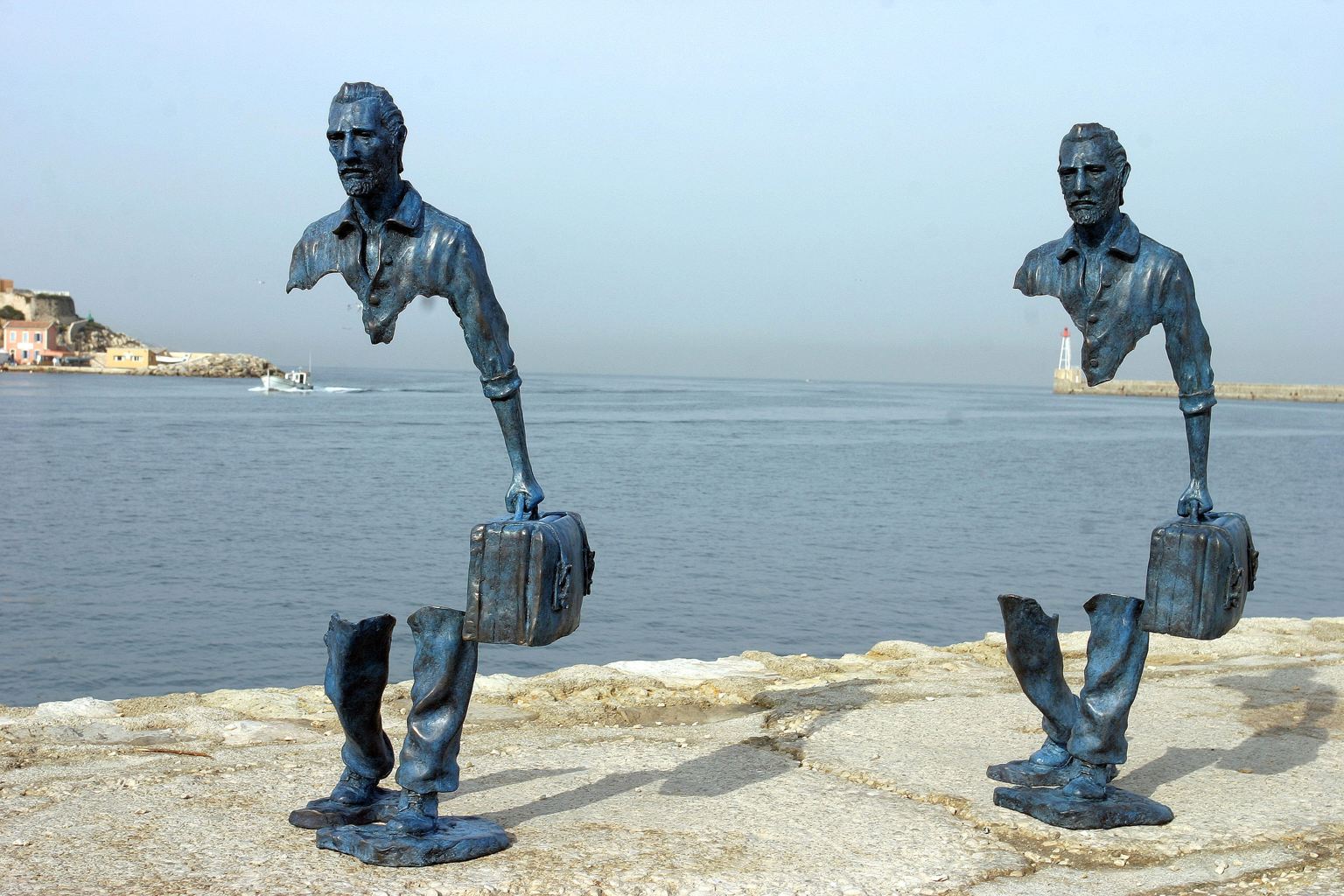
Bruno Catalano, 1960 | Lo scultore dei viaggiatori

Bruno Catalano, 1960 | Lo scultore dei viaggiatori

Bruno Catalano è uno scultore Franco-Italiano di fama internazionale, celebre per la serie di sculture in bronzo intitolata "Les Voyageurs" (I Viaggiatori).
Catalano è nato a Khouribga, Marocco.
La sua vita è stata segnata da un profondo senso di sradicamento: all'età di 15 anni fu costretto all'esilio dal Marocco insieme alla sua famiglia, sbarcando a Marsiglia con la speranza di una nuova vita.
Prima di dedicarsi interamente all'arte a 30 anni, ha lavorato come marinaio ed elettricista.
Influenzato da maestri come Rodin, Giacometti e César, ha sviluppato una tecnica unica che gli permette di creare figure umane con ampie porzioni del corpo mancanti, sfidando apparentemente le leggi della fisica.


Read More

Bruno Catalano, 1960 | Lo scultore dei viaggiatori

Bruno Catalano è uno scultore Franco-Italiano di fama internazionale, celebre per la serie di sculture in bronzo intitolata "Les Voyageurs" (I Viaggiatori).
Catalano è nato a Khouribga, Marocco.
La sua vita è stata segnata da un profondo senso di sradicamento: all'età di 15 anni fu costretto all'esilio dal Marocco insieme alla sua famiglia, sbarcando a Marsiglia con la speranza di una nuova vita.
Prima di dedicarsi interamente all'arte a 30 anni, ha lavorato come marinaio ed elettricista.
Influenzato da maestri come Rodin, Giacometti e César, ha sviluppato una tecnica unica che gli permette di creare figure umane con ampie porzioni del corpo mancanti, sfidando apparentemente le leggi della fisica.


Vassilis Antonakos / Βασίλης Αντωνάκος, 1980 | Abstract painter

Vassilis Antonakos / Βασίλης Αντωνάκος, 1980 | Abstract painter

Greek artist🎨 Βασίλης Αντωνάκος was born in Athens.
Art had always been an alternative way to express himself even since he was a child.
He attended the Vakalo Art and Design College and then he continued his studies at the School of Fine Arts in Athens.
Mostly being a self-taught artist with a wide range of work in painting, sculpting and stage design.
His first solo exhibition -titled "Faces"- took place in 2013 in Red Dot in Athens.


Read More

Vassilis Antonakos / Βασίλης Αντωνάκος, 1980 | Abstract painter

Greek artist🎨 Βασίλης Αντωνάκος was born in Athens.
Art had always been an alternative way to express himself even since he was a child.
He attended the Vakalo Art and Design College and then he continued his studies at the School of Fine Arts in Athens.
Mostly being a self-taught artist with a wide range of work in painting, sculpting and stage design.
His first solo exhibition -titled "Faces"- took place in 2013 in Red Dot in Athens.


Tyson Snow, 1977 | Figurative Sculptor /painter

Tyson Snow, 1977 | Figurative Sculptor /painter

Award winning artist Tyson Snow has always had a passion for fine art and a desire for an outlet where he could create work that was powerful, personal and beautiful.
Tyson has worked tirelessly to improve that idea and has since found the pathway to success.
Tyson has focused on fine art for more than 10 years.


Read More

Tyson Snow, 1977 | Figurative Sculptor /painter

Award winning artist Tyson Snow has always had a passion for fine art and a desire for an outlet where he could create work that was powerful, personal and beautiful.
Tyson has worked tirelessly to improve that idea and has since found the pathway to success.
Tyson has focused on fine art for more than 10 years.


Allegory of Poetry

Allegory of Poetry

As a literary device, an allegory is a metaphor in which a character, place or event is used to deliver a broader message about real-world issues and occurrences.
Allegory (in the sense of the practice and use of allegorical devices and works) has occurred widely throughout history in all forms of art, largely because it can readily illustrate or convey complex ideas and concepts in ways that are comprehensible or striking to its viewers, readers, or listeners.
Writers or speakers typically use allegories as literary devices or as rhetorical devices that convey (semi-)hidden or complex meanings through symbolic figures, actions, imagery, or events, which together create the moral, spiritual, or political meaning the author wishes to convey.

Auger Lucas (French Rococo Era painter, 1685-1765) | An Allegory of Poetry

Read More

Allegory of Poetry

As a literary device, an allegory is a metaphor in which a character, place or event is used to deliver a broader message about real-world issues and occurrences.
Allegory (in the sense of the practice and use of allegorical devices and works) has occurred widely throughout history in all forms of art, largely because it can readily illustrate or convey complex ideas and concepts in ways that are comprehensible or striking to its viewers, readers, or listeners.
Writers or speakers typically use allegories as literary devices or as rhetorical devices that convey (semi-)hidden or complex meanings through symbolic figures, actions, imagery, or events, which together create the moral, spiritual, or political meaning the author wishes to convey.

Auger Lucas (French Rococo Era painter, 1685-1765) | An Allegory of Poetry

Giorgio Conta, 1978 | Figurative sculptor

Giorgio Conta, 1978 | Figurative sculptor

Italian artist Giorgio Conta was born in Cles and lives and works in Monclassico in Val di Sole (TN).
He grew up in an artistic environment where, being his father a well known artist, he came into contact with various personalities from the art and culture world, including the great pianist Arturo Benedetti Michel-angeli, close friend of the family, who expressed the wish to be his Godfather.
After having earned his high-school diploma he attended a sculpture school devoting himself to painting and drawing as well.


Read More

Giorgio Conta, 1978 | Figurative sculptor

Italian artist Giorgio Conta was born in Cles and lives and works in Monclassico in Val di Sole (TN).
He grew up in an artistic environment where, being his father a well known artist, he came into contact with various personalities from the art and culture world, including the great pianist Arturo Benedetti Michel-angeli, close friend of the family, who expressed the wish to be his Godfather.
After having earned his high-school diploma he attended a sculpture school devoting himself to painting and drawing as well.


Paolo Troubetzkoy | Sculptor of the Belle Époque

Paolo Troubetzkoy | Sculptor of the Belle Époque

The Italian sculptor and painter Paolo (prince) Troubetzkoy / Павел Петрович Трубецкой (1866-1938), born on the shores of Lake Maggiore, was the illegitimate child of a Russian diplomat and an American pianist and singer, living under an assumed identity until he was acknowledged with his brothers at the age of five.
He would succeed in transforming the circumstances of his birth into assets that would lead to a dazzling international career.


Read More

Paolo Troubetzkoy | Sculptor of the Belle Époque

The Italian sculptor and painter Paolo (prince) Troubetzkoy / Павел Петрович Трубецкой (1866-1938), born on the shores of Lake Maggiore, was the illegitimate child of a Russian diplomat and an American pianist and singer, living under an assumed identity until he was acknowledged with his brothers at the age of five.
He would succeed in transforming the circumstances of his birth into assets that would lead to a dazzling international career.


Rosanne Pomerleau, 1958 | Figurative painter

Rosanne Pomerleau, 1958 | Figurative painter


Rosanne Pomerleau was born in Ascot Corner.
Training: Self-taught painter.
Achievements: Solo and group exhibitions in Canada and the United States.
Prize of Excellence in 1986, silver medal in watercolour and Prize for Excellence in pastel at the Amsterdam Art International Exhibition in California, U.S.A.
The Selected works of art were exhibited in San Francisco in October 1998.
Member of the American Society of Portrait Artists since 1998.
Collections: Her work is part of public and private collections all over the world.

Read More

Rosanne Pomerleau, 1958 | Figurative painter


Rosanne Pomerleau was born in Ascot Corner.
Training: Self-taught painter.
Achievements: Solo and group exhibitions in Canada and the United States.
Prize of Excellence in 1986, silver medal in watercolour and Prize for Excellence in pastel at the Amsterdam Art International Exhibition in California, U.S.A.
The Selected works of art were exhibited in San Francisco in October 1998.
Member of the American Society of Portrait Artists since 1998.
Collections: Her work is part of public and private collections all over the world.

Jens Ferdinand Willumsen | Symbolist / Expressionist painter

Jens Ferdinand Willumsen | Symbolist / Expressionist painter


Jens Ferdinand Willumsen (1863-1958) was a Danish painter, sculptor, graphic artist, architect and photographer.
He became associated with the movements of Symbolism and Expressionism.
J. F. Willumsen was born in Copenhagen, Denmark.
He was the son of Hans Willumsen and Ane Kirstine.

Read More

Jens Ferdinand Willumsen | Symbolist / Expressionist painter


Jens Ferdinand Willumsen (1863-1958) was a Danish painter, sculptor, graphic artist, architect and photographer.
He became associated with the movements of Symbolism and Expressionism.
J. F. Willumsen was born in Copenhagen, Denmark.
He was the son of Hans Willumsen and Ane Kirstine.

Civiltà romana

Civiltà romana


Per Civiltà Romana si intendono tutti quegli aspetti della popolazione indoeuropea chiamata Romani (inizialmente stanziata a Roma, poi diffusasi su gran parte d'Europa e nell'intero bacino del Mediterraneo), da sociali a religiosi, culturali, letterari, artistici, militari.
L'origine del nome della città e quindi del popolo che lo abitava, era incerta anche in età arcaica.
Servio, grammatico a cavallo tra il IV e il V secolo d.C., riteneva che il nome potesse derivare da un'antica denominazione del fiume Tevere, Rumon, dalla radice ruo (a sua volta proveniente dal greco ρεω), scorro, così da assumere il significato di Città del Fiume.
Ma si tratta di un'ipotesi che non ha riscosso molto successo.

Read More

Civiltà romana


Per Civiltà Romana si intendono tutti quegli aspetti della popolazione indoeuropea chiamata Romani (inizialmente stanziata a Roma, poi diffusasi su gran parte d'Europa e nell'intero bacino del Mediterraneo), da sociali a religiosi, culturali, letterari, artistici, militari.
L'origine del nome della città e quindi del popolo che lo abitava, era incerta anche in età arcaica.
Servio, grammatico a cavallo tra il IV e il V secolo d.C., riteneva che il nome potesse derivare da un'antica denominazione del fiume Tevere, Rumon, dalla radice ruo (a sua volta proveniente dal greco ρεω), scorro, così da assumere il significato di Città del Fiume.
Ma si tratta di un'ipotesi che non ha riscosso molto successo.

Romain de Tirtoff | Art Déco fashion illustrator

Romain de Tirtoff | Art Déco fashion illustrator


Nessun altro stilista ha avuto un'influenza maggiore di Erté nel XX secolo.
Le sue creazioni sgargianti hanno caratterizzato uno dei decenni più opulenti ed iconici della storia: gli anni '20.
Attraversando molti ambiti della cultura visiva, tra cui illustrazioni per riviste di moda, costumi per l'opera e il balletto, scultura e scenografia per il teatro, lo stile inconfondibile di Erté ha segnato l'era moderna.

Read More

Romain de Tirtoff | Art Déco fashion illustrator


Nessun altro stilista ha avuto un'influenza maggiore di Erté nel XX secolo.
Le sue creazioni sgargianti hanno caratterizzato uno dei decenni più opulenti ed iconici della storia: gli anni '20.
Attraversando molti ambiti della cultura visiva, tra cui illustrazioni per riviste di moda, costumi per l'opera e il balletto, scultura e scenografia per il teatro, lo stile inconfondibile di Erté ha segnato l'era moderna.

Max Leiva, 1966 | Figurative sculptor

Max Leiva, 1966 | Figurative sculptor

"I'm fascinated by the human essence, our very condition, our fragility and behavior in society" - Max Leiva.

Max Leiva is a contemporary Guatemalan artist known for his expressive figurative sculptures.
The artist graduate of the country’s National School of Fine Arts, spends his working time between his home country and Mexico.
The globe-trotting artist, who spent time at the University of Silpakorn in Thailand under a UNESCO scholarship, states that Guatemala lacks sufficient foundry facilities required to undertake his work.


Read More

Max Leiva, 1966 | Figurative sculptor

"I'm fascinated by the human essence, our very condition, our fragility and behavior in society" - Max Leiva.

Max Leiva is a contemporary Guatemalan artist known for his expressive figurative sculptures.
The artist graduate of the country’s National School of Fine Arts, spends his working time between his home country and Mexico.
The globe-trotting artist, who spent time at the University of Silpakorn in Thailand under a UNESCO scholarship, states that Guatemala lacks sufficient foundry facilities required to undertake his work.


George Lundeen, 1948 | Departure / La partenza, 1986

George Lundeen, 1948 | Departure / La partenza, 1986


"Departure", installed in the park near the library in Loveland, CO, is a life size bronze sculpture by the American artist, George Lundeen.
According to the artist, "The original piece came from a sketch I did in the Rome train station.
There were a couple of kids across from me on the marble floor.
It became the first life-size piece I ever did".

Read More

George Lundeen, 1948 | Departure / La partenza, 1986


"Departure", installed in the park near the library in Loveland, CO, is a life size bronze sculpture by the American artist, George Lundeen.
According to the artist, "The original piece came from a sketch I did in the Rome train station.
There were a couple of kids across from me on the marble floor.
It became the first life-size piece I ever did".